


Late launches almost never happen for the reason people blame afterward. The label didn't "come in late." The lab didn't "sit on the panel." What happened is that nobody owned the dependency chain between those things, and each handoff drifted a few days until the slack ran out. By the time someone notices, the commercial team has already promised a distributor a ship date that's no longer physically possible.
A wine release governance calendar fixes this by working backward from the one date that's hard to move — the commercial launch — and treating every upstream step as a scheduled commitment with an owner and a clock. Not a to-do list. A set of dated gates where each one has a responsible party, a signoff, and a defined consequence when the date slips.
This is less about adding structure for its own sake and more about making the failure visible early, while there's still time to recover.
Why releases slip even when everyone is "on top of it"
The frustrating part is that late launches usually involve teams that are individually competent. Winemaking hits its marks. The label designer delivers. Compliance files on time. And yet the release still lands two weeks late.
The reason is that these steps are sequential and interdependent, but they're managed in parallel silos. The cellar tracks bottling by tank availability. Marketing tracks the launch by the campaign calendar. Compliance tracks label approvals by whatever the regulatory backlog looks like that quarter. Each group has a reasonable internal plan. Nobody owns the seams between them.
A typical example: a COLA comes back with a minor correction request. Two-day fix. But the corrected label needs re-approval, which resets a government clock that nobody on the commercial side was watching. The bottling line was booked assuming approved labels would be in hand. The slot gets pushed. That push collides with the next scheduled run. Suddenly a two-day label tweak has cascaded into a three-week delay, and the launch date promised to three distributors is dead.
What you see across a lot of wineries is that the slip is almost always a dependency failure, not a task failure. Everyone did their job. The calendar just didn't connect the jobs.
The dates that actually drive a release
Before building the governance calendar, you need to be honest about which dates are fixed and which are negotiable. People invert this constantly — they treat the launch as flexible and the bottling slot as fixed, when it's usually the opposite.
Streamline your winery operations effortlessly.
Corkyly helps you track, manage, and optimize every step from vine to bottle.
- Vineyard & production tracking
- Customer relationship management
- Inventory & sales analytics
No credit card required
Here's the ordering that matters, from least movable to most:
| Milestone | How movable is it? | Who it blocks if late |
|---|---|---|
| Commercial launch / on-sale date | Hard — tied to distributor commitments, campaigns, events | Everyone downstream of it |
| Pre-release QA signoff (final analytical + sensory) | Semi-fixed — needs real bottle-aged samples | Launch, shipping |
| Label approval (COLA / state registrations) | Unpredictable — government timeline you don't control | Bottling, packaging order |
| Bottling window | Fixed once booked, but booked early | Everything after it |
| Dry goods / label print delivery | Semi-fixed, supplier-dependent | Bottling |
The thing most owners miss: label approval is the least predictable step and sits in the middle of the chain. That's the one you have to buffer most aggressively, because you genuinely don't control the timeline. Treating a COLA like a task that "takes about three weeks" is how releases die. Treat it like a range with a long tail, and build the calendar around the pessimistic end.
If your bottling scheduling is already tight, the compounding effect gets worse — which is exactly why bottling run batching and changeover discipline matters so much here. A release delay that forces an unplanned line changeover doesn't just cost days, it costs materials and varietal integrity.
Build the calendar by working backward, not forward
Most winery release plans are built forward: "Okay, bottling is in March, so launch is... summer-ish?" That vagueness is the problem. Reverse the whole thing.
-
Lock the commercial launch date. This is your anchor. Everything is measured in days-before-launch (L-minus).
-
Subtract the release logistics window. Shipping to distributors, DTC release staging, allocation confirmation. Call it L-14 to L-21.
-
Set the pre-release QA signoff gate. Final analytics and a sensory panel on actual bottled, settled product need real time. Put the hard signoff at L-30, with sampling starting earlier.
-
Back into the bottling date. Bottling must finish early enough that QA has settled bottles to test. For most still wines that's L-45 to L-60 depending on how much bottle rest you want before the panel.
-
Place label approval ahead of bottling. Approved labels must be printed and delivered before bottling. Working back from an L-50 bottling date, printed labels need to land by L-57, which means approval by L-70 or earlier.
-
Start the approval submission at the pessimistic edge. If COLA plus state registration can take six to eight weeks in a bad quarter, submit at L-120, not L-85.
-
Order dry goods against the bottling date, not the approval date. Glass, closures, capsules have their own lead times that don't care about your label timeline.
A diagram of the backward-planning flow clarifies owners, deadlines and buffers.
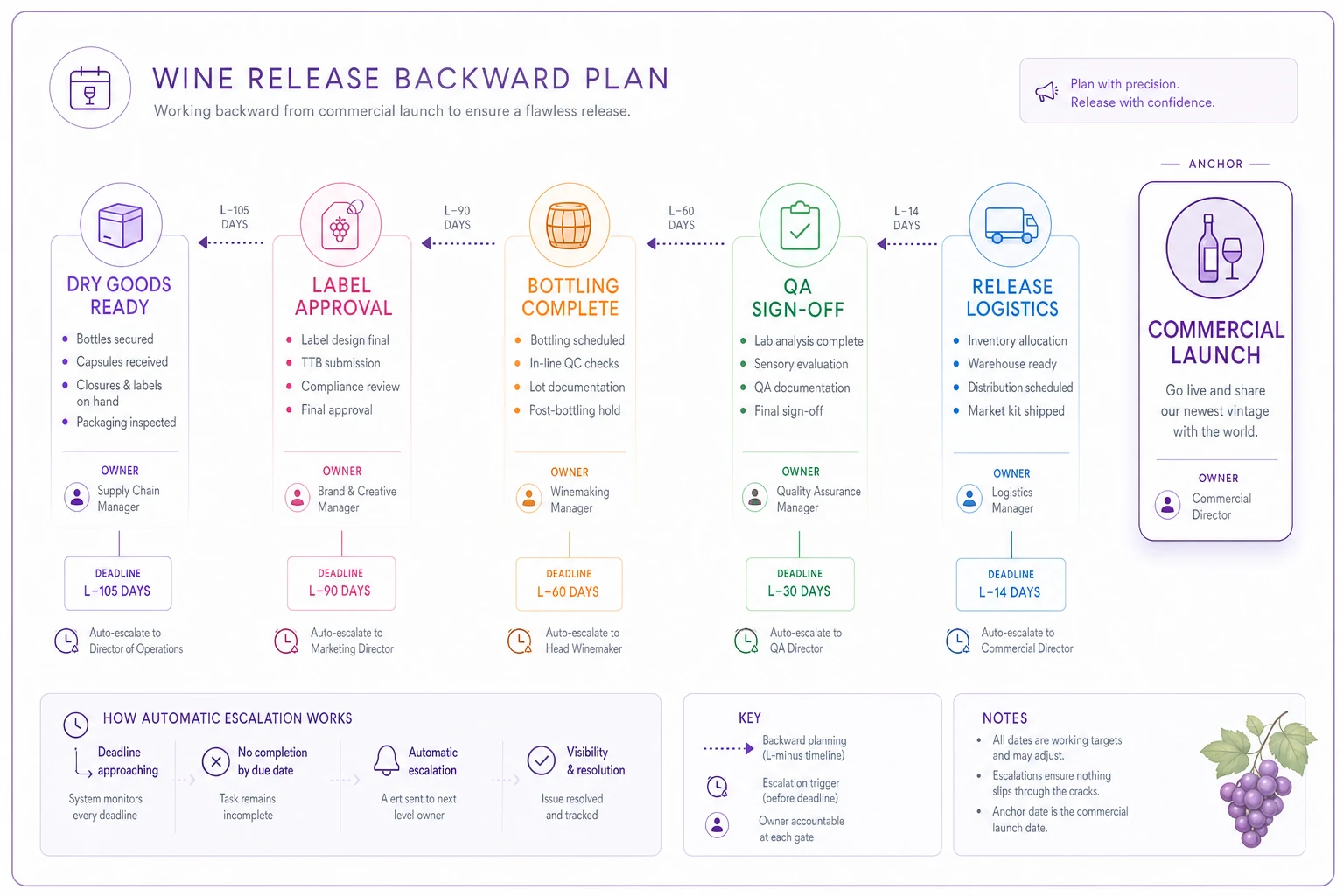
What makes this work isn't the specific numbers — yours will differ by wine style and market. It's that every gate now has a date, and every date has slack built in at the least predictable steps. When you plan forward, slack gets consumed silently. When you plan backward with explicit buffers, a slip shows up as "we're eating into the buffer" long before it becomes "we're going to be late."
This ties directly into broader seasonal operations and cashflow synchronization, because a release calendar isn't isolated — bottling slots, cellar capacity and the cash tied up in finished goods all move together.
Assign ownership with RACI — and actually enforce it
A dated calendar with no owners is just a prettier version of the same problem. Each gate needs a RACI so there's zero ambiguity about who moves it, who approves it, and who gets told when it slips.
Keep RACI deliberately lean. Too many people marked "Consulted" and the whole thing turns into meetings. Here's a worked example for the label-approval gate:
Keep Consulted roles minimal — extra Cs tend to create delays rather than preventing them.
-
Responsible Compliance coordinator — submits the COLA, tracks status, files corrections
-
Accountable Operations lead — owns whether this gate is met, has authority to escalate
-
Consulted Winemaker (label accuracy on alcohol, appellation, vintage), Marketing (design integrity)
-
Informed Sales/commercial lead — must know immediately if approval timing threatens the launch
The single most important cell in that grid is who is Informed on the commercial side the moment a gate is at risk. That's the connection that's usually missing. Compliance knows the COLA bounced three days before anyone in sales finds out, and those three days are often the difference between a recoverable slip and a dead launch date.
A quick RACI sanity checklist for each gate:
-
[ ] Exactly one person is Accountable (not two, not a department)
-
[ ] The Responsible party can actually do the work without waiting on an unlisted approver
-
[ ] The commercial side is explicitly Informed on any at-risk status
-
[ ] Nobody is Consulted "just to be safe" — every C has a real reason
-
[ ] The escalation path is written down, not assumed
The escalation path is written down, not assumed
Escalation clocks: the part everyone skips
This is where governance calendars live or die. A gate can have a date and an owner and still silently slip, because "we're a little behind" is a judgment call and people are optimistic by nature. Escalation clocks remove the judgment.
An escalation clock says: if this gate hasn't cleared by X days before its deadline, it automatically escalates to the Accountable owner, regardless of how confident the Responsible party feels.
A worked example for the QA signoff gate (deadline L-30):
-
L-37 Settled samples must be pulled and in the lab. If not, Responsible flags it. No escalation yet — just a logged status.
-
L-34 Analytical results must be in hand. If missing, auto-escalate to Operations lead.
-
L-32 Sensory panel complete. If not scheduled or completed, escalate to Operations lead and notify Commercial that the launch is now at risk.
-
L-30 Hard signoff. If not signed, the launch date is formally reviewed — move the date or invoke a contingency, decided by the Accountable owner, not left to drift.
Notice the pattern: the clock escalates before the deadline, not at it. By the time you hit L-30, you shouldn't be discovering a problem — you should already be two escalation steps into solving it. Setting escalation at the deadline itself means you learn you're late exactly when it's too late to do anything about it.
The other subtle thing: escalation should widen the audience as the risk grows. Early slips stay inside the owning team. Later slips pull in commercial. This keeps people from either crying wolf on day one or hiding the problem until it's a crisis.
Where this breaks as you scale
One release a year, you can run on a whiteboard and a sharp operations person's memory. The governance calendar still helps, but you'll survive without it.
The math changes fast when you're running multiple releases a year across multiple SKUs, channels and markets. Now you have overlapping calendars — a spring release's bottling window butting against a fall release's label submissions — and the dependencies cross between them. A COLA delay on one wine pushes a bottling slot that another release was counting on. The failure modes multiply, and no single person can hold all the dependency chains in their head anymore.
What breaks, specifically:
-
State-by-state registration tracking. One national launch can mean dozens of separate approval clocks, each with its own timeline and failure mode. Tracking these in a spreadsheet gets unmanageable once you're in more than a handful of states.
-
Line scheduling contention. Multiple releases competing for the same bottling slots means a slip in one cascades into others. The calendar has to see across releases, not just within one.
-
Signoff bottlenecks on key people. The winemaker is Accountable or Consulted on QA and label accuracy for every release. Past a certain volume, that person becomes the constraint, and the calendar needs to surface that load before it buries them.
This is the point where the calendar stops being a document and needs to be a system — something that tracks each gate's status, fires the escalation clocks automatically, and shows the commercial team their real at-risk launches without someone manually chasing updates. AI-assisted operational platforms earn their keep here precisely because the drudge work — watching deadlines, detecting a slipping gate, routing the right notification to the right owner before the slack runs out — is exactly the kind of coordination overhead that humans do poorly at scale and software does reliably. The goal isn't automation for its own sake; it's that nobody should have to remember to check whether the COLA cleared. The calendar should be watching, and it should raise its hand before you're late.
A real scenario
A mid-sized producer running about six releases a year across roughly fifteen states kept missing on-sale dates — not catastrophically, but routinely by one to three weeks. The pattern was always the same: a label correction or a slow state registration that nobody on the commercial side heard about until the ship date was already impossible.
They weren't disorganized. Each team had its own tracking. The gap was entirely in the seams between teams and the absence of escalation before deadlines hit.
They rebuilt around a backward-planned governance calendar: launch-anchored gates, a lean RACI per gate, and escalation clocks that pulled the sales lead into the loop at the at-risk stage rather than the already-late stage. The biggest single change was moving COLA submissions to the pessimistic edge of the timeline — submitting roughly four months before launch instead of waiting until bottling was near.
Over the following year, late launches dropped from most releases to one, and that one slipped by a few days rather than weeks. The on-time improvement also quietly cleaned up the downstream mess — fewer rush shipments, fewer scrambled line changeovers, fewer awkward calls to distributors. None of it required new people. It required the dependencies to be visible and the clocks to escalate early.
When this level of governance makes sense — and when it doesn't
This isn't free. Building and maintaining a governance calendar is real overhead, and it's worth being honest about when it pays off.
It makes sense when:
-
You're running multiple releases a year across multiple channels or states
-
Your launches are tied to hard commitments — distributor windows, events, campaigns
-
You've already missed a date and felt the downstream cost in rush shipping and credibility
-
Key people (winemaker, compliance) are bottlenecks across several releases at once
It's overkill when:
-
You do one or two releases a year and the same person owns the whole chain
-
Your launch dates are genuinely flexible and nobody downstream is counting on them
-
You're small enough that a weekly standup catches every slip in time
A very small DTC-focused producer with soft release dates and no distributor obligations probably doesn't need this yet. The coordination cost outweighs the benefit. The moment you take on hard commitments to third parties, though, the calculus flips immediately.
The honest line is: governance calendars protect you from coordination failures, and coordination failures only hurt when there are enough moving parts to lose track of. If you can hold the whole release in one head, you don't need this yet. If you can't — and most growing wineries reach that point faster than they expect — the question isn't whether to build it, it's how much a missed launch has already cost you.
The reason late launches feel so avoidable in hindsight is that they are avoidable — but only if you catch the slip while there's still slack to absorb it. A governance calendar doesn't prevent problems. COLAs will still bounce, panels will still flag issues, suppliers will still run late. What it does is make those problems visible and owned early, so a two-day label fix stays a two-day fix instead of becoming a three-week launch disaster.
Tie your dates backward from the launch, buffer the steps you don't control, give every gate an owner and a clock, and make sure the commercial side hears about risk before it becomes reality. If you want to see how these release dates connect to the margin math downstream, it's worth looking at the winery KPIs that actually move margins — because a release that lands on time protects a lot more value than it looks like on the calendar.
Ready to elevate your winery management?
Join 500+ wineries using Corkyly to increase operational efficiency, boost customer loyalty, and grow sales.