

Walking through a mid-sized Napa winery's bottling facility last spring, I watched their crew spend 47 minutes cleaning lines between a late-harvest Riesling and their estate Cab. The production manager told me they run this exact changeover sequence about twice a week during their March-to-November bottling season. Quick math: that's around 78 hours annually just on one recurring changeover pattern.
But what really caught my attention—they were bottling 180 cases of the Riesling followed by 2,400 cases of Cab. The changeover time ate up nearly 30% of the total run time for that Riesling batch. When you factor in the material loss from line priming, testing bottles, and quality checks, those 180 cases probably cost them closer to what 250 cases should.
Why bottling run batching breaks down in real operations
Most wineries inherit their batching approach from whoever trained them. Usually some version of "bottle whites first, then reds" or "start with the smallest runs to get them out of the way." These rules worked fine when most wineries produced maybe four or five different wines total.
Today's reality looks different. Even smaller operations often bottle 12–20 different SKUs when you count different bottle sizes, label variations for different markets, and club-exclusive releases. Add in contract bottling for neighboring vineyards, and suddenly you're juggling production schedules that would make a regional brewery nervous.
The traditional approach ignores three critical operational constraints:
Closure compatibility windows
Natural cork requires specific humidity conditions during application. Switching from natural cork to screwcap means recalibrating the entire capping station, checking torque specifications, and often swapping out liner materials. A winery bottling both their premium reserve wines (natural cork) and everyday drinking wines (screwcap) might lose 35–40 minutes per closure-type changeover, not counting the risk of closure defects if humidity wasn't properly adjusted.
Sulfite and preservative sequencing
Running a low-sulfite natural wine after your standard production means extensive line sanitation to prevent cross-contamination. But the reverse sequence can be just as problematic. Residual cleaning agents from that deep sanitation can affect the sulfite levels in your next standard batch if rinse protocols aren't perfect.
Label adhesive temperature curves
Your label applicator needs different temperature settings for different paper stocks and adhesive types. Foil labels on your reserve wines might need 185°F while standard paper labels work best at 155°F. The adhesive needs 15–20 minutes to stabilize at the new temperature. Rushing this adjustment leads to crooked labels, bubbles, or labels that peel off in the case.
The compound effect of poor sequencing
A Paso Robles operation discovered their batching mistakes through customer complaints, not production metrics. They were running small lots of their single-vineyard Syrah (maybe 95 cases) immediately after their house red blend (usually 800+ cases). The flavor profile contamination was subtle—most customers couldn't identify it—but their wine club members started noticing their limited releases "tasted different than at the winery."
Streamline your winery operations effortlessly.
Corkyly helps you track, manage, and optimize every step from vine to bottle.
- Vineyard & production tracking
- Customer relationship management
- Inventory & sales analytics
No credit card required
Investigation revealed the real issue: aromatic compound carryover in the filler bowls. Even after standard cleaning, trace amounts of the bigger, more tannic blend were affecting the delicate aromatics of the small-lot wines. The fix wasn't just better cleaning—it was smarter sequencing that grouped wines by flavor intensity and tannin levels.
Material waste compounds these problems. Every changeover means:
-
Priming losses (usually 6–12 bottles depending on line configuration)
-
Quality check bottles (another 3–6 bottles)
-
Adjustment bottles while dialing in fill levels (4–8 bottles)
-
End-of-run partial cases that can't be sold
For small runs under 200 cases, you might lose 2–3% of total production just to changeover waste. Scale that across dozens of small runs per year, and you're looking at hundreds of cases worth of wine literally going down the drain.
Building batching rules that actually work
After analyzing bottling schedules across roughly forty small-to-medium wineries, certain patterns consistently reduce both changeover time and material waste. The most effective operations organize their batching decisions around constraint compatibility rather than traditional wine categories.
Primary batching by closure type:
| Closure Sequence | Changeover Time | Material Loss | Best For |
|---|---|---|---|
| Cork → Cork | 8–12 minutes | 6–8 bottles | Premium series |
| Screwcap → Screwcap | 5–8 minutes | 4–6 bottles | Everyday wines |
| Cork → Screwcap | 35–45 minutes | 12–15 bottles | Avoid when possible |
| Screwcap → Cork | 40–50 minutes | 15–18 bottles | Schedule overnight |
The following image illustrates a batching decision workflow.
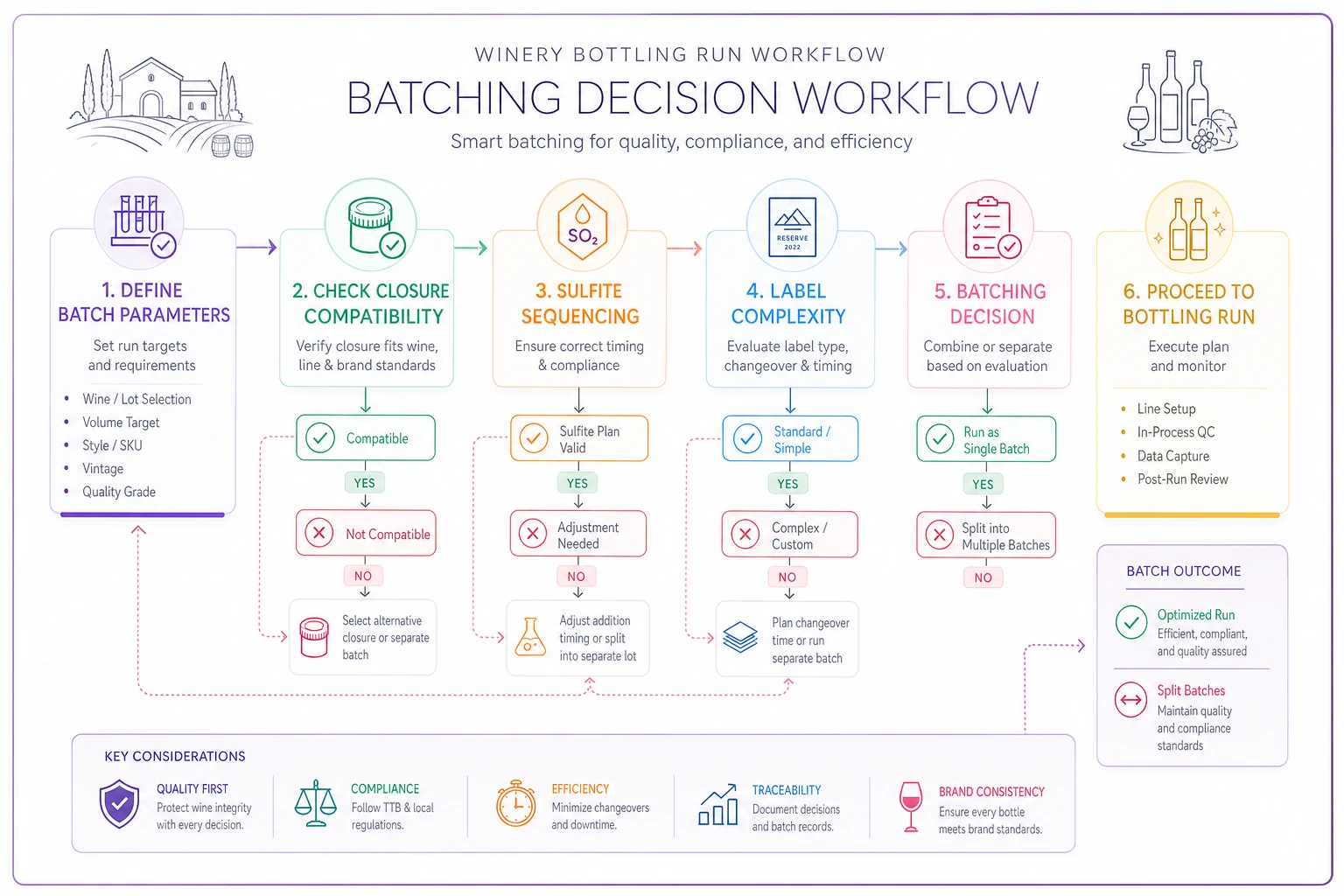
Start by batching by closure type to minimize long changeovers and material loss.
Secondary organization by sulfite levels:
-
Group all low-sulfite/natural wines together
-
Run them either first thing Monday morning or last thing Friday
-
Allow extra sanitation time in schedule (add 90 minutes minimum)
-
Never run conventional wines immediately after without full CIP cycle
Tertiary grouping by label complexity:
-
Simple pressure-sensitive labels
group together
-
Foil or embossed labels
run consecutively
-
Multiple label panels (front, back, neck)
batch these together
-
Temperature-sensitive adhesives
maintain applicator temp within 10°F range
Some wineries try to get clever with their sequencing, running lightest-to-darkest or lowest-to-highest alcohol. While these factors matter for quality, they're secondary to the mechanical constraints of your bottling line. A light rosé might theoretically contaminate your bold Petite Sirah, but if they both use natural cork and standard labels, the changeover efficiency usually outweighs the contamination risk.
Measuring what matters: KPIs that drive better batching
Changeover time gets all the attention because it's easy to measure. You can literally stand there with a stopwatch. But focusing solely on changeover time leads to suboptimal decisions—like running all your small lots back-to-back and dealing with quality issues later.
Effective fill loss rate
Track material loss as a percentage of the run size, not absolute bottles. Losing 15 bottles on a 2,000-case run (0.06%) is different from losing 15 bottles on a 150-case run (0.83%). Set different targets:
-
Large runs (500+ cases)
Keep under 0.1%
-
Medium runs (200–500 cases)
Keep under 0.3%
-
Small runs (<200 cases)
Keep under 1.0%
One Sonoma operation reduced their small-run fill loss from 1.8% to 0.7% just by grouping small lots with similar closure and label requirements. That improvement saved them roughly 300 bottles per month during peak season.
Varietal integrity score
This one's harder to track but crucial for quality. Sample the first and last bottles from each run. Test for:
-
pH drift (should be within 0.02)
-
SO2 variance (within 2 ppm)
-
Residual sugar contamination (critical for dry wines after sweet wines)
Rate each run on a 1–5 scale. Anything below 4 triggers a review of your batching sequence. A Central Coast winery implemented this system and discovered their Pinot Grigio consistently scored low when bottled after their Viognier—the Viognier's higher viscosity left residue that affected the Grigio's clarity.
Schedule attainment rate
What percentage of your bottling runs actually happen when scheduled? This metric reveals whether your batching rules are realistic. If you're constantly pushing runs to the next day because changeovers took longer than planned, your batching logic needs adjustment.
Track both:
-
Runs completed on scheduled day
Target >85%
-
Runs completed within scheduled hour
Target >70%
Track both:
Real-world batching frameworks
A 15,000-case winery in Paso uses this batching framework. They bottle twice monthly during off-peak season, weekly during spring/summer:
Week 1: Screwcap focus
-
Monday AM
White wines, screwcap, standard labels
-
Monday PM
Rosé and light reds, screwcap, standard labels
-
Tuesday AM
Continue reds if needed
-
Tuesday PM
Clean and prepare for next week
This separation dramatically reduced their closure-related changeovers. They went from averaging 3.5 hours of changeover time per bottling day to about 1.5 hours. Their materials waste dropped by roughly 40% because they weren't constantly priming lines for different closure types.
A different approach works for a 5,000-case boutique winery that bottles monthly:
Day 1: All small lots (<150 cases)
-
Group by closure type first
-
Then by label similarity
-
Accept longer day to minimize waste percentage
Day 2: Medium runs (150–400 cases)
-
Start with simplest labels
-
Progress to complex labels
-
Keep closure type consistent
Day 3: Large runs (400+ cases)
-
Single SKU if possible
-
Or two very similar products
-
Use this day for club wines or core products
This structure acknowledges that small lots need different optimization than large runs. By dedicating specific days to different run sizes, they optimize for the right metrics at the right time.
When traditional batching wisdom fails
The "whites before reds" rule makes sense until you're dealing with an oaked Chardonnay that needs cork closures and a light Pinot Noir with screwcaps. The Chardonnay's oak compounds and higher viscosity create more contamination risk than the light red would.
Similarly, the "dry before sweet" guideline breaks down when your sweet wine uses completely different closure and label systems. The mechanical changeover time might exceed any contamination risk from reverse sequencing.
Geographic origin batching—running all Carneros fruit together, then all Sta. Rita Hills—sounds logical but often creates inefficiencies. Unless you're highlighting terroir differences on the label itself, origin-based batching usually increases changeover complexity without improving quality or efficiency.
Adapting batching rules for seasonal variations
Harvest season throws all normal batching logic out the window. You're bottling last year's wines while this year's fruit comes in. Tank space becomes the primary constraint, not bottling efficiency.
-
First priority
Free up tank space for incoming fruit
-
Second
Minimize contamination between varieties
-
Third
Changeover efficiency
This might mean bottling your Merlot before your Sauvignon Blanc because you need that Merlot tank for incoming Cab. The closure and label changeovers become acceptable costs for maintaining fermentation capacity.
Post-harvest (December through February), priorities shift again:
-
First
Prepare wines for spring release
-
Second
Optimize for gift season packaging
-
Third
Standard efficiency metrics
Multiple wineries report their December bottling schedules revolve entirely around gift pack configurations. They'll run all their 2-pack gift sets in one sequence, regardless of variety, because the packaging changeover time exceeds any other consideration.
The technology that makes better batching possible
Modern bottling operations generate massive amounts of data that most wineries never analyze. Your filler knows exactly how many bottles it filled, at what rate, with what variation. Your capper tracks every closure application with torque measurements. Your labeler records every label applied and rejected.
The problem isn't data availability—it's connecting these data streams into actionable batching decisions. AI-powered operational software that integrates bottling equipment data with inventory management and production planning changes the entire equation. Instead of guessing whether that Grenache-to-Tempranillo changeover will take 25 or 45 minutes, you know based on the last six times you ran that sequence.
These platforms can simulate different batching sequences and predict total run time, material waste, and quality risks. They factor in variables humans often miss—like how humidity changes throughout the day affect label adhesion, or how operator fatigue in hour six leads to more adjustment waste than hour two.
These systems also enable dynamic re-scheduling. When your cork supplier delivers a day late, the software automatically reorganizes the entire week's batching sequence to maintain efficiency while working around the constraint. No more scrambling to figure out what can run tomorrow while your premium reds wait for their closures.
Making batching decisions under real constraints
Every winery faces unique constraints that generic batching advice ignores. A Russian River producer might share a mobile bottling line with three other wineries, forcing all batching decisions into two-day windows once monthly. A Willamette Valley operation might have temperature-controlled storage for only 500 cases, requiring frequent small bottling runs to avoid warehouse overload.
Document your actual constraints, not your theoretical ones. That Paso winery I mentioned earlier thought their constraint was bottling line speed. After tracking operations for three months, they discovered the real bottleneck was label inventory management. They'd constantly run out of specific labels mid-run, forcing emergency changeovers to different SKUs. Fixing their label ordering process improved bottling efficiency more than any batching optimization could.
Start by identifying your three biggest bottling pain points:
-
Excessive changeover time between specific products?
-
Quality issues from poor sequencing?
-
Material waste on small runs?
-
Schedule delays from missing components?
-
Labor costs from extended bottling days?
Build your batching rules to address these specific issues first. Generic best practices come second.
The path forward
Bottling run batching will only get more complex as consumer preferences drive SKU proliferation. The wineries succeeding aren't the ones with the fastest bottling lines or the newest equipment. They're the ones who've figured out how to sequence their runs to minimize waste, maintain quality, and actually hit their production schedules.
Start simple. Track your next month of bottling runs. Document every changeover time, every material loss, every quality issue. Look for patterns. Which transitions consistently cause problems? Which sequences run smoothly?
Then build rules based on your actual operation, not theoretical best practices. Maybe you'll discover that running your Chardonnay after your Pinot Noir saves 25 minutes of changeover time with no quality impact. Maybe you'll find that grouping by bottle size matters more than closure type for your specific line configuration.
The wineries that master bottling run batching don't just save time and materials. They deliver more consistent quality to their customers, reduce operator stress, and free up resources to focus on what actually matters—making great wine.
Ready to elevate your winery management?
Join 500+ wineries using Corkyly to increase operational efficiency, boost customer loyalty, and grow sales.