

Running a winery means juggling three completely different timelines that never quite sync up. Your vineyard blocks run on weather and growth stages. Your cellar runs on fermentation schedules and tank availability. Your bank account runs on monthly cycles that don't care when grapes decide to ripen.
Most wineries handle this by scrambling. A heat spike pushes harvest forward ten days, tanks aren't empty yet, the bottling line is scheduled for something else, and suddenly you're making expensive compromises—moving wine too early, renting emergency storage, paying overtime, or worst case, letting fruit hang too long because you literally have nowhere to put it.
The problem compounds as you grow. Five blocks and twenty tanks, you can keep it in your head. Fifteen blocks across three vineyards, sixty tanks, and a barrel room? Every decision ripples through the operation in ways that don't surface until it's already too late.
Why traditional planning breaks down in wine operations
Standard production planning assumes predictable inputs. Manufacturing plants know when raw materials arrive and how long each step takes. Wineries operate in a world where nature sets half the schedule and quality requirements regularly override efficiency.
Take a typical September scenario: Block 7 Pinot needs picking within a 3-day window based on sugar levels. But the Chardonnay in tanks 15-18 won't be ready to rack for another week. The bottling line has a Merlot run scheduled that can't move because the glass shipment is already in transit. Payroll hits in four days and the big wholesale payment isn't due for three weeks.
Each department makes logical decisions in isolation. The vineyard manager picks at optimal ripeness. The winemaker protects wine quality. The bottling supervisor maintains efficiency. The CFO manages cash. These isolated rational choices create systemic chaos.
What usually happens: the vineyard manager calls an emergency meeting, everyone argues their constraints, the owner makes a gut call on incomplete information, and three weeks later nobody can explain why margins tanked.
This isn't a communication problem or even really a planning problem—it's structural. Without a framework that explicitly maps dependencies and trade-offs, every seasonal crunch becomes an expensive fire drill.
Building your seasonal matrix: blocks, bottles, and budgets
A functional seasonal playbook starts with accepting three realities. Vineyard timing is somewhat flexible but quality-constrained. Cellar capacity is physically fixed in the short term. Cashflow requirements are non-negotiable.
Streamline your winery operations effortlessly.
Corkyly helps you track, manage, and optimize every step from vine to bottle.
- Vineyard & production tracking
- Customer relationship management
- Inventory & sales analytics
No credit card required
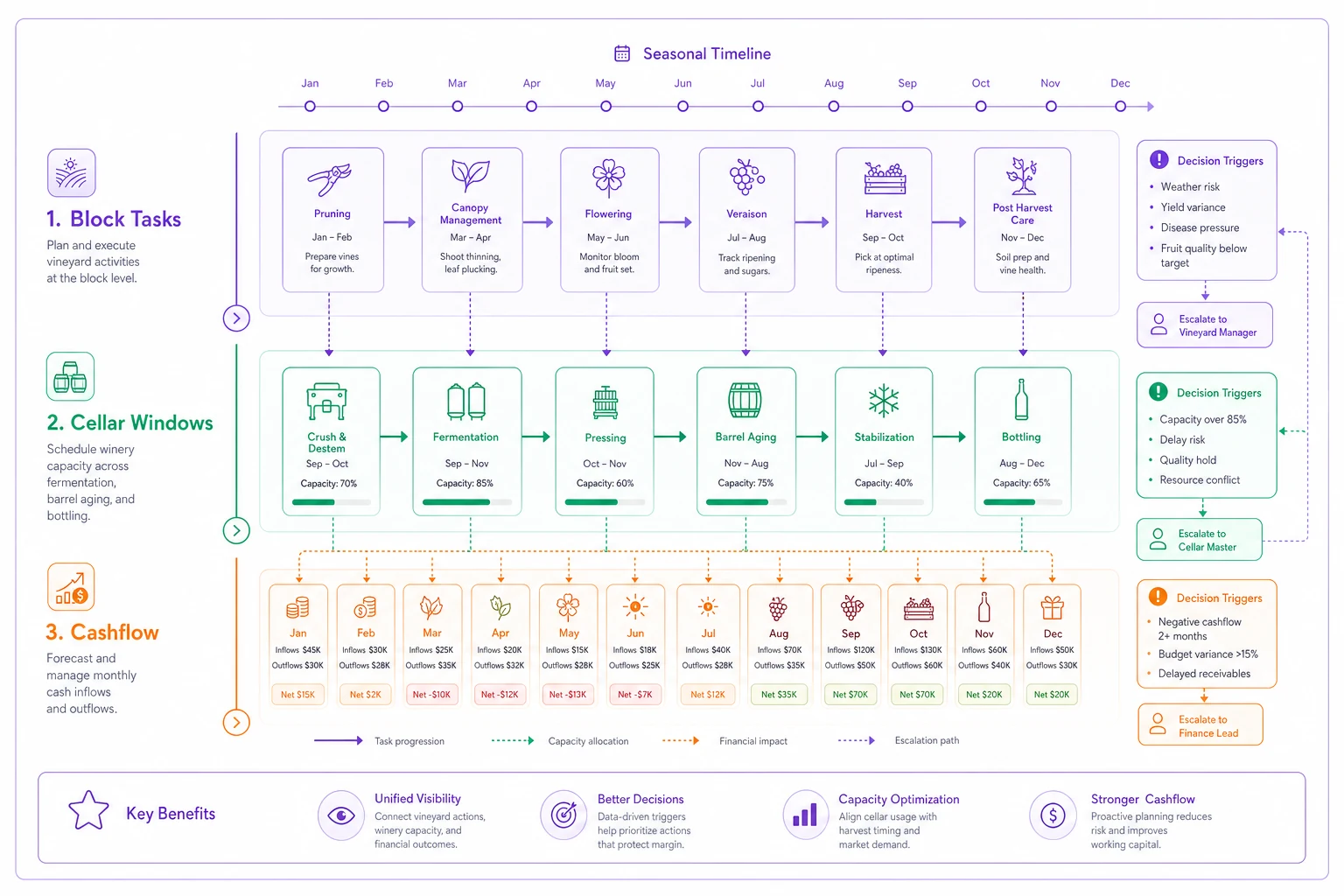
The matrix needs three layers that actually talk to each other.
Layer 1: Block-Level Task Demand Map every block's critical operations by week for the entire year—not just harvest. Pruning windows, spray schedules, canopy management, irrigation decisions, harvest timing, post-harvest prep. For each task, note the flexibility window. Some operations can slide two weeks; others can't move more than 48 hours.
Include actual labor requirements. Not "crew needed"—real numbers. Block 7 needs 8 people for 3 days. Block 12 needs 4 people for 5 days. That granularity matters when you're trying to figure out if you can handle overlapping harvests without losing your mind or your margin.
Layer 2: Cellar and Bottling Windows Track every tank, barrel, and processing constraint by capacity and timing. Tank 15 holds 3,000 gallons and will be empty October 3rd, but needs 48 hours for cleaning and prep. The bottling line handles 400 cases per day but needs 4-hour changeovers between varietals.
Most operations fail here because they track what's in tanks but not when it moves. Your matrix needs movement dates as firm data points, not vague plans. When does this wine absolutely need to move? What's the earliest it could move without quality loss? What triggers the decision?
A simple visual of the matrix workflow clarifies how block-level tasks, cellar movements, and cashflow constraints interact.
Connect this to your bottling run batching systems to avoid the changeover chaos that quietly destroys September margins.
Layer 3: Monthly Cashflow Reality Overlay your actual cash cycle. When do wholesale payments arrive? When does payroll hit? Quarterly taxes, loan payments, supplier terms? Most wineries know their annual budget but can't tell you their cash position three weeks forward with any real accuracy.
The goal isn't perfect prediction—it's understanding constraints. If payroll is $43,000 on the 15th and your main distributor pays net-45, you know exactly how much room you have for overtime or emergency rentals.
The governance cadence that prevents scrambling
Data alone doesn't prevent crises. You need a review rhythm that catches problems while you still have options.
Weekly ops review (30 minutes, every Monday) Pull up the next 14 days across all three layers. What blocks need attention? What's moving in the cellar? Where's cash tight? This isn't a planning meeting—it's a constraint check. Red flags get escalated immediately, everything else rolls forward.
One operations manager running 1,800 acres told me their single biggest improvement was making this meeting mandatory. "We went from three emergency meetings per week during harvest to maybe one every two weeks. Same problems, just caught earlier."
Monthly planning session (2 hours, first Thursday) Review the next 60 days in detail. This is where trade-offs get discussed before they become emergencies. If three blocks might overlap, decide now whether you'll pay overtime, risk quality, or rent temporary storage. Put trigger points in writing: "If Block 7 Brix hits 24 before September 10, we delay Block 9 and accept the $3,000 overtime cost."
Schedule the weekly ops review early Monday so flagged issues can be acted on during the same workweek.
Quarterly strategic review (half day) Step back and look at the full year. What patterns emerged? Where did the matrix break? What assumptions need updating? This is also when you adjust escalation rules based on what actually happened. Document decisions and their logic—when you're arguing about whether to pick Block 7 or wait another four days, being able to reference "last year we waited and lost 8% to bird damage costing $11,000" changes the conversation from opinion to data.
Escalation rules that eliminate ad-hoc panic
Unplanned conflicts happen every season. The difference between profitable operations and chaotic ones is how decisions get made when plans collide.
Level 1: Field/Cellar Manager Decision
-
Single block timing shifts under 5 days
-
Tank switches within the same varietal
-
Labor adjustments under $5,000
-
Same-week bottling schedule changes
Level 2: Operations Manager Approval
-
Multi-block scheduling conflicts
-
Cross-varietal tank changes
-
Labor costs $5,000–$15,000
-
Bottling delays over one week
-
Any quality-impacting decision
Level 3: Owner/GM Decision
-
Harvest delays risking quality
-
Emergency storage or equipment rental
-
Labor costs over $15,000
-
Major bottling cancellations
-
Cash shortfalls requiring line of credit
The value here isn't the specific thresholds—it's that everyone knows them ahead of time. Your vineyard manager doesn't waste time in meetings for small adjustments. Your owner doesn't get blindsided by expensive decisions made without their input.
A 450-acre operation in Paso reduced harvest labor costs by around 18% just by implementing clear escalation rules—not through better planning or efficiency, but by eliminating the chaos tax of unclear decision authority.
Trade-off documentation: protecting next year's margins
Every compromise teaches you something, but only if you capture it. Most wineries repeat the same expensive mistakes annually because nobody documented why decisions were made in the first place.
| Date | Conflict | Decision | Cost/Impact | Trigger | Alternative Considered |
|---|---|---|---|---|---|
| 9/12 | Block 7 & 9 overlap | Delay Block 9 | $3,400 overtime | Block 7 Brix hit 24.5 | Partial pick rejected—quality risk |
| 9/18 | Tanks full, Block 12 ready | Rent 3 temporary tanks | $8,500 | Ferm taking 3 extra days | Early rack rejected—wine not ready |
| 9/25 | Bottling conflict with harvest | Cancel bottling | $2,000 fee + 2 week delay | Harvest moved up 5 days | Weekend bottling—$6,000 extra |
This isn't busywork. Next August, when you're building the season matrix, this log becomes your reality check. Those emergency rental tanks? They've happened three of the last four years—maybe it's time to add capacity. That bottling conflict? Happens every fall—schedule October runs for November instead.
Integration points: where your matrix meets daily operations
A seasonal matrix only works if it connects to actual daily workflow. Most planning systems fail here—they live in spreadsheets nobody checks until there's already a problem.
Your harvest logistics system needs to pull from the same block-timing data. When the vineyard manager updates pick dates, that should immediately flag cellar capacity conflicts—not surface them three days later in a morning meeting.
Your operational KPIs should include matrix accuracy as a tracked metric. What percentage of planned picks happened within the scheduled window? How often did cellar moves match the timeline? Not about perfection—nature doesn't allow that—but understanding your planning accuracy helps you build better matrices going forward.
The cashflow layer needs to feed purchasing decisions too. When someone wants to order three months of bottles to capture a discount, the matrix shows whether you'll have cash to cover payroll. When harvest looks early, you can see the overtime impact on specific pay periods, not just the monthly budget.
Software automation: from spreadsheet chaos to operational clarity
Seasonal matrices are incredibly powerful and absolutely miserable to maintain manually. Even a smaller winery has hundreds of date-dependent variables constantly shifting. Miss one update and your entire planning framework starts showing bad information.
Most operations start with elaborate spreadsheets—multiple tabs, complex formulas, color coding. They work fine until about the third week of real operations, when someone forgets to update pick dates, someone else changes tank assignments without noting it, and suddenly nobody trusts the data.
Operational software built for wineries changes this dynamic. Instead of manually updating three different spreadsheets every time a block timing shifts, the system automatically cascades changes through cellar capacity and cashflow projections. When your vineyard manager updates an expected harvest date from their phone in the field, the cellar team immediately sees the impact on tank availability.
The real value isn't just automation—it's the connection between different parts of the operation. AI-assisted platforms can monitor patterns and surface conflicts you might otherwise miss, like noticing that pushing Block 7's harvest back four days creates a bottleneck with three other blocks all hitting optimal ripeness the same week. Or flagging that your planned bottling schedule lands right when seasonal labor costs peak, quietly compressing your margins before anyone notices.
A good platform also supports the governance cadence—weekly conflict reports, monthly planning summaries, escalation alerts when decisions cross thresholds. The matrix becomes a living operational tool rather than a planning document that gets abandoned once harvest actually starts.
Beyond survival: using your matrix for strategic growth
Once you have a functioning seasonal matrix, something shifts. Instead of just surviving each vintage, you can start making actual strategic improvements.
Patterns become visible. Blocks 3, 7, and 9 always conflict because they're the same clone on similar exposures—maybe replant one with a later-ripening variety. October bottling runs consistently collide with late harvest varieties—schedule them for November instead.
The cashflow layer reveals opportunities too. That brutal two-week stretch in September where you're always cash-tight? Maybe restructure supplier payments or renegotiate terms with distributors. Or use improved cash visibility to take advantage of early-payment discounts you previously couldn't risk.
Most importantly, you can model changes before committing. Thinking about adding 10 acres of Cabernet? Plug it into next year's matrix and see where it creates pressure. Planning a tank expansion? The matrix shows whether you actually need more capacity or just better scheduling.
Making it real: start with next quarter, not next year
Building a complete seasonal matrix feels overwhelming at first. Start smaller—map the next 90 days across all three layers. That's enough to catch immediate problems while building the habit of this kind of planning.
Get the structure right before worrying about perfect data. Here's a simple process to get moving:
-
List every block and its estimated harvest window for the next 90 days
-
Map current tank status and projected move dates alongside those windows
-
Pull your actual cash calendar—payroll dates, incoming payments, fixed obligations
-
Identify any obvious overlaps or pressure points
-
Set escalation thresholds before the first conflict actually happens
-
Run your first Monday ops review with the draft matrix in front of the team
Rough estimates that get updated beat precise plans that don't exist. Use last year as your baseline, then adjust as reality unfolds.
The point isn't prediction—it's preparation. Weather will surprise you, equipment will break, staff will quit at the worst possible moment. But with a clear framework for understanding ripple effects and making trade-offs, those surprises become manageable problems instead of expensive disasters.
The difference between wineries that scale and those that hit operational walls usually isn't wine quality or capital—it's whether they can see the operation as an interconnected system and make decisions accordingly. The seasonal matrix is the foundation for that visibility. Next harvest, while other operations scramble through emergency meetings and expensive compromises, you'll be working from a playbook that explicitly shows options, costs, and consequences—which is what actually lets you focus on making great wine instead of managing preventable chaos.
Ready to elevate your winery management?
Join 500+ wineries using Corkyly to increase operational efficiency, boost customer loyalty, and grow sales.