

Harvest planning looks great on spreadsheets until Block 7 hits 24.5 Brix three days early, Block 12 needs picking immediately after unexpected rain, and your night crew shows up to find the destemmer still processing fruit from the morning shift.
Most wineries with multiple vineyard sites learn this lesson the expensive way. You've got microclimates spread across elevation changes, soil types, and sun exposures. Each block follows its own ripening curve. Then harvest hits and suddenly you're coordinating 4 picking crews, 6 trucks, and a cellar that processes fruit at exactly one speed—not nearly fast enough when everything ripens at once.
The real challenge isn't predicting when blocks will be ready. Any decent viticulturist can track Brix and pH. The problem happens when your harvest schedule meets operational reality: crew availability, truck routing, and most critically, the hard limit of how fast your cellar can actually process fruit without creating quality issues.
Why traditional harvest scheduling breaks down
Standard harvest planning starts with block priority based on ripeness. Makes sense until you realize ripeness is just one variable in a complex equation. A typical 400-acre operation might have blocks spread across 30 miles, elevation differences of 800 feet, and microclimates that can show 5-degree temperature swings on the same morning.
Take a real scenario from Sonoma County. Estate vineyard sits at 1,200 feet with morning fog influence. Their valley floor blocks, 8 miles away, see full sun by 7 AM. The mountain fruit typically trails the valley by 10-14 days. Except in 2020, when a heat spike compressed that window to 4 days. Their cellar crew worked 19-hour shifts trying to process everything. Quality suffered. The winemaker still talks about losing aromatics in their reserve Pinot because it sat in bins for 11 hours waiting for tank space.
These situations reveal the fundamental flaw in basic harvest planning. Most operations treat harvest logistics as three separate problems: when to pick (viticulture), who picks (labor), and where it goes (cellar). In reality, these elements create interdependencies that standard scheduling misses completely.
Your Block 3 Cabernet might be perfect at 25 Brix, but if picking it means your Chardonnay sits in the sun for an extra 6 hours because the press is tied up, you've traded one quality issue for another. Worse, you pick everything at optimal ripeness but create a processing bottleneck that forces fruit to sit in macro bins, starting fermentation before you intended.
Building schedules that actually work
Effective harvest logistics start with understanding your true processing capacity, not theoretical throughput. Most wineries overestimate their cellar speed by 30-40% because they calculate based on equipment specs rather than actual workflow.
Streamline your winery operations effortlessly.
Corkyly helps you track, manage, and optimize every step from vine to bottle.
- Vineyard & production tracking
- Customer relationship management
- Inventory & sales analytics
No credit card required
A 5-ton/hour destemmer doesn't process 5 tons per hour in practice. You lose time during bin changes (8-12 minutes each), cleaning between varieties (20-30 minutes), tank transfers (15-20 minutes), crew breaks and shift changes, plus equipment adjustments for different fruit conditions.
Map your actual processing time over three harvests and you'll find patterns. Red varieties typically process 20% slower than whites due to destemming. Whole cluster lots need different handling. Hand-sorted fruit cuts your throughput by 60%.
With real capacity numbers, you can backward plan from the cellar. If you process 4 tons per hour actual throughput, and have 12 hours of cellar operation daily, that's 48 tons maximum. Factor in variety changes and cleaning, realistic capacity drops to 36-40 tons.
Now overlay your microclimate patterns. Track not just average ripening dates but the compression that happens during heat events. If your hillside blocks typically ripen over 18 days but compress to 8 days in hot years, you need contingency plans for processing 2.5x your normal daily volume.
Here's how to organize picking timing by block characteristics:
Morning pick blocks (5 AM - 10 AM):
-
Delicate varieties (Pinot Noir, Chardonnay)
-
Blocks over 15 minutes from cellar
-
South-facing slopes that heat quickly
-
Blocks requiring hand-sorting
Afternoon pick blocks (3 PM - 8 PM):
-
Thick-skinned varieties (Cabernet, Petite Sirah)
-
Blocks within 10 minutes of cellar
-
North-facing or shaded areas
-
Machine-harvestable blocks
Night pick priorities (10 PM - 4 AM):
-
Anything requiring cold fruit processing
-
Blocks over 30 minutes from cellar
-
High-acid varieties for sparkling
-
Blocks with morning fog influence
Once you establish these windows, factor in your actual processing rate to determine realistic tonnage targets. A lot of plans fall apart because they assume you can pick 15 tons of fruit when your cellar maxes out at 8 tons per shift.
Crew choreography across multiple blocks
Labor coordination becomes exponentially complex when picking multiple blocks simultaneously. A 20-person crew picking one block operates efficiently. Split them across three blocks and productivity drops 35% due to communication gaps, travel time, and equipment distribution.
The standard approach assigns crews to blocks based on proximity. Logical but flawed. Better to assign based on picking speed requirements. Your fastest crews should handle blocks feeding directly to press or destemmer, varieties requiring selective picking, and blocks with tight harvest windows.
Slower, steadier crews work better on blocks going to cold storage, simple pick-everything scenarios, and backup blocks that provide schedule flexibility.
Think about crew energy curves throughout shifts. Morning crews pick 20-30% faster in their first 3 hours. Schedule your most critical blocks during peak performance windows. Afternoon crews maintain steadier pace but need more breaks in heat.
Create formal handoff protocols between shifts. The morning foreman tells the afternoon lead "we're halfway through Block 8." But halfway by row count? By tonnage? By time estimate? These ambiguities cascade into delays.
Document everything: block ID and specific rows completed, tons picked and bins filled, equipment left on site, quality issues noted, and estimated completion time. Build 20% buffer time between crew shifts. Overlapping crews trying to share picking equipment wastes more time than the brief gap between shifts.
Build 20% buffer time between crew shifts.
Document everything: block ID and specific rows completed, tons picked and bins filled, equipment left on site, quality issues noted, and estimated completion time. Build 20% buffer time between crew shifts. Overlapping crews trying to share picking equipment wastes more time than the brief gap between shifts.
Truck routing that prevents cellar chaos
Transportation seems straightforward until you're juggling multiple picking sites, limited trucks, and a cellar that needs steady flow, not feast or famine delivery.
Most operations use simple rotation: truck delivers, returns to field, repeat. This creates predictable problems. Trucks arrive in clusters, overwhelming the cellar, then nothing for an hour. Meanwhile, picked fruit sits in fields heating up.
Better approach: staggered dispatch based on processing time, not picking completion. If destemming takes 45 minutes per load, dispatch trucks on 45-minute intervals regardless of when picking completes. This requires more coordination but eliminates cellar bottlenecks.
Map actual drive times at different hours. Your 20-minute route at 6 AM becomes 35 minutes at 4 PM with harvest traffic, farm equipment, and tired drivers. GPS estimates miss dirt road conditions, weight restrictions on rural bridges, and mandatory safety stops.
Calculate true round-trip cycles: loading time at vineyard (15-20 minutes), drive to cellar (varies by block), wait time at cellar (0-45 minutes), unloading (20-30 minutes), return drive (varies), and positioning for next load (10 minutes). A "30-minute" round trip easily becomes 90 minutes. Plan accordingly.
Stage trucks strategically. Rather than returning empty trucks to distant blocks, position them at intermediate blocks. Pick nearby blocks first while distant blocks continue picking into staged bins. When those trucks return, fruit is ready for immediate loading.
The intake staging puzzle
Cellar intake creates the ultimate bottleneck. Everything converges here: different varieties, varying fruit conditions, multiple processing paths, and strict quality protocols.
Smart intake staging starts 24 hours before fruit arrives. Your cellar team needs processing order by variety and style, tank assignments confirmed, additions prepared, equipment configurations planned, and sorting table staff scheduled.
Create physical staging zones, not just schedule slots. Designate areas for "Next up" (fruit processing within 1 hour), "On deck" (processing in 1-3 hours), "Holding" (fruit that can wait 3-6 hours), and "Overflow" (emergency holding with cooling capability).
Temperature monitoring in each zone prevents quality loss. Fruit temperature climbing 2 degrees per hour in holding? Reorganize priority. Some varieties tolerate waiting (Cabernet, Zinfandel) while others deteriorate quickly (Pinot Noir, Sauvignon Blanc).
| Trigger | Action | Authority |
|---|---|---|
| Fruit temp exceeds 65°F | Move to next-up zone | Cellar lead |
| Press breaks down | Redirect whites to cold storage | Winemaker |
| Tank not ready | Hold max 2 hours, then alternate tank | Assistant winemaker |
| Unexpected variety arrives | Process if same equipment setup, otherwise holding zone | Cellar lead |
| Quality issue detected | Full stop, winemaker inspection | Anyone |
Predetermined decisions prevent arguments during crush chaos. Everyone knows the rules before problems arise. Post this table where intake decisions happen—usually near the receiving dock where visibility is highest.
Here's a simple workflow to visualize staging and intake coordination.
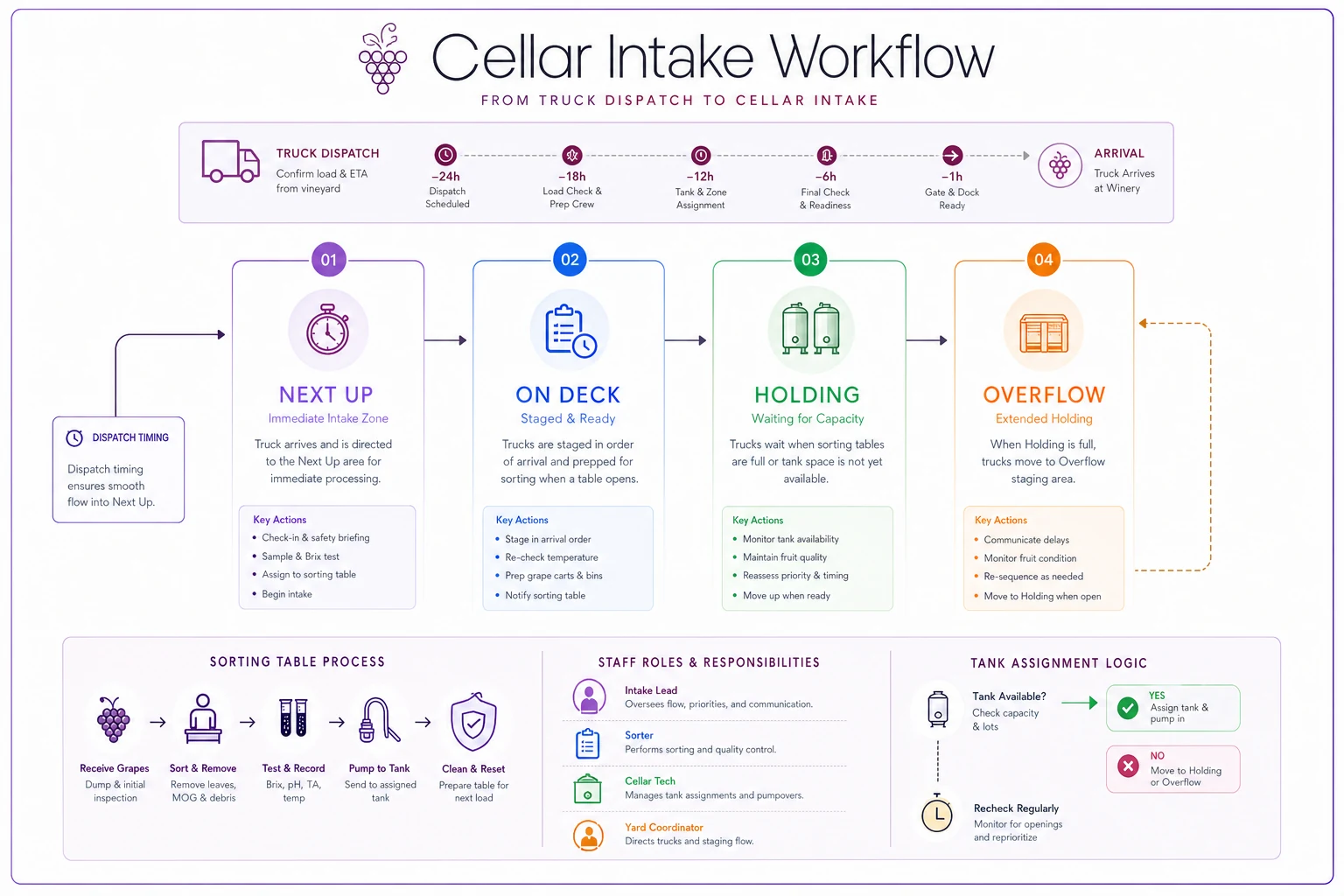
Predetermined decisions prevent arguments during crush chaos. Everyone knows the rules before problems arise. Post this workflow diagram near the receiving dock and use it during briefings.
Technology systems that reduce manual coordination
Paper schedules and radios worked for decades, but modern harvest complexity demands better information flow. The right operational software transforms coordination from constant firefighting to proactive management.
Real-time block status tracking eliminates confusion. Every crew lead updates picking progress hourly via phone or tablet—not detailed reports, just simple status like percent complete, tons picked, any issues. This feeds a central dashboard showing all active blocks, eliminating the "where are we on Block 14?" phone calls.
Automated truck dispatching calculates optimal dispatch times based on current picking rate, drive time to cellar, cellar processing queue, and truck availability. Drivers get notifications for their next pickup with location, tonnage estimate, and departure time. This reduces radio chatter by 70%.
Intake queue management shows the cellar team incoming loads 2+ hours ahead. They know variety, tonnage, quality notes, and target tank before fruit arrives. Prep happens proactively instead of reacting to surprise deliveries.
When blocks ripen faster than expected or equipment breaks, AI-powered scheduling tools recalculate the entire harvest plan in minutes. What normally takes a management meeting becomes an automated optimization that accounts for all constraints simultaneously.
These features eliminate specific coordination failures that cost time and quality. An operational platform designed for wineries connects vineyard, transportation, and cellar data to prevent the information gaps that create bottlenecks. When field crews, drivers, and cellar staff work from the same real-time information, many traditional harvest problems simply disappear.
Contingency rules when everything happens at once
Perfect harvest schedules last about 48 hours into picking season. Then reality hits. Equipment breaks, weather changes, staff no-shows.
Build contingency triggers before problems arise. Weather contingencies include picking all Pinot Noir and thin-skinned varieties immediately when rain is forecast within 24 hours, shifting all picking to night operations during heat spikes above 95°F while increasing cellar cooling capacity, and harvesting sugar-sensitive blocks first when frost warnings appear.
Equipment failures require different responses. When the destemmer goes down, redirect all reds to whole-cluster fermentation tanks. Press failure means moving whites to cold storage while extending red maceration. No cooling available? Process only night-picked fruit and hold day picks until systems recover.
Labor shortages demand prioritization adjustments. With 20% crew shortage, focus on machine-harvestable blocks. At 40% shortage, pick only top-tier blocks and accept longer hang time on others. Cellar team shortage means reducing sorting and increasing whole-cluster percentage to maintain processing speed.
Quality issues need immediate protocol changes. Widespread rot requires doubling sorting table staff and reducing picking pace for thoroughness. Uneven ripeness calls for split picks with multiple passes through the same block. Smoke exposure demands separate tanks and minimal handling to avoid extracting smoky compounds.
Write these rules when you're calm, not during crisis. Post them where decisions happen: picking headquarters, cellar workspace, and management offices.
Learning from logistics failures
Track what actually happens versus planned schedules. Most operations discover patterns they've never formally recognized.
Morning picks consistently run 90 minutes late. Specific blocks always ripen together despite being planted years apart. Certain crews work 30% faster but need more quality oversight. Tank cleaning takes 40% longer than allocated time.
Use three years of variance data to build realistic schedules. If Block 12 has been ready September 15-18 for five harvests, plan for September 13. Early readiness is manageable, surprise rushing is not.
Calculate true costs of bottlenecks: fruit sitting 4 extra hours causes potential 0.3 pH rise, night crew overtime costs $3,200 additional labor, rushed processing creates 15% more MOG (material other than grapes), and tank shortages force blending of lots meant to stay separate.
These numbers justify investment in better planning tools, additional equipment, or expanded cellar capacity. A $25,000 investment in operational software looks different when you're losing $45,000 per harvest to avoidable bottlenecks.
Making it sustainable for your team
Harvest logistics isn't just about fruit movement. Your team's energy and morale directly impact quality and safety.
Sustainable shift patterns include limiting individuals to maximum 14-hour days, requiring 10-hour breaks between shifts, rotating physically demanding positions, and scheduling experienced staff during critical operations.
Confusion causes more problems than equipment failures. Maintain clear communication through a single source of truth for schedules (not multiple spreadsheets), morning briefings with all leads present, designated decision makers for each area, and written handoffs between shifts.
After intense picking days, schedule lighter processing days when possible. Your team needs rhythm, not constant sprinting. Burnout in week two of harvest creates mistakes that last through bottling.
The real cost of poor harvest logistics
Inefficient harvest logistics costs more than overtime pay and stressed staff. Quality suffers in measurable ways.
A 500-case boutique winery lost $45,000 in revenue when bottleneck delays caused their premium Chardonnay to begin fermenting in bins. The resulting wine sold for $22/bottle instead of planned $38.
Larger operations see volume impacts. A 50,000-case winery processing 20% of fruit sub-optimally due to logistics failures might lose 2 points of quality across 10,000 cases. At $3 per bottle impact, that's $360,000 in reduced revenue.
Beyond direct losses, reputation damage from inconsistent quality takes years to rebuild. One badly managed harvest can shift buyer perception permanently.
Moving forward with better systems
Effective harvest logistics for complex multi-site operations requires three elements working together: realistic capacity planning based on actual performance (not theoretical throughput), integrated scheduling that considers all constraints simultaneously, and dynamic adjustment capability when plans inevitably change.
Start by mapping your true operational capacity. Time everything for one full harvest. Build schedules with 20% buffer time. Create clear contingency rules. Train teams on communication protocols.
Consider how operational software designed for wineries can eliminate coordination gaps. When picking crews, transportation, and cellar teams share real-time information through a unified platform, many bottlenecks simply disappear. AI-powered scheduling can recalculate optimal pick sequences as conditions change, preventing the cascade failures that turn manageable issues into quality disasters.
The difference between good and great harvest execution isn't heroic effort during crush. It's systematic planning that prevents firefighting mode altogether. Your fruit quality depends on logistics excellence as much as viticultural skill. Build the operational systems that let your fruit express its full potential, even when fourteen blocks decide to ripen on the same Tuesday morning.
The difference between good and great harvest execution isn't heroic effort during crush. It's systematic planning that prevents firefighting mode altogether. Your fruit quality depends on logistics excellence as much as viticultural skill. Build the operational systems that let your fruit express its full potential, even when fourteen blocks decide to ripen on the same Tuesday morning.
Ready to elevate your winery management?
Join 500+ wineries using Corkyly to increase operational efficiency, boost customer loyalty, and grow sales.