

Most sustainable packaging conversations at wineries die in the same place: someone brings a lighter glass sample to a tasting-room meeting, everyone nods, and then nothing happens because nobody can answer the two questions that actually matter. Does this survive our bottling line at the speed we run it? And what does it cost across a full year, not just per unit?
That gap—between good intentions and a decision the operations team can actually execute—is where most packaging sustainability efforts stall. The problem isn't that winery owners don't care about carbon or cost. It's that packaging sits at the intersection of purchasing, cellar operations, compliance, brand, and distribution, and no single person owns all of it. So the decision keeps getting punted.
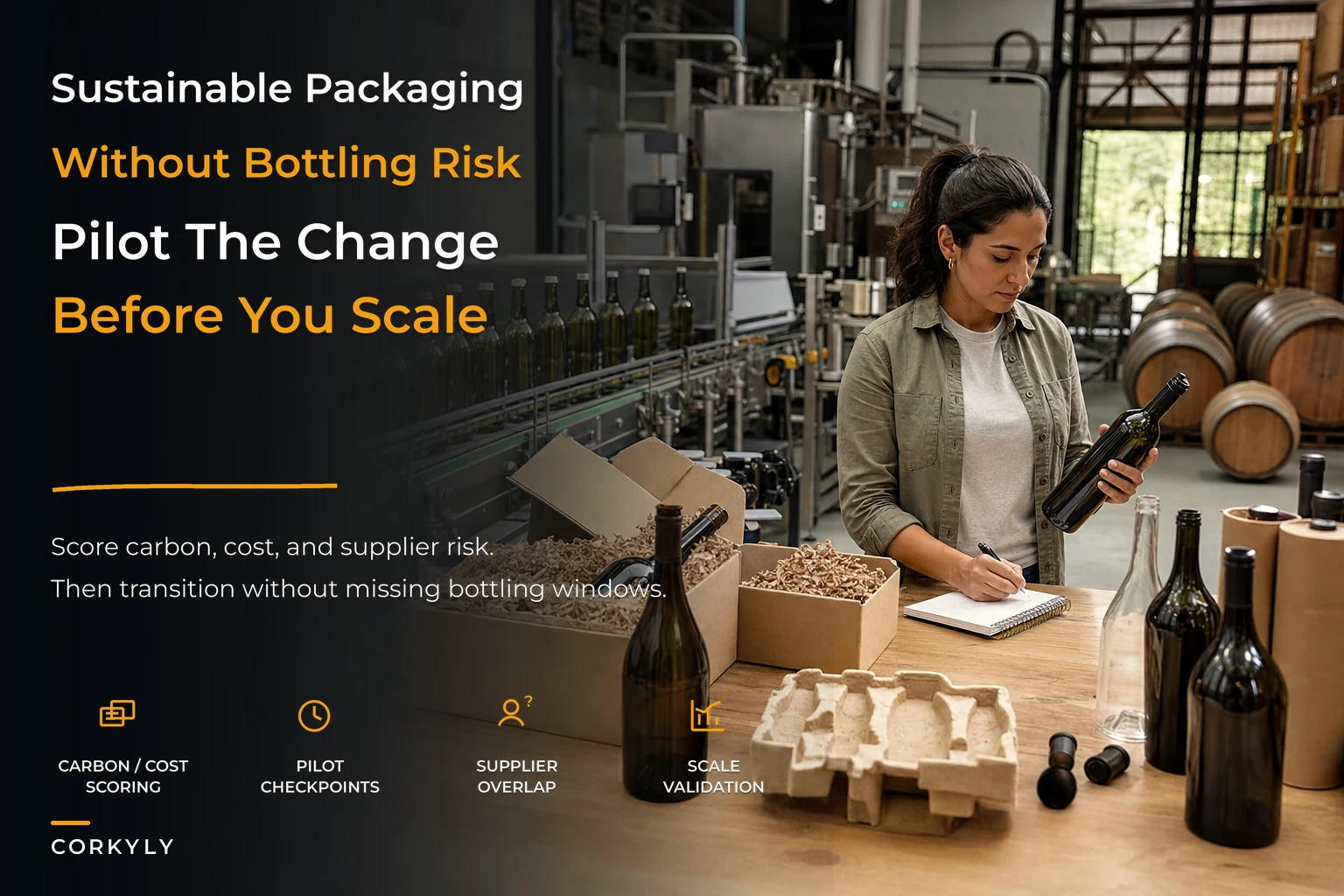
This article treats packaging change as an operational transition, not a moral one. You score options across three dimensions, run a controlled pilot before committing, and phase suppliers in a way that never leaves you short during a bottling window. That last part is non-negotiable. A sustainability win that costs you a bottling run is just a loss.
Why packaging decisions break down at wineries specifically
The core issue is that packaging touches more parts of your operation than almost any other input, but it usually gets treated like a commodity purchase.
Think about what a single glass SKU actually connects to. Bottle weight affects your carbon footprint and your shipping cost. Bottle dimensions affect whether your existing labeler and filler can handle it without a changeover. Closure type affects line speed and your aging profile. The carton affects palletization, which flows into freight economics and your distributor's warehouse fees. Change one thing and you've quietly touched five downstream systems.
What tends to happen at small and mid-sized wineries is that these connections stay invisible until something breaks. A winery switches to a lighter bottle to cut carbon, the new bottle has a slightly different neck finish, and suddenly the corker is misfiring at line speed. Now you're running at 60% of normal throughput during your tightest bottling window, and the "sustainability project" is costing you overtime and cork rejects.
There's also a structural reason this keeps breaking down: the person who wants the change—often the owner or a marketing lead—is rarely the person who feels the pain when a transition goes sideways. That's the cellar and bottling crew. When incentives and pain live in different people, decisions get made without the operational reality check they need.
The lifecycle scoring model: carbon, cost, and supplier risk
Before you pilot anything, you need a way to compare options that doesn't collapse into "this one feels greener." Scoring forces the tradeoffs into the open so you're comparing whole pictures, not single attributes.
Streamline your winery operations effortlessly.
Corkyly helps you track, manage, and optimize every step from vine to bottle.
- Vineyard & production tracking
- Customer relationship management
- Inventory & sales analytics
No credit card required
Score every candidate packaging option across three axes. A 1 to 5 scale on each is enough to rank options and expose the ugly tradeoffs.
Carbon is not just bottle weight, though weight dominates. A rough breakdown for still wine packaging:
-
Glass manufacturing (the heaviest single factor for most wineries)
-
Transport weight (empties in, full cases out)
-
Recycled content percentage of the glass
-
End-of-life recyclability in your actual distribution markets
Cost has to be annualized and total, not per-unit. The per-bottle price is what everyone quotes and what misleads everyone. Real cost includes:
-
Landed unit cost (bottle + closure + label + carton)
-
Line efficiency impact (does it slow bottling or increase rejects?)
-
Freight per case (lighter, better-nesting packaging can swing this meaningfully)
-
Distributor and warehouse handling implications
Supplier risk is the axis wineries chronically underweight, and it's the one that ruins bottling windows. Score it on:
-
Lead time and lead-time variability
-
Number of qualified backup sources
-
Minimum order quantities relative to your annual volume
-
Financial and geographic stability of the supplier
Here's a simplified version of what a scored comparison looks like in practice:
| Option | Carbon (1–5) | Annualized cost (1–5) | Supplier risk (1–5) | Notes |
|---|---|---|---|---|
| Current standard bottle | 2 | 4 | 4 | Baseline; two qualified suppliers |
| Lightweight glass (~420g) | 4 | 4 | 2 | Single source, long lead time |
| Recycled-content glass | 4 | 3 | 3 | Higher unit cost, decent supply |
| Bag-in-box (tier volume only) | 5 | 5 | 3 | Not viable for premium SKUs |
Higher is better on every axis. What the table exposes immediately is the lightweight glass problem: great on carbon, fine on cost, but a supplier risk score of 2 because there's one source with a long lead time. That's the option that looks best in a slideshow and gets you burned in September.
The insight most wineries miss: your highest-carbon-improvement option is very often your highest supply-risk option, because greener materials tend to come from fewer, newer, or more specialized suppliers. Scoring makes that tension impossible to ignore.
The pilot-to-scale decision tree
You don't roll a new packaging spec straight into your main bottling run. The pilot exists to catch the things scoring can't predict—how the material actually behaves on your specific line, at your specific speed, with your crew.
Here's the decision logic, in order:
-
Does it pass the scoring floor? Set a minimum acceptable score on each axis—nothing below a 2 on supplier risk regardless of how green it is, for example. If it fails on any axis, it's out. No pilot.
-
Can you source a pilot quantity without committing to a full contract? If the supplier's minimum order is your entire annual volume, that's not a pilot—that's a bet. Push for a trial allocation or walk.
-
Run the pilot on a small, low-stakes lot. Pick a SKU where a delay or a reject batch won't hurt you—not your flagship, not a large distributor commitment. Run it at real line speed, not a careful slow demo.
-
Measure against defined pass/fail gates (covered in the KPI section below). Line speed, reject rate, seal integrity, label adhesion.
-
If it passes, does it pass at scale volume? A material that behaves fine on a 500-case pilot can behave differently across a 5,000-case run as the line heats up and the crew fatigues. Run a second, larger validation before full commitment.
-
Only then, phase the supplier transition.
The mistake people make is treating a successful vendor demo as a passed pilot. A demo on the supplier's equipment tells you nothing about your corker, your labeler, or your ambient cellar humidity. The pilot has to happen on your floor.
There's a related trap worth naming: piloting during your busiest bottling window because "that's when you're bottling anyway." Don't. A pilot during peak season means zero slack to recover if something fails. Pilot during a shoulder period even if it means a dedicated small run.
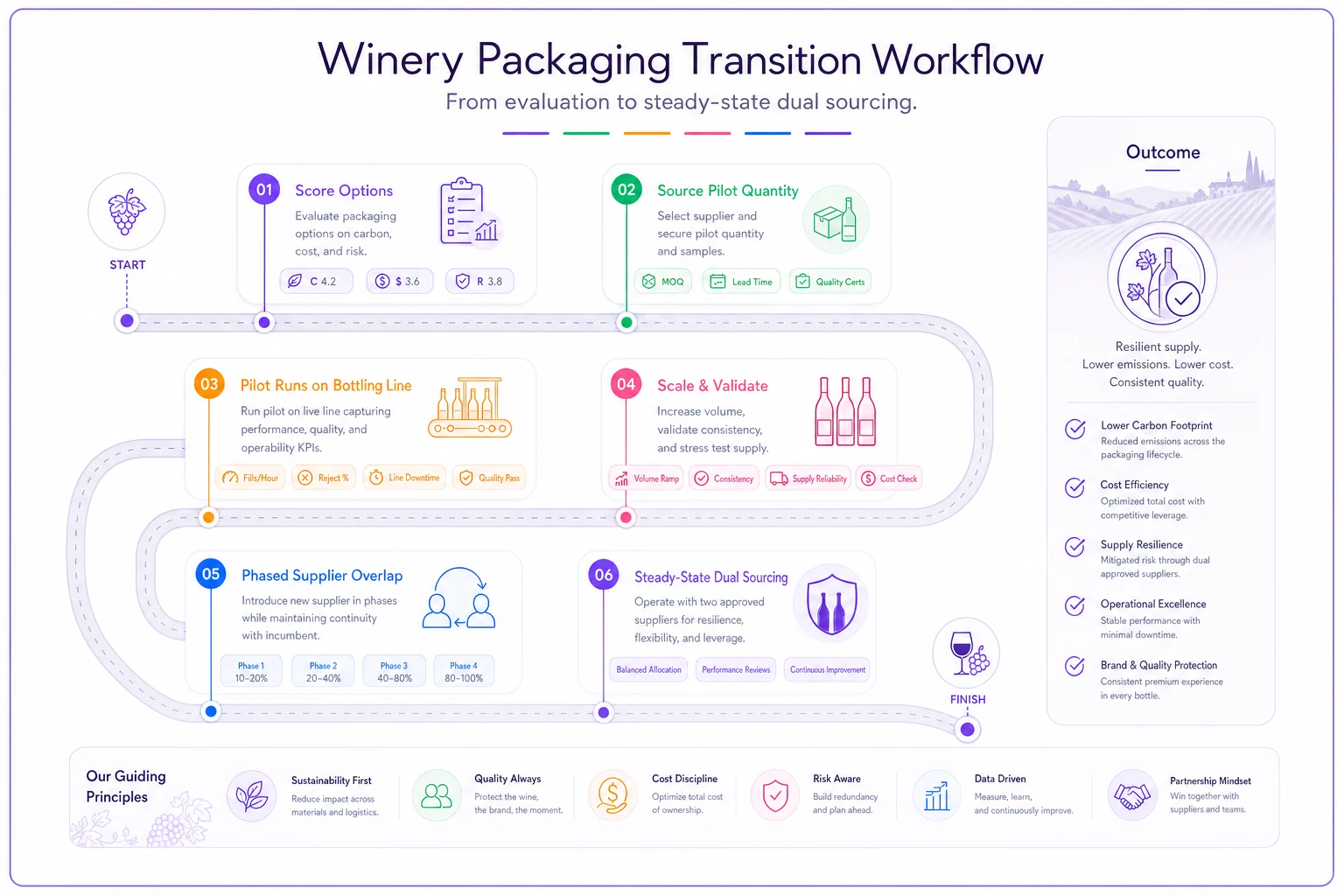
A simple flow like this makes decisions tangible for ops and purchasing.
Phasing the supplier transition so bottling windows survive
This is the part that separates a clean transition from a disaster. The goal is simple: never be in a position where your only packaging source is an unproven new supplier during a window you can't move.
The safe approach is overlap, not replacement. You keep your existing supplier active while you scale the new one in, and you only fully retire the old source once the new one has delivered on-spec, on-time, across at least two real bottling cycles.
-
Phase 1 — Parallel qualification (1–2 bottling cycles). New supplier provides pilot and validation quantities. Old supplier still covers 100% of production commitments. You're paying a small premium for redundancy. That premium is insurance, not waste.
-
Phase 2 — Split allocation. Once the new supplier passes validation, move a portion—somewhere around 25–40%—of volume to them on lower-risk SKUs first. Keep the incumbent on critical and high-volume SKUs. If the new supplier stumbles on lead time or spec, you've limited the blast radius.
-
Phase 3 — Majority transition with a live backup. Shift the bulk of volume once you've seen two clean cycles. Critically, do not dequalify your old supplier. Keep them as a qualified backup with a standing agreement, even a small periodic order to keep the relationship warm.
-
Phase 4 — Steady state with dual sourcing. Wherever possible, land at two qualified sources rather than one. Single-sourcing is the root cause of most packaging-driven bottling delays, and it's exactly the risk that sustainability transitions tend to create when the green option only has one supplier.
This overlap discipline reflects the same logic behind broader supply-chain resilience planning. If you haven't built a redundancy map for your packaging inputs yet, the thinking in our supply-chain resilience blueprint for wineries applies directly here—a sustainable-packaging transition is precisely the kind of change that quietly introduces single points of failure if you're not deliberate about it.
Keep the incumbent supplier active with a small standing order to preserve them as a qualified backup.
If you can land two qualified sources for a new spec, you eliminate most of the bottling-window risk that turns sustainability wins into operational headaches.
The KPI set that protects your bottling window
You can't manage a transition on gut feel. You need a small set of numbers that tell you whether the new packaging is actually working on your line, with clear thresholds that trigger action.
Keep it tight. More metrics don't help—they just make it easier to ignore the ones that matter.
-
Line throughput vs. baseline — bottles per hour on the new spec compared to your current spec. A drop of more than roughly 5–8% needs investigation before you scale.
-
Reject/breakage rate — closures that misfire, bottles that crack under the filler or corker. Even a small uptick multiplies fast across a full run.
-
Seal/closure integrity — random sample testing for oxygen ingress or leaks. Non-negotiable pass/fail.
-
Label adhesion and placement — new bottle geometry frequently trips up labelers. Track misapplied labels per thousand.
-
Supplier on-time-in-full (OTIF) — did the packaging arrive complete and on the promised date? Track this from day one of the pilot, because lead-time reliability is your biggest window risk.
-
Landed cost per case, actual — the real number after freight and rejects, checked against your scoring assumption. Assumptions drift; verify them.
One pattern worth watching: throughput and reject rate tend to move together, and both tend to degrade later in a long run rather than at the start. A pilot that only measures the first hour will miss the fatigue-and-heat problems that show up in hour four. Build that into how you sample.
The mechanics of protecting throughput during any packaging change—minimizing changeovers, sequencing runs to avoid disruption—overlap heavily with good bottling discipline generally. If changeover losses are a recurring problem, the batching approach we've laid out for bottling runs pairs naturally with a packaging transition, since introducing a new spec is essentially a planned changeover you get to control.
When this makes sense, and when it doesn't
Not every winery should be chasing packaging changes right now, and pretending otherwise leads to expensive, half-finished transitions.
When it makes sense:
-
You have predictable annual volume and can commit to meaningful order quantities, which gives you leverage with suppliers.
-
Freight is a large share of your packaging cost, so lightweighting pays back in real dollars, not just on a carbon spreadsheet.
-
You have shoulder periods in your calendar where you can pilot without risking a critical window.
-
Your distributors or export markets are starting to ask about packaging sustainability—meaning there's a commercial return, not just a goodwill one.
When it's a bad idea:
-
You're already running your bottling line at capacity during your only window. There's no slack to absorb a pilot problem, and that's a genuinely dangerous position to be in.
-
Your volume is too low to hit reasonable minimum orders on the greener option, forcing you into single-sourcing with no backup.
-
Your flagship brand's identity is tightly tied to a specific heavy bottle, and the market you sell into reads lightweight glass as "cheap." Carbon math doesn't help if it tanks perceived value.
Who should probably wait: very small producers without a second qualified supplier available for the greener spec. If a transition would leave you with exactly one source for a critical input, the supply risk almost always outweighs the carbon benefit until the market matures and more suppliers exist.
If you're facing any of the 'bad idea' conditions, the prudent move is to wait until you can pilot without risking a critical window or until supplier options mature.
A realistic transition scenario
Consider a mid-sized estate producing around 12,000 cases a year—mostly one flagship red and a couple of tier SKUs. Freight was eating into margin because their standard bottle ran heavy, close to 550g, and they were shipping cross-country to distributors.
They scored three alternatives. The lightweight option (~430g) scored well on carbon and freight but had a single qualified supplier with an eight-week-plus lead time—a supplier risk score they weren't comfortable with for the flagship. So they made a deliberate split decision: move the two tier SKUs to the lightweight bottle first, keep the flagship on the incumbent bottle while a second lightweight source got qualified.
The pilot on a tier SKU caught a real problem—the labeler needed adjustment for the narrower bottle, throwing misapplied labels at roughly double the normal rate. Because it was a pilot on a low-stakes lot, they fixed the labeler setup before it ever touched production volume. Throughput on the corrected run came within a few percent of baseline.
Over the following year, moving the tier SKUs to lighter glass trimmed freight noticeably—a few thousand dollars across those SKUs once you netted out the slightly higher unit cost—and cut a meaningful chunk of packaging carbon on that volume. The flagship stayed put until a second supplier was qualified. No bottling window was ever put at risk, because the incumbent supplier stayed live the entire time. The win came from sequencing, not from switching everything at once.
Bringing it together
Sustainable packaging isn't a materials decision—it's an operations decision that happens to involve materials. The wineries that get it right aren't the ones with the best intentions. They're the ones who scored their options honestly, piloted on their own floor before committing, and phased suppliers so they always had a fallback during a window they couldn't move.
The failure mode is almost always the same: chasing the greenest option straight into single-sourcing, skipping a real pilot, and discovering the problem during peak bottling. The framework above exists specifically to prevent that sequence.
If you're building out broader sustainability work alongside this, packaging fits neatly next to the resource-efficiency thinking in the 90-day water and energy audit playbook—together they give you a defensible, operationally grounded story rather than a scattered set of good intentions.
Score it, pilot it, phase it. In that order, and never at the expense of a bottling window.
Ready to elevate your winery management?
Join 500+ wineries using Corkyly to increase operational efficiency, boost customer loyalty, and grow sales.