
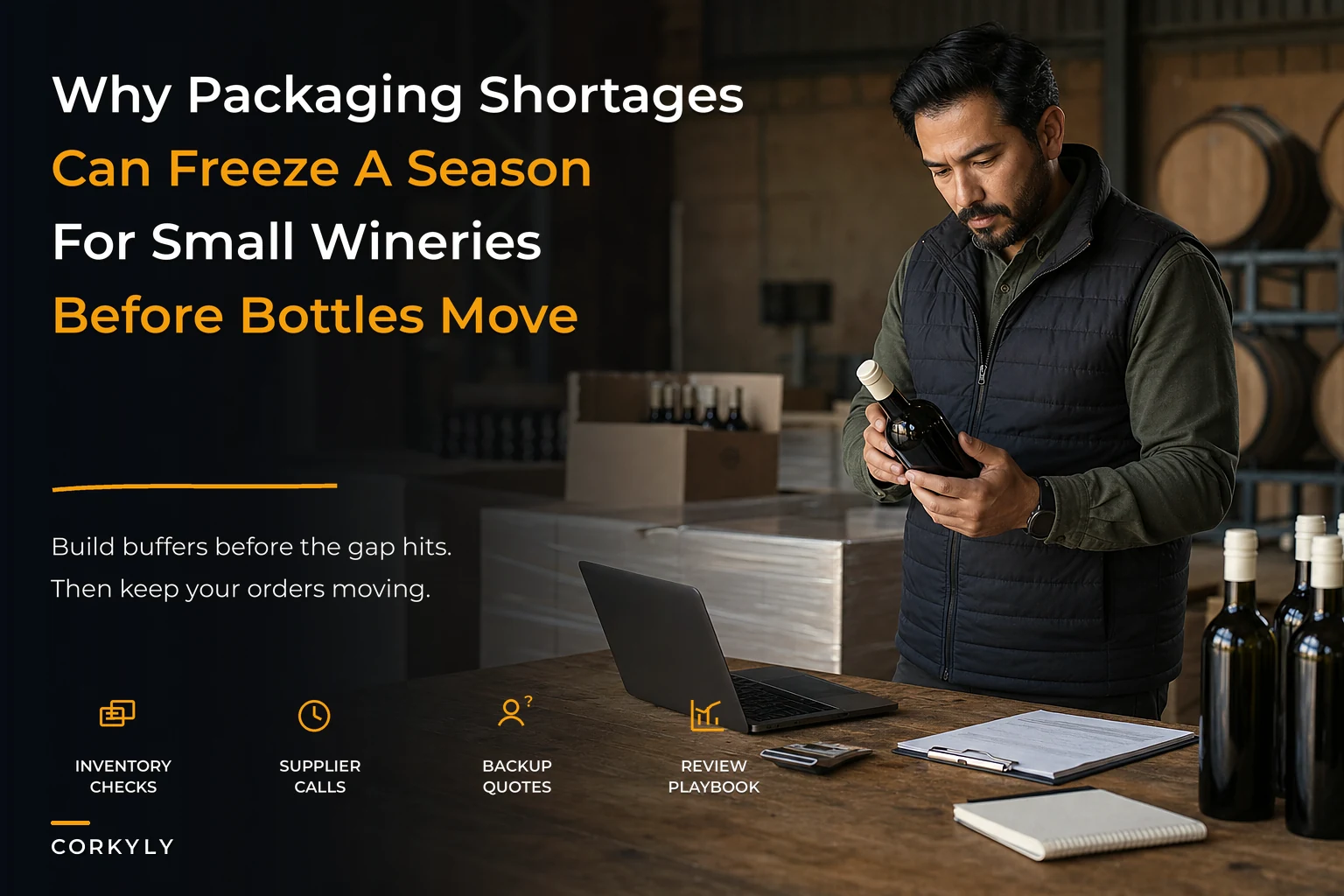

Three years ago, a Sonoma winery found out their cork supplier had declared bankruptcy—twelve days before bottling their entire 2019 vintage. The owner spent days calling seventeen different suppliers, eventually driving to Oregon himself to pick up mismatched corks at triple the original price. They bottled on schedule, but the emergency procurement wiped out their entire quarterly profit margin.
That scenario plays out somewhere every harvest season. Not always corks—sometimes it's capsules, bottles, labels, or cartons. The specifics change, but the operational breakdown is the same: wineries treat packaging materials like they're always available, then panic when they're not.
After watching dozens of wineries navigate supply disruptions, the pattern becomes pretty obvious. The ones that survive shortages without hemorrhaging cash all follow similar procurement disciplines. They tier their inputs by business impact, maintain calculated buffer inventories, and run monthly reviews that catch problems before they become emergencies.
Why wineries keep getting caught by packaging shortages
Most small wineries order packaging materials the same way they've always done it—when they're getting ready to bottle. Call the usual supplier six weeks out, place the order, assume it arrives.
This worked fine when you had three local glass suppliers and cork came from one distributor who kept massive inventories. The supply landscape has shifted, though. Glass production consolidated into fewer plants. Natural cork faces increasing competition from synthetic alternatives, fragmenting the market. Label printers juggle smaller runs with longer lead times.
The real issue isn't that materials become unavailable—it's that wineries don't know they're unavailable until it's too late to adjust. A 2,500-case winery typically discovers shortages around week four of their six-week bottling prep. That leaves two weeks to find alternatives, negotiate pricing, arrange logistics, and potentially adjust the entire bottling schedule.
What makes this worse is how packaging shortages cascade through operations. Can't get your preferred bottles? Now you need different labels. Different labels mean reconfiguring the bottling line. Reconfiguring the line means scheduling overtime labor. Suddenly a simple glass shortage becomes a $15,000 problem touching every department.
Risk-tiering your packaging inputs (and why most wineries get this backwards)
The standard approach treats all packaging materials equally—order everything at once, hope it all arrives. But packaging components carry very different risk profiles, and understanding those differences changes how you manage procurement entirely.
Streamline your winery operations effortlessly.
Corkyly helps you track, manage, and optimize every step from vine to bottle.
- Vineyard & production tracking
- Customer relationship management
- Inventory & sales analytics
No credit card required
Start by mapping every packaging input against two factors: lead time and substitutability. This creates four distinct risk tiers that drive different procurement strategies.
Tier 1: High lead time, low substitutability These are your operation-stoppers. Custom bottles, embossed glass, proprietary closures. A boutique winery making 3,000 cases of reserve Cab in custom Bordelaise bottles faces a sixteen-week lead time with essentially zero alternatives. Missing this delivery means either delaying bottling entirely or completely redesigning the package.
Tier 2: High lead time, high substitutability Standard bottles, synthetic corks, basic capsules. You can swap suppliers, but everyone needs eight to twelve weeks. Multiple suppliers exist, but all require significant lead time.
Tier 3: Low lead time, low substitutability Printed labels, custom cartons. Quick to produce but specific to your brand. You can rush these in two weeks if needed, but only from approved printers who have your files and specifications.
Tier 4: Low lead time, high substitutability Generic capsules, standard corrugate, basic closures. Available from multiple suppliers with one to two week delivery. These rarely cause operational problems unless procurement is completely unmanaged.
Here's what this looks like mapped out for a typical small winery:
| Component | Lead Time | Substitutability | Risk Tier | Buffer Strategy |
|---|---|---|---|---|
| Custom estate bottles | 16 weeks | None | Tier 1 | 3-month minimum |
| Standard Burgundy bottles | 10 weeks | Multiple suppliers | Tier 2 | 6-week minimum |
| Printed labels | 2 weeks | Single printer | Tier 3 | 2-run buffer |
| Natural corks | 8 weeks | Limited options | Tier 2 | 8-week minimum |
| Capsules (standard) | 1 week | Many suppliers | Tier 4 | 2-week float |
| Shipping boxes | 2 weeks | Several vendors | Tier 4 | 1-month float |
Once you tier your inputs, procurement strategy becomes straightforward. Tier 1 items get ordered six months out with mandatory confirmations every thirty days. Tier 2 follows a quarterly ordering cycle with backup suppliers pre-qualified. Tiers 3 and 4 run on standard reorder points.
Buffer inventory rules that actually match winery operations
Generic inventory formulas don't work for wineries. The standard "economic order quantity" assumes steady demand and predictable lead times—neither of which exists when you're bottling different varietals on different schedules with seasonal production spikes.
Buffer sizes need to reflect operational reality. After looking at procurement patterns across wineries ranging from 1,500 to 15,000 cases annually, some clear patterns emerge around sustainable buffer levels.
For glass inventory, the working formula is: (Peak monthly bottling volume × 1.5) + one full bottling run. A winery bottling 800 cases monthly during peak season maintains roughly 1,200 bottles plus their largest single run (usually around 400 bottles). This handles normal variation plus one supplier delay without stopping production.
Closure buffers follow different logic. Natural cork degrades, so massive buffers create quality issues. The sweet spot is eight weeks of average usage plus one emergency run. That emergency stock sits separately, rotated annually, specifically for supply disruptions.
The sweet spot is eight weeks of average usage plus one emergency run.
Label inventory operates on run minimums, not time buffers. Most wineries maintain two full label runs in inventory—one for immediate use, one as buffer. Since label printing has shortened to two-week lead times at most commercial printers, this provides adequate coverage without massive carrying costs.
The thinking around bottling run batching applies here too—your buffer strategy has to account for minimum run sizes, not just time-based coverage.
For smaller operations under 2,000 cases annually, these buffers might seem excessive. But the math shifts when you factor in supplier minimums. Cork suppliers often require 1,000-piece minimums. Glass comes by the pallet. At small volumes, you're essentially forced into maintaining buffers by default anyway.
Vendor contract clauses that prevent the worst surprises
Standard winery purchase orders contain nothing about supply guarantees, allocation priorities, or force majeure definitions. Then when disruptions hit, wineries discover they have zero recourse and no guaranteed allocation.
Three specific clauses change this dynamic. They won't prevent all problems, but they establish clear expectations and remedies when supplies get tight.
Allocation commitment language: "Supplier agrees to maintain allocation priority for Buyer equivalent to the average of the previous twelve months' purchases, provided Buyer maintains minimum quarterly order volumes of [amount]. In shortage situations, Buyer's allocation percentage cannot fall below 80% of trailing twelve-month average."
This prevents suppliers from cutting you off entirely when supplies tighten. A winery purchasing 10,000 bottles monthly gets guaranteed access to at least 8,000 even during shortages—and more importantly, it establishes your position in the allocation queue before problems arise.
Substitution pre-approval rights: "Supplier may fulfill orders with substitute products meeting attached Specifications (Appendix A) upon 48-hour notice. Substitutions within specification incur no price adjustment. Substitutions outside specification require Buyer approval and trigger price remedies outlined in Section X."
This accelerates emergency procurement by pre-defining acceptable alternatives. Instead of negotiating during a crisis, you've already agreed that 49mm corks can substitute for 44mm, or that Stelvin closures can replace cork for certain SKUs.
Supply interruption remedies: "Failure to fulfill confirmed orders triggers: (a) immediate right to source from alternative suppliers with Supplier covering differential costs up to 25% premium, (b) waiver of minimum order quantities for six months, (c) priority allocation on next available inventory."
These remedies create real incentives for suppliers to maintain inventory and communicate problems early. The 25% differential coverage makes defaulting economically painful for suppliers, while the MOQ waiver provides flexibility during recovery.
The monthly procurement review
What typically happens: wineries check packaging inventory when they're planning bottling runs, discover problems, then scramble. The operations that avoid this pattern run systematic monthly reviews that catch issues while there's still time to adjust.
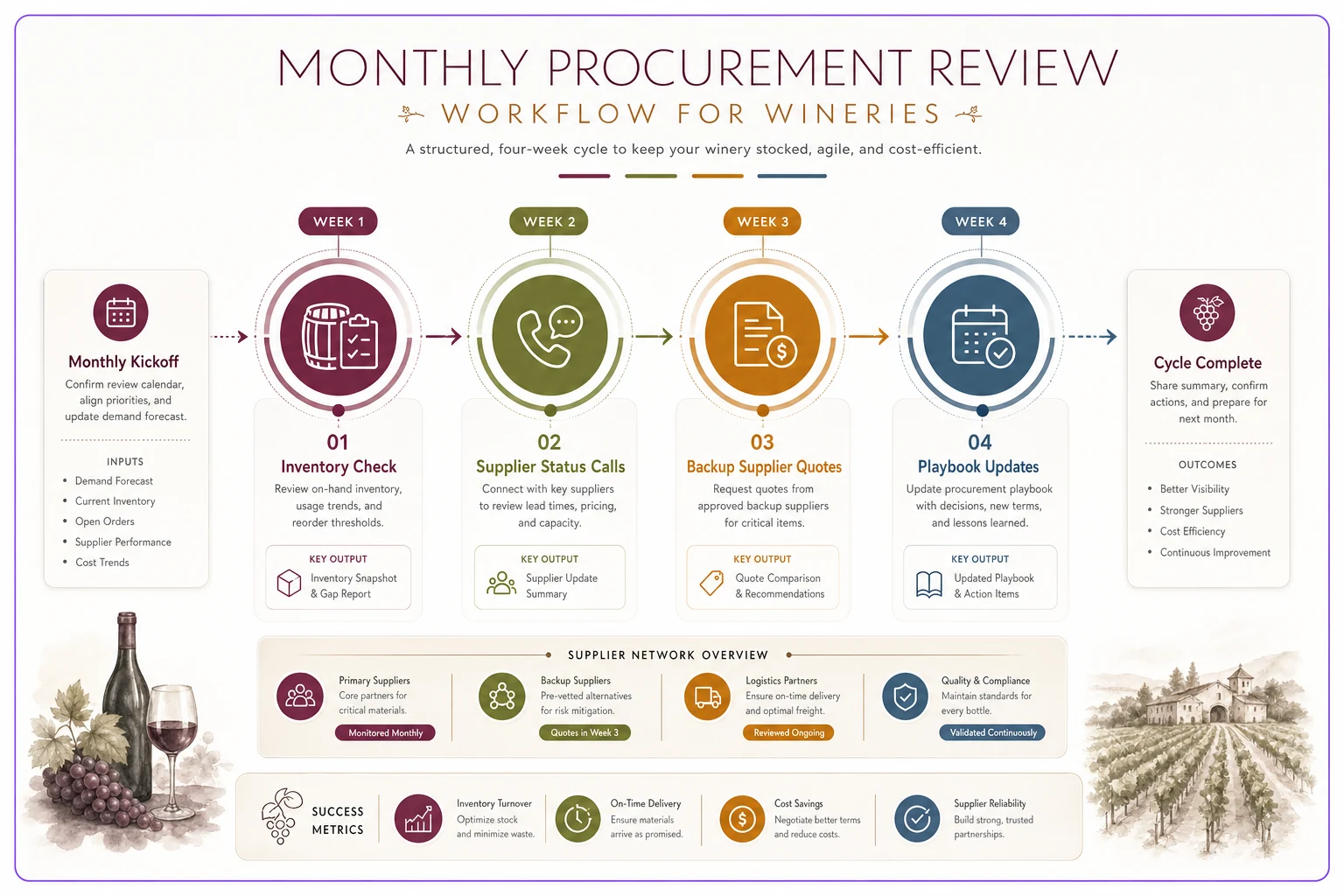
The review takes about ninety minutes monthly and follows a specific sequence:
Week 1 of each month: Pull current inventory levels for all packaging materials. Compare against upcoming bottling schedules for the next 120 days. Flag any items that drop below buffer minimums in that window.
Week 2: Contact all Tier 1 and Tier 2 suppliers for order status updates. Not just your pending orders—ask about their supply situation, raw material availability, production schedules. Suppliers rarely volunteer problems, but they'll usually answer direct questions honestly.
Week 3: Review alternative supplier pricing and availability. Even if you don't need them right now, maintain current quotes from backup suppliers. This intelligence becomes invaluable during actual shortages.
Week 4: Update your procurement playbook based on findings. Adjust reorder points, modify bottling schedules if needed, lock in pricing where it makes sense.
A simple monthly review workflow looks like this:
The key is running this review regardless of current needs. Most wineries only audit suppliers when placing orders. By then, you've lost the flexibility to adjust strategies or secure alternatives at reasonable prices.
A practical example: a Napa winery runs their monthly review and discovers their cork supplier has pushed delivery from six weeks to ten weeks due to shipping delays from Portugal. They're not ordering for another month, but this intelligence lets them pull their order forward and lock in allocation before other wineries discover the delay.
Contingency playbooks for common disruptions
Every season, the same shortage scenarios repeat across the industry. Glass plants have maintenance shutdowns. Cork shipments get delayed at ports. Label printers have equipment failures. Instead of treating each as a unique crisis, documented playbooks turn panic into process.
Glass shortage playbook:
-
Immediately inventory all glass on hand, including different formats
-
Contact secondary suppliers for standard bottles (keep list updated quarterly)
-
Evaluate format flexibility—can 750ml wines go into 375ml or magnums?
-
Check distributor warehouses for remnant inventory
-
Consider lightweight glass alternatives if available
-
As last resort, delay lowest-margin SKUs to preserve flagship bottlings
One Central Coast winery executed this exact sequence when their glass supplier's furnace went down. They found enough bottles across three distributors for about 600 cases, switched two wines to lightweight glass, and only delayed one small-production Rosé. Total additional cost: around $3,200. Without the playbook, they would have delayed the entire bottling schedule.
Cork quality rejection protocol:
-
Isolate affected lots immediately
-
Document defect rate with photos and samples
-
Pull samples from reserve inventory for immediate bottling needs
-
Initiate quality claim with supplier (requires documentation from step 2)
-
Test alternative closures on affected wines
-
For critical bottlings, consider upgrading to premium cork grades
-
Adjust bottle storage conditions if cork moisture is the issue
Label printer failure response:
-
Verify if delay affects all SKUs or specific label types
-
Check if printer can produce temporary simplified labels
-
Contact backup printers with print-ready files
-
Evaluate hand-labeling for small critical runs
-
For export orders, consider destination market labeling
-
Document costs for insurance claims if equipment failure
These playbooks eliminate decision paralysis during disruptions. Instead of gathering stakeholders to debate options, you execute predetermined steps that have been vetted during calm periods.
How AI-powered procurement platforms fit into this
The manual version of supply chain resilience works, but it's exhausting to sustain. Tracking multiple suppliers, monitoring lead times, maintaining playbooks—it's essentially a part-time job that small wineries can't always staff properly.
AI-assisted operational platforms change the economics here. Instead of manually checking supplier statuses monthly, automated systems can flag anomalies as they emerge. The platform tracks historical lead times and automatically adjusts reorder points when delays become patterns rather than one-off events.
More sophisticated implementations go beyond basic monitoring. They analyze patterns across multiple wineries to surface emerging shortages before they hit broadly. If several wineries start reporting cork delays from the same supplier, the system can alert other clients using that supplier to pull orders forward—before the shortage becomes common knowledge and alternatives dry up.
The real value comes from turning data into specific actions. Rather than generating reports about inventory levels, the platform creates specific procurement tasks: "Order 2,400 bottles of CL-382 from Supplier A by March 15 to maintain buffer minimums through May bottling." It tracks supplier performance over time, flags when diversifying sources makes sense, and maintains backup supplier relationships through periodic quote requests.
For the operational KPIs that actually matter, procurement reliability becomes something you can actually measure and manage—rather than a source of recurring anxiety at the worst possible times.
Building resilience without drowning in inventory costs
The balance point between resilience and carrying cost varies by winery size, but a few patterns hold across operations. Wineries that navigate repeated supply disruptions without excess inventory tend to follow three principles that smaller operations often miss.
First, they separate buffer inventory from working inventory in their cost calculations. Buffer stock is insurance, not working capital. A $15,000 glass buffer that prevents one bottling delay pays for itself immediately. The mistake is treating that buffer like trapped cash rather than operational insurance.
Second, they negotiate storage terms with suppliers that shift carrying costs. Several wineries maintain "virtual buffers"—paid inventory that suppliers hold until called forward. You pay upfront but avoid warehouse costs and damage risks. One Paso Robles operation maintains roughly three months of glass this way, calling pallets forward as needed.
Third, they coordinate packaging procurement across multiple varietals and bottling runs. Instead of ordering bottles separately for each wine, they standardize where possible and order in larger quantities. This sounds obvious, but a significant share of small wineries still order packaging per-wine rather than optimizing across their portfolio.
The wineries that struggle with supply chain resilience typically make one fundamental error: they manage packaging like it's always available rather than treating it as a critical operational constraint. Once you shift that perspective, the investments in buffers, systems, and supplier relationships stop feeling optional.
Your winery's resilience ultimately depends on systematic procurement discipline, not lucky timing or good supplier relationships. The playbooks, buffers, and monthly reviews transform supply chain management from reactive scrambling to something that actually runs. And when the next shortage hits—because it will—you'll be the operation still bottling while others scramble for emergency supplies.
Ready to elevate your winery management?
Join 500+ wineries using Corkyly to increase operational efficiency, boost customer loyalty, and grow sales.