
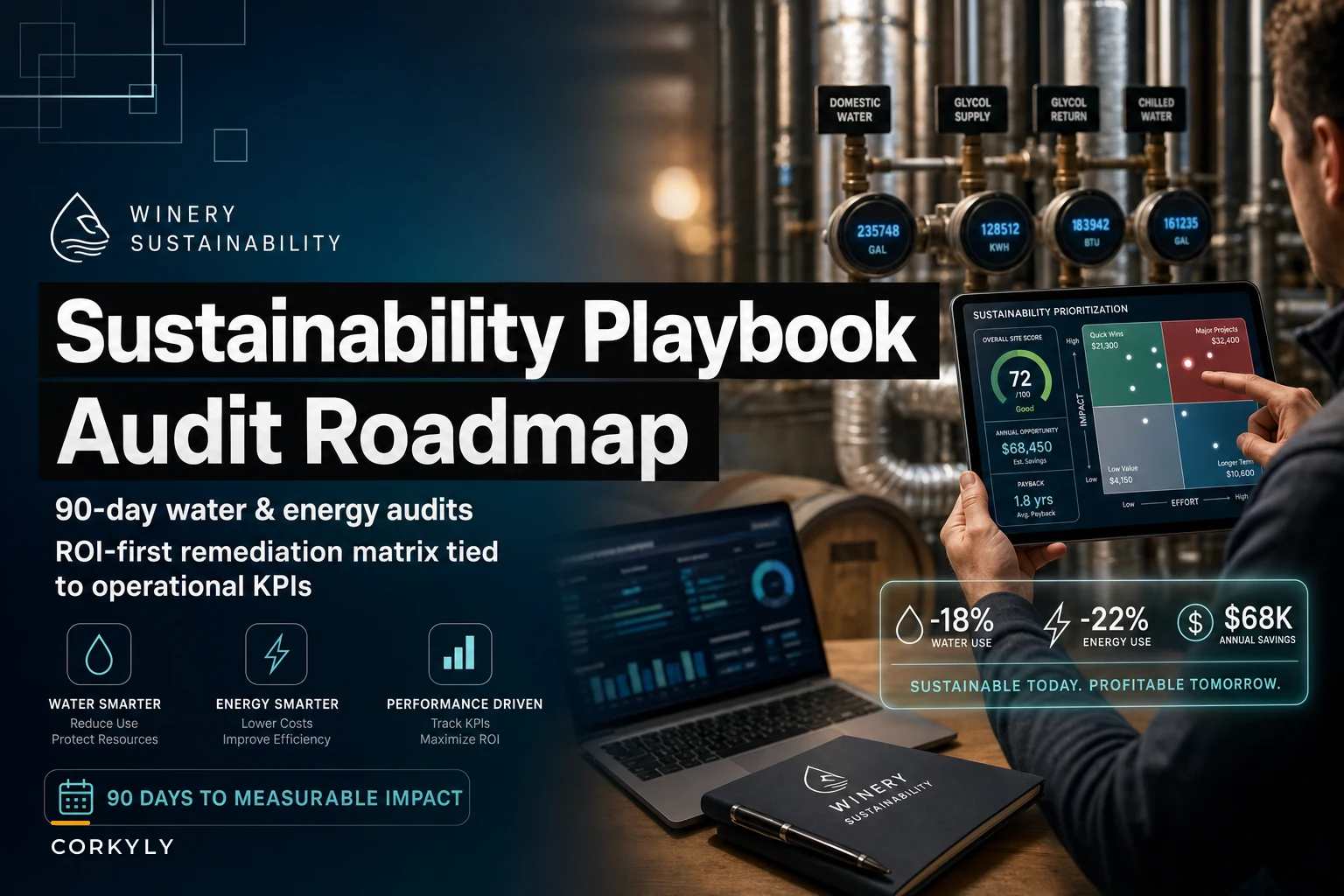

Most sustainability efforts at wineries stall in the same place: someone gets a quote for a solar array or a wastewater treatment upgrade, sees a six-figure number, and quietly shelves the whole idea. The problem isn't the technology. It's that the conversation started at the most expensive intervention instead of the cheapest one, and nobody built a way to compare a $400 fix against a $90,000 one on the same page.
A 90-day audit fixes that. Not a consultant's 60-page report you'll never open again — a lightweight, seasonal pass through your water and energy use that ends with a ranked list you can actually act on. The point isn't to measure everything. It's to find the handful of interventions where the payback is fast, the disruption is low, and the timing lines up with your operational calendar.
Here's how to run one that produces decisions instead of a binder.
Why 90 days, and why lightweight
Ninety days is long enough to catch two or three distinct operational states — the tail of harvest, cellar work, early bottling prep — without dragging the audit across a full year where you lose momentum. A winery's water and energy profile swings wildly by season. Audit only in February and you'll miss the crush-pad water spikes and refrigeration load that dominate fermentation. Audit only during harvest and you'll overweight temporary loads that don't reflect your baseline.
The "lightweight" part matters more than people expect. Exhaustive audits produce paralysis. You end up with 140 line items, no ranking, and no clear first move. A lightweight audit deliberately caps itself — you track a small number of meters and flows, note the obvious waste, and stop measuring once you have enough to prioritize. Precision beyond that point is wasted effort until you've captured the easy wins.
A realistic scope for the 90 days:
-
Electricity
main meter reads plus sub-metering (even temporary clamp meters) on refrigeration, the crush pad, and the tasting room HVAC
-
Water
intake meter, plus rough flow estimates for tank cleaning, barrel washing, and crush-pad sanitation
-
Compressed air
leak survey during a quiet shift (this one's almost always a surprise)
-
Hot water and glycol
note where it's generated and how far it travels
You're not modeling the whole facility. You're finding the leaks — literal and financial.
The three cost tiers you're actually sorting into
Before the matrix, it helps to mentally bucket everything into three tiers, because the decision logic is different for each.
Streamline your winery operations effortlessly.
Corkyly helps you track, manage, and optimize every step from vine to bottle.
- Vineyard & production tracking
- Customer relationship management
- Inventory & sales analytics
No credit card required
Tier one — behavioral and near-zero cost. These are fixes that need attention, not capital. Turning off the crush-pad water when the line's idle. Adjusting glycol setpoints that drifted two degrees colder than the wine actually needs. Fixing the compressed-air leaks you found. Almost nobody budgets for these because they don't feel like "projects," and that's exactly why they persist for years.
Tier two — low capital, fast payback. Nozzle upgrades, timers, insulation on glycol lines, variable-frequency drives on pumps, LED retrofits in the barrel room. These typically pay back inside 6–18 months and rarely disrupt operations if you schedule them right.
Tier three — major capital. Solar, wastewater reclamation, full refrigeration replacement, well work. Real money, long paybacks, heavily dependent on incentives and financing. These belong in a separate multi-year plan, not your 90-day remediation list.
The mistake that keeps showing up: wineries jump straight to tier three because it's the exciting, brochure-worthy stuff, while tier-one waste keeps bleeding money every single day the big project is being "evaluated."
The ROI-first prioritization matrix
Every intervention you find gets scored on four dimensions, then sorted. Keep it on one page.
| Intervention | Est. annual savings | Upfront cost | Payback | Seasonal window | Ops disruption | Priority |
|---|---|---|---|---|---|---|
| Fix compressed-air leaks | $1,800–$2,600 | ~$300 | <3 mo | Any low-activity week | Minimal | Do now |
| Glycol setpoint correction | $2,000–$3,500 | $0 | Immediate | Between ferments | None | Do now |
| Crush-pad nozzle + shutoff valves | $1,200–$2,000 | ~$900 | 6–9 mo | Pre-harvest | Low | Schedule |
| VFD on transfer pumps | $1,500–$2,800 | ~$4,000 | 18–20 mo | Post-bottling | Medium | Schedule |
| Barrel-room LED retrofit | $600–$1,100 | ~$2,500 | ~2.5 yr | Winter | Low | Defer/bundle |
| Refrigeration compressor replacement | $6k–$11k | ~$85,000 | 8–10 yr | Off-season only | High | Capital plan |
The column that changes everything is seasonal window. A fix with great ROI still can't happen if the only install window collides with crush. VFDs on your transfer pumps might be a clear winner on payback, but if the install requires taking pumps offline for two days, that job lives in the post-bottling lull — not October. Tie every intervention to a real calendar slot and half your sequencing decisions make themselves.
Sort primarily by payback, then filter by whether the seasonal window is open in the next 90–120 days. Anything that scores well and fits the calendar goes to the top. Everything else gets a real date, not a vague "later."
Where water waste actually hides
Water at a winery isn't one number — it's a dozen small flows, and the biggest ones rarely get metered separately. Tank and barrel cleaning is almost always the largest single use, and it's also where the most water gets wasted through habit: hoses left running, pre-rinse cycles longer than they need to be, cleaning-in-place programs dialed in years ago and never revisited.
One thing worth checking: crush-pad sanitation water that runs continuously during processing when it only needs to run intermittently. On a busy intake day that's not a rounding error. One mid-sized producer found their crush-pad flow was running 30–40% higher than necessary simply because the default was "leave it on." A shutoff valve and a changed habit cut that back with zero capital spent.
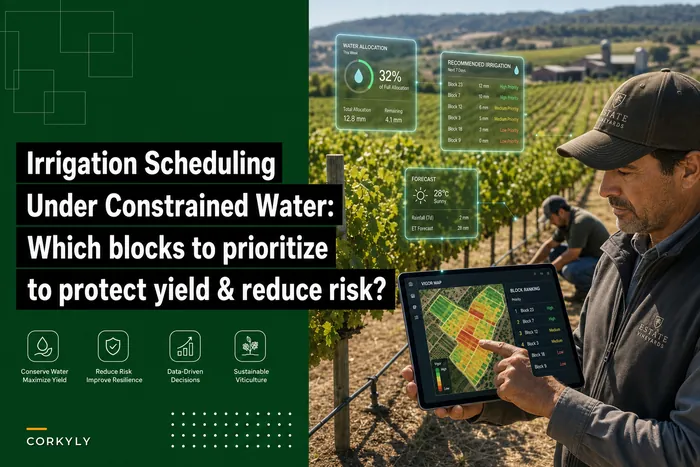
Water strategy also connects directly to the vineyard side. If you're already thinking hard about allocation during dry years — and if you're not, this block-ranking checklist for irrigation under constrained water is worth your time — then cellar water efficiency is the other half of the same conversation. Wineries tend to treat vineyard water and facility water as separate universes when they draw from the same constrained supply.
Energy: the loads nobody sub-meters
Refrigeration is the giant. For most wineries it's the single largest electrical load, and it's where small setpoint and scheduling errors quietly compound. Glycol systems running colder than needed, poorly insulated lines, tanks cooled harder than the fermentation actually requires — all of it inflates the bill without anyone noticing.
Compressed air deserves special attention because the waste is invisible. A leak survey during a quiet shift — walking the lines with a cheap ultrasonic detector — routinely turns up leaks equivalent to running an extra small compressor around the clock. It's one of the highest-ROI items on this entire list and costs almost nothing to fix.
The tasting room tends to get over-focused on because it's visible and comfortable to work on. LED lighting and HVAC scheduling there are worth doing, but they're rarely where the real money is. Don't let the easy, visible fixes crowd out the refrigeration and compressed-air savings that dwarf them.
Running the 90 days: a practical sequence
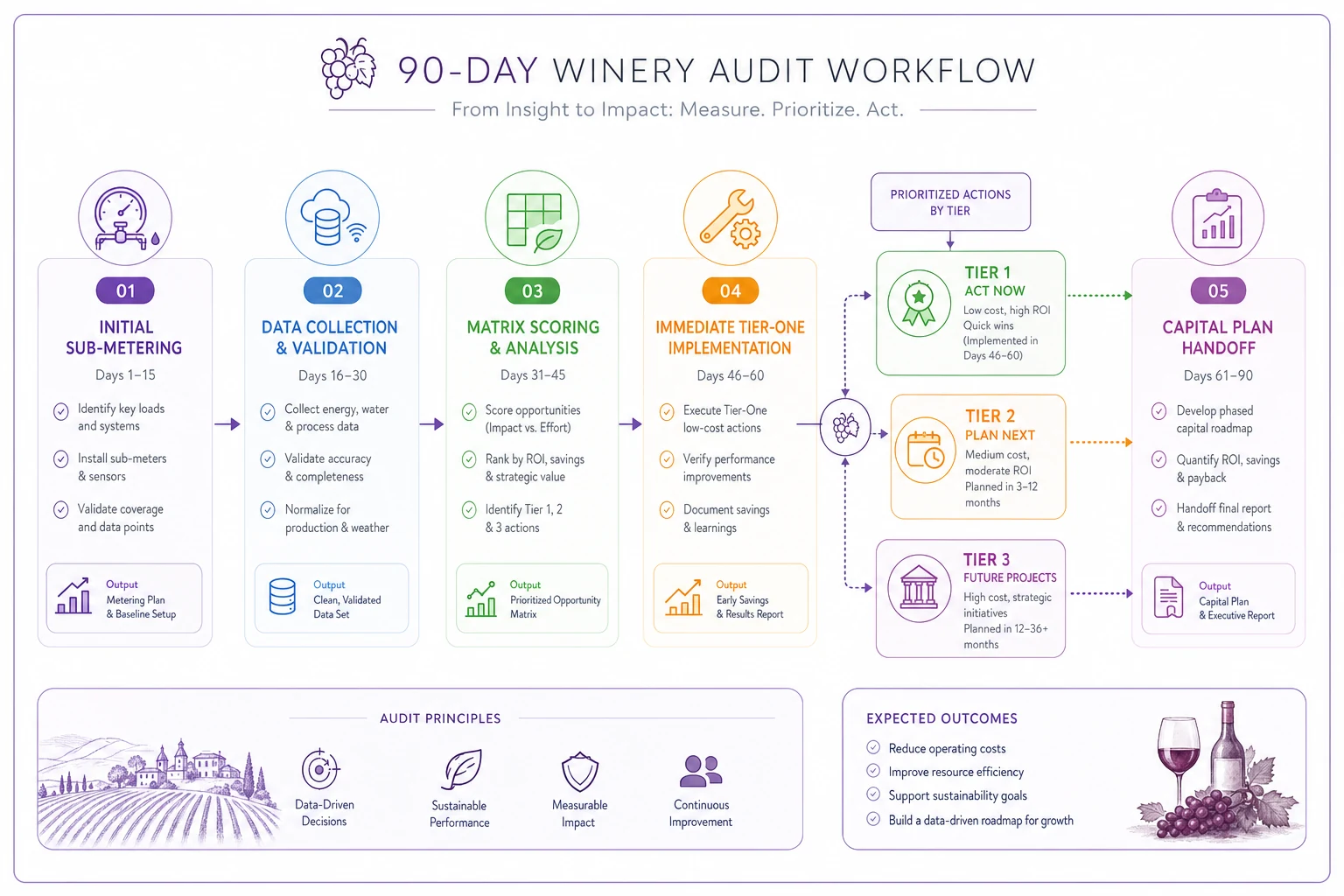
[GRAPH: 90-Day Winery Audit Workflow — from initial sub-metering through data collection, matrix scoring, immediate tier-one fixes, and final capital plan handoff]
A simple visual makes it easier to keep the team moving through the stages.
-
Weeks 1–2 Install temporary sub-metering, pull 12 months of utility bills, and walk the facility during a normal operating day. Note obvious waste as you go.
-
Weeks 3–6 Collect data across at least two operational states. Run the compressed-air leak survey. Time a few tank-cleaning cycles to get real water figures instead of estimates.
-
Weeks 7–8 Build the matrix. Score every intervention on savings, cost, payback, seasonal window, and disruption.
-
Weeks 9–10 Execute the tier-one, zero-cost fixes immediately. There's no reason to wait — they don't need budget approval.
-
Weeks 11–12 Schedule tier-two projects into their seasonal windows and draft the tier-three capital plan with rough incentive research attached.
The discipline is doing the free fixes during the audit, not after. Momentum dies if everything waits for a final report.
A short checklist for the walk-through
If you can't explain a spike,
-
Are any hoses or sanitation lines running while equipment sits idle?
-
What temperature is glycol actually set to versus what the wine needs?
-
When was the last compressed-air leak survey? (If the answer is "never," start there.)
-
Are cleaning-in-place cycles still running their original programmed times?
-
Is refrigeration cooling tanks harder than the fermentation stage requires?
-
Are glycol and hot-water lines insulated along their full run?
-
Does the tasting room HVAC run on a schedule or just stay on?
-
Where does metered water use spike, and can you explain every spike?
that's your next thing to investigate.
A real scenario
A family winery producing around 9,000 cases annually ran this process across a fall-into-winter window. Utility spend was climbing and the owner assumed solar was the only real answer — which quoted north of $90k and stalled the whole conversation.
The 90-day audit told a different story. The compressed-air survey found leaks costing an estimated $2,000+ a year, fixed for a few hundred dollars over one afternoon. Glycol setpoints had drifted colder than any active fermentation needed — a free correction worth a couple thousand more annually. Crush-pad sanitation water was running well above what the process required. Bundled together, the tier-one and cheap tier-two fixes landed somewhere in the $6k–$8k annual savings range for well under $2,000 spent.
Solar didn't disappear from the plan. It moved to a properly researched capital timeline where incentives could be lined up instead of rushed. The difference was that the winery captured the easy money first rather than letting it leak for another two years while the big decision sat unresolved.
When this makes sense — and when it doesn't
This approach fits almost any producer under roughly 50,000 cases who hasn't done a structured audit recently. If your utility bills have crept up and you can't clearly explain why, that's the signal.
Where it's a bad fit: if you've already run a rigorous audit in the last year and executed the tier-one and tier-two items, a repeat 90-day pass won't find much. At that point you're in capital-planning territory, and the decision logic is entirely different — it's about incentives, financing, and multi-year sequencing. Similarly, if you're mid-construction or planning a facility expansion, fold efficiency into the design phase rather than auditing a facility that's about to change anyway.
Keeping the findings usable
The reason most audits don't produce a second round of savings is that the data disappears. Sub-meter readings, leak-survey notes, cleaning-cycle timings — they end up in someone's inbox and never inform next year's decisions. Treating this like any other operational record, with a consistent home and naming convention so you can compare year over year, is what turns a one-time audit into a trend you can actually manage.
There's also a supply-chain angle worth flagging: some tier-two fixes — VFDs, specialized nozzles, insulation kits — have real lead times. The same supply-chain resilience thinking that keeps packaging from stalling your season applies to efficiency hardware. Order parts for scheduled-window projects early, so the install slot doesn't arrive with nothing to install.
The takeaway
Sustainability at a winery isn't decided by the size of your solar array. It's decided by whether you found the compressed-air leak, corrected the glycol setpoint, and shut off the crush-pad water — the boring, cheap, fast-payback fixes that a 90-day audit surfaces and an ROI-first matrix forces you to rank honestly.
Do those first, tie every project to a real seasonal window, and let the expensive capital decisions wait until you've earned the savings to help fund them.
Do those first, tie every project to a real seasonal window, and let the expensive capital decisions wait until you've earned the savings to help fund them.
Ready to elevate your winery management?
Join 500+ wineries using Corkyly to increase operational efficiency, boost customer loyalty, and grow sales.