
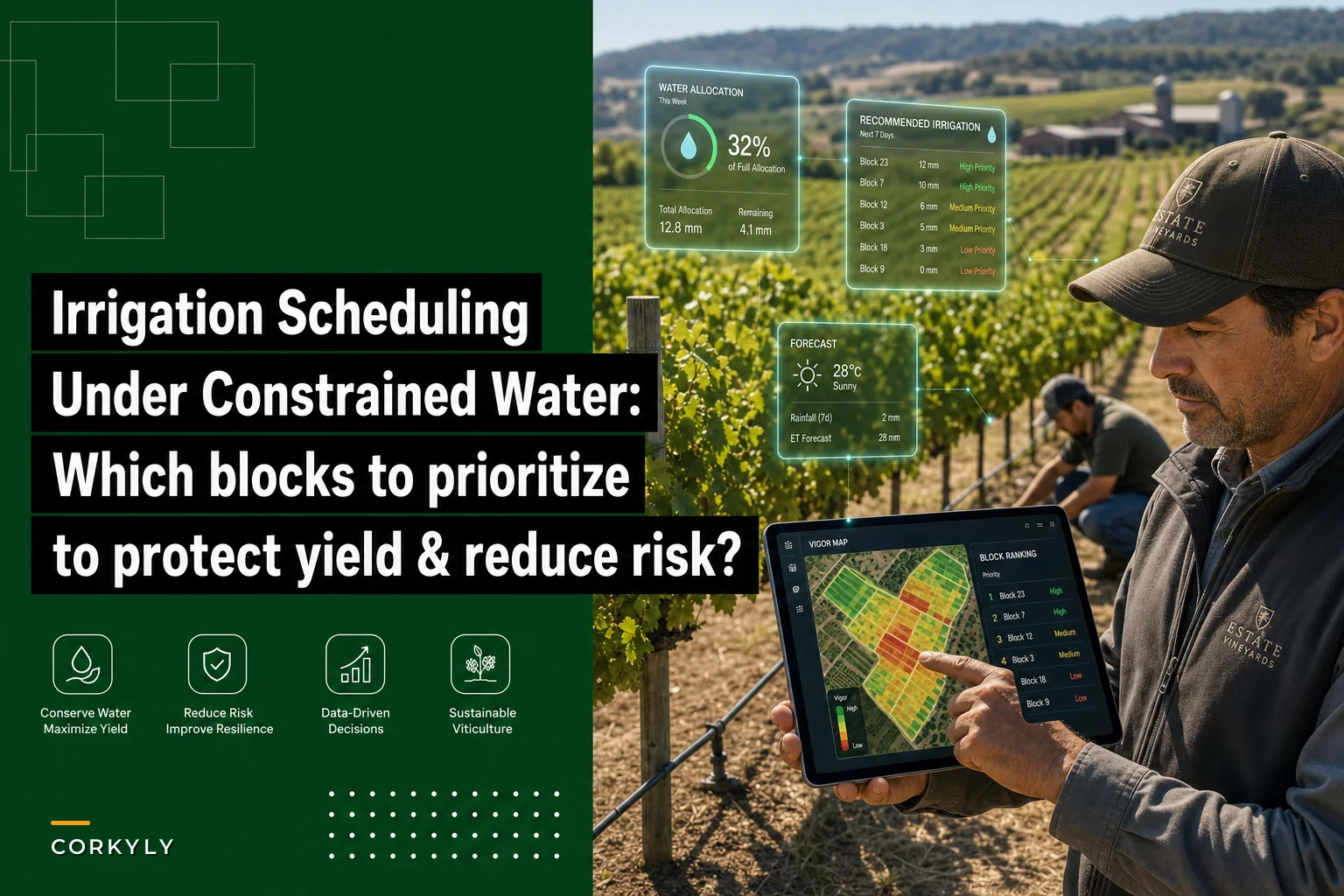

Water constraints hit different blocks differently. Most vineyard managers miss this during allocation planning. They spread limited water evenly across blocks, thinking fairness equals good management. But a 12-year-old Cabernet block on deep clay soils doesn't need the same protection as young Pinot Noir vines on shallow sand during veraison.
Poor water prioritization compounds over seasons. Blocks that could survive with minimal irrigation get overwatered while critical blocks that determine vintage quality slowly decline. By harvest, you're looking at uneven ripening, reduced yields in premium blocks, and contracts you can't fulfill because you protected the wrong vines at the wrong times.
Building your block vulnerability matrix
Start with vigor maps if you have them. Low vigor zones need water first during heat events — these vines have less canopy protection and smaller root systems. But moderate vigor zones often show stress symptoms last while suffering the most long-term damage. They maintain appearance while depleting carbohydrate reserves that affect next year's crop.
Your rootstock catalog drives the second layer of prioritization:
| Rootstock | Drought Tolerance | Priority During Shortage | Critical Timing Window |
|---|---|---|---|
| 110R | High | Low | Veraison only |
| 1103P | Moderate-High | Medium | Fruit set through veraison |
| 101-14 | Low | Critical | All season |
| Riparia | Very Low | Emergency | Weekly monitoring |
| Own-rooted | Variable | High | Depends on soil depth |
Soil type multiplies or reduces rootstock vulnerability. Drought-tolerant rootstock on shallow soils becomes high-priority. Meanwhile, 101-14 on deep loam might survive longer than expected.
The crop load factor everyone forgets: blocks carrying 4 tons per acre need different protection than blocks at 2 tons. Higher crop loads mean higher transpiration rates. A heavily cropped block of young vines on shallow soil becomes your highest risk category, regardless of variety reputation for drought tolerance.
Creating actionable triage categories
Group blocks into four operational categories that drive weekly decisions:
Streamline your winery operations effortlessly.
Corkyly helps you track, manage, and optimize every step from vine to bottle.
- Vineyard & production tracking
- Customer relationship management
- Inventory & sales analytics
No credit card required
Critical Protection Blocks Young vines (under 5 years), shallow soils, high crop load, sensitive rootstocks. These get first water access during any shortage. Monitor weekly with pressure bomb readings. Set trigger points at -12 bars for white varieties, -14 bars for reds.
Economic Priority Blocks Your contract fulfillment blocks, highest price-per-ton parcels, blocks tied to specific wine programs. These might not be most vulnerable biologically, but losing them costs more. Irrigate when stem water potential hits -13 to -15 bars depending on variety.
Resilient Reserve Blocks Mature vines, deep soils, drought-tolerant rootstocks, managed to lower crop loads. These become your buffer zones. Let them reach -16 to -18 bars before irrigation. They'll show cosmetic stress but maintain yield.
Sacrifice Zones Blocks scheduled for replanting, lowest quality sections, areas with infrastructure issues. During severe shortages, these get no water. Document the decision for insurance claims.
Weekly operational cadence that actually works
Monday mornings: collect pressure bomb readings from designated monitoring vines in each block. Same vines, same time, same person doing measurements. Inconsistent sampling makes the data worthless.
Create this simple tracking sheet:
-
Week of
_
-
Block A-7
Current reading bars | Trigger point bars | Action:
-
Block B-3
Current reading bars | Trigger point bars | Action:
-
Block C-1
Current reading bars | Trigger point bars | Action:
Tuesday: Calculate available water for the week. Include reservoir levels, well capacity, district allocations. Subtract 15% as emergency buffer.
Wednesday: Run irrigation sets based on Monday's data and Tuesday's capacity. Document actual hours run versus planned. This gap analysis shows where your infrastructure limits implementation.
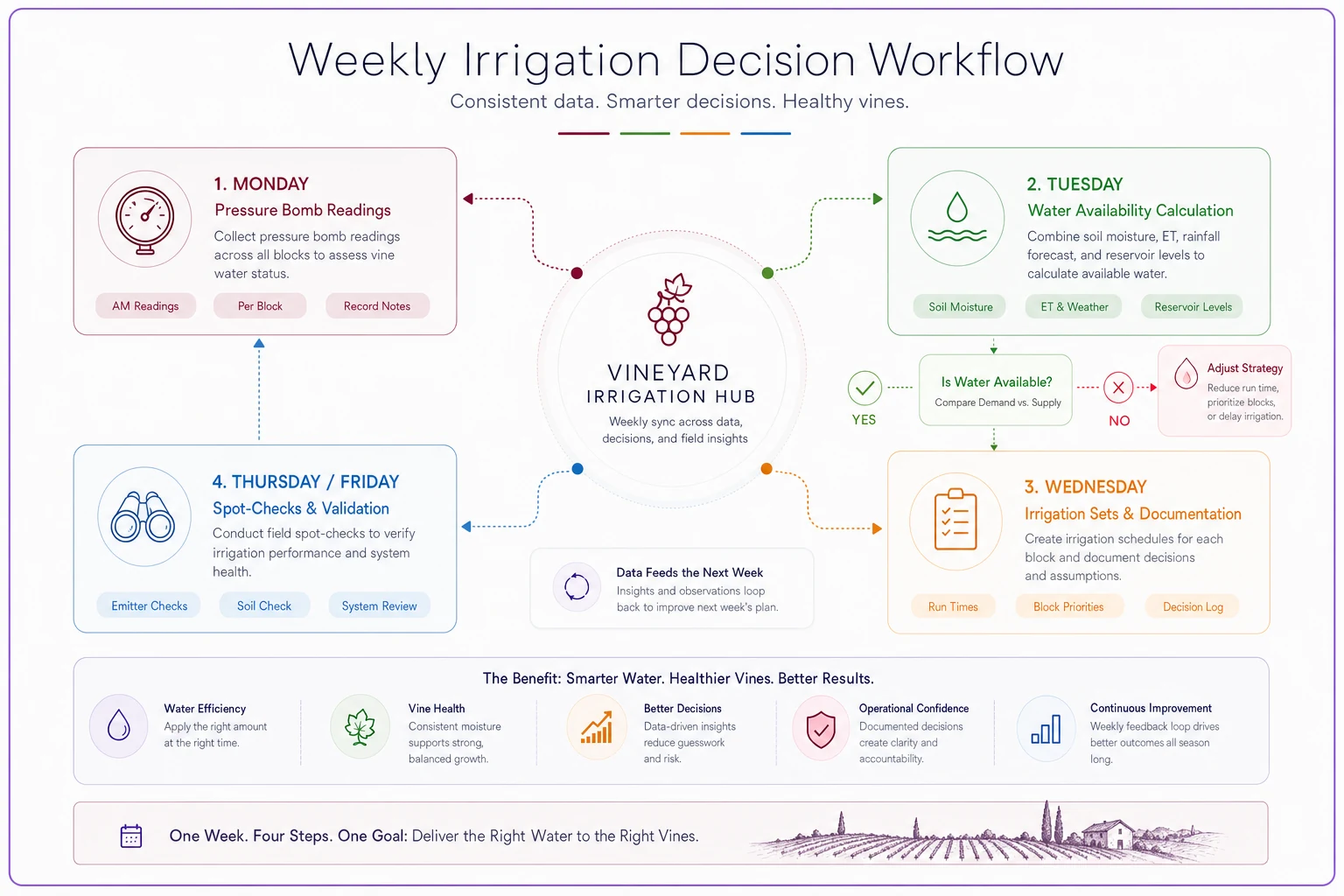
A compact visual of the weekly cadence helps crews see responsibility and timing at a glance.
Thursday/Friday: Spot-check blocks that were marginal on Monday. Look for leaf rolling before 11am, shoot tip browning, or basal leaf yellowing. These visual cues sometimes appear before pressure bomb readings change.
Infrastructure constraints that break good plans
The best triage system fails when infrastructure can't deliver water where needed. Most vineyards have blocks sharing mainlines, so you can't irrigate critical and sacrifice zones independently.
Map your irrigation zones against your triage categories. Where they don't align, you need infrastructure investment or management workarounds. Sometimes running shorter sets more frequently lets you cover more critical blocks even with shared lines.
Map mainlines and pump capacity before shortage season so you know which blocks are operationally feasible to protect.
Pump capacity becomes the bottleneck during peak demand. If your system can only push 400 gallons per minute but your critical blocks need 600 GPM for adequate coverage, you're forced into longer sets that delay coverage of other priority blocks.
Timing windows that determine success or failure
Growth stages create non-negotiable irrigation windows regardless of your water budget:
Budbreak to fruit set: Vines can handle moderate stress. Save water here unless you see shoot growth stopping completely.
Fruit set to veraison: Critical period for berry cell division. Severe stress here causes permanent yield loss. Even resilient blocks need monitoring.
Veraison to harvest: Strategic deficit improves quality in reds but can crash yields if overdone. Whites typically need more consistent moisture for aromatic development.
Post-harvest: Often ignored during water shortages, but stressed vines going into dormancy show reduced cold hardiness and poor budbreak next season.
Record templates that prevent next year's crisis
Document decisions and outcomes in a format you'll actually reference:
2024 Water Allocation Log
-
July 15-21
45% of normal allocation available
-
Prioritized blocks
A7, B3, C1 (young vines)
-
Deferred blocks
D5, E2 (deep soil mature vines)
-
Result
2% yield loss in deferred blocks, maintained contracts
Seasonal Summary
-
Total water used vs. allocated
-
Yield by block with irrigation hours
-
Quality metrics (Brix, pH, TA) by irrigation treatment
-
Next season adjustments needed
This documentation helps insurance claims, informs replanting decisions, and builds institutional knowledge about block performance under stress.
The compound effects of poor prioritization
Getting triage wrong doesn't just affect this year's crop. Repeatedly under-irrigating sensitive blocks causes:
-
Smaller trunk diameter growth, reducing future capacity
-
Reduced carbohydrate storage affecting next year's fruitfulness
-
Increased susceptibility to trunk diseases through stressed tissue
-
Earlier vine decline requiring replanting
Meanwhile, over-irrigating resilient blocks wastes water while potentially reducing wine quality through excessive vigor and delayed ripening.
Software coordination for distributed decision-making
When irrigation decisions involve multiple crew leaders, vineyard managers, and ownership, information gaps multiply problems. One manager might not know another already irrigated a shared block. Critical readings collected Monday might not reach decision-makers until Wednesday.
Modern vineyard management platforms solve this by centralizing irrigation records, pressure bomb readings, and block priorities in one system. Crew leaders input data from phones in the field. Managers see real-time dashboard views of block status. Automated alerts flag when blocks approach trigger points.
The efficiency gain isn't just faster decisions. It's preventing the miscommunication that leads to double-irrigation of low-priority blocks while critical zones go dry. When everyone sees the same triage rankings and current status, water allocation becomes objective, not political.
Adjusting strategy as conditions evolve
Your initial triage plan won't survive the season unchanged. Unexpected heat spikes, equipment failures, or district curtailments force rapid reprioritization.
Build flexibility into your system:
-
Set "promotion triggers" that move blocks up priority tiers
-
Define emergency protocols for extreme events
-
Create contingency plans for 25%, 50%, and 75% water reductions
-
Document which contracts have force majeure clauses
During the 2021 California drought, vineyards with dynamic triage systems maintained 85-90% of normal yields while those with static plans saw 60-70% yields. The difference was weekly adjustment based on actual conditions versus following a plan made in spring.
Common triage mistakes that seem logical but aren't
Prioritizing by variety reputation leads to major problems. Yes, Cabernet Sauvignon has drought tolerance, but not when it's young vines on shallow soil carrying 5 tons per acre. Meanwhile, Chardonnay on deep soil with moderate crop might need less water than expected.
Protecting highest-value blocks exclusively sounds financially smart until you lose entire sections of productive vineyard. Better to take 10% quality reduction in premium blocks than 100% loss in standard blocks that pay operating costs.
Waiting for visual symptoms means you're already too late. By the time leaves roll and shoots stop growing, you've triggered metabolic changes that affect current and future crops. Proactive monitoring beats reactive irrigation.
Making peace with imperfect outcomes
Under severe water constraints, some damage is inevitable. The goal isn't perfection but optimized loss distribution. Document what you're choosing to sacrifice and why. This transparency helps ownership understand outcomes and prevents finger-pointing after harvest.
Accept that some blocks will show stress. Cosmetic issues like smaller berries or earlier leaf senescence don't always correlate with wine quality problems. Sometimes controlled stress improves concentration and complexity, especially in reds.
The vineyards that navigate water constraints successfully treat triage as an operational system, not an emergency response. They have clear triggers, defined responsibilities, and documented decision trails. They know which blocks to protect and which to release before the crisis hits.
Water scarcity will likely intensify in coming decades. Vineyards building systematic triage capabilities now position themselves for long-term viability. Those hoping each year will be different face increasing risk with each vintage.
The operational discipline of block ranking, trigger-based decisions, and documented outcomes transforms water management from reactive scrambling to proactive optimization. Your vines might stress, but your business doesn't have to.
Ready to elevate your winery management?
Join 500+ wineries using Corkyly to increase operational efficiency, boost customer loyalty, and grow sales.