


Most wineries treat procurement like a light switch: on when the tank room needs glass, off when the invoices clear. That works fine — until your bottling schedule collides with a port slowdown, a cork demand spike tied to harvest timing somewhere else, or a printer who suddenly needs eight weeks instead of three for capsules. Then everything seizes.
The core problem is that a seasonal procurement winery reorder policy can't run on a single reorder point. Lead times move. Demand moves. Supplier reliability moves. If your reorder logic assumes the same numbers in February that it does in August, you'll over-order in slow months — tying up cash and warehouse space — and under-order right before your biggest bottling runs, which means rush freight bills and potentially delayed releases.
This piece walks through how to build a procurement calendar that actually flexes: lead-time heatmaps, risk-tiered safety stock, and a vendor-contact cadence that shifts reorder points depending on where you are in the season. There's a worked bottling-run example toward the end so the math isn't abstract.
Start With a Lead-Time Heatmap, Not an Average
The single biggest mistake in winery procurement is using an average lead time. Averages hide exactly the risk that hurts you.
Take glass. Your supplier might quote "4 weeks" as an average, but if you plot actual delivery times across a full year, you'll usually see something like: 3 weeks in Q1, 4–5 weeks in Q2, and 7–9 weeks from July through September when everyone in the Northern Hemisphere is bottling and freight is tight. The average is 5 weeks. The number that matters — the one during your bottling window — is 8.
A lead-time heatmap is just a simple grid: material categories down the side, months across the top, each cell scored by the realistic lead time during that window. You're not trying to be precise to the day. You're just trying to see the hot zones.
| Material | Jan–Mar | Apr–Jun | Jul–Sep | Oct–Dec |
|---|---|---|---|---|
| Bottles (standard) | 3–4 wk | 4–5 wk | 7–9 wk | 5–6 wk |
| Bottles (custom/imported) | 8–10 wk | 10–12 wk | 14–16 wk | 12–14 wk |
| Corks (natural) | 4 wk | 5–6 wk | 6–8 wk | 5 wk |
| Screwcaps | 3 wk | 3–4 wk | 5–6 wk | 4 wk |
| Capsules | 2–3 wk | 3 wk | 5–7 wk | 4 wk |
| Custom labels | 3 wk | 3–4 wk | 6–8 wk | 5 wk |
| Cartons/dividers | 2 wk | 2–3 wk | 4–5 wk | 3 wk |
Two things usually jump out once you build this for your own operation. First, custom and imported items are almost always the constraint — longest lead times and the most seasonal variability. Second, the danger months tend to cluster. When one category goes hot, the others usually follow, because they share freight lanes and calendar pressure.
The heatmap isn't decoration. It becomes the input that drives every reorder point downstream. Skip it and carry one lead-time number all year, and everything built on top inherits that flaw.
Risk-Tier Your Safety Stock Instead of Blanketing Everything
Once you can see lead-time variability, the next move is deciding how much buffer each material actually deserves. Not everything should get the same safety stock.
Streamline your winery operations effortlessly.
Corkyly helps you track, manage, and optimize every step from vine to bottle.
- Vineyard & production tracking
- Customer relationship management
- Inventory & sales analytics
No credit card required
Wineries tend to do one of two things. Either they carry heavy safety stock across the board — expensive, eats warehouse space you'd rather use for finished goods — or they run lean on everything and get burned by the one component that stalls a whole run. Neither extreme works.
Tier your materials by two questions:
-
How badly does a stockout hurt? A missing capsule delays a release. A generic carton you can source locally is a Tuesday afternoon problem.
-
How unreliable is the supply? Long lead times, single-source vendors, and imported goods all raise risk.
That gives you a rough three-tier system:
Tier 1 — High impact, high risk. Custom bottles, printed labels, natural corks, anything single-sourced or imported. These get the deepest safety stock — sometimes 4–6 weeks of coverage during hot windows. A stockout here stops a bottling run cold.
Tier 2 — Moderate impact or moderate risk. Screwcaps, standard capsules, dividers. Carry a reasonable buffer, maybe 2–3 weeks, but you don't need to over-invest.
Tier 3 — Low impact, easily replaceable. Generic cartons, tape, basic supplies. Minimal safety stock. If you run short, you can source locally without derailing anything.
Scale safety stock with the heatmap rather than keeping it fixed year-round.
The insight most people miss: safety stock should scale with the heatmap, not stay fixed year-round. A Tier 1 item might need 3 weeks of buffer in February and 6 weeks in August, because both the lead time and the consequence of a miss get worse during bottling season. Static safety stock is quietly the same mistake as static reorder points — it ignores the calendar entirely.
For a closer look at how these buffer decisions ripple into finished-goods planning, the supply-chain resilience blueprint for packaging covers the sourcing and contingency side that pairs directly with this tiering approach.
Dynamic Reorder Points: The Actual Formula
A reorder point (ROP) is the inventory level that triggers a new order. The classic version:
ROP = (average daily usage × lead time) + safety stock
The problem is that every variable in that equation moves seasonally. So instead of one ROP per item, you calculate a ROP per seasonal window using the numbers from your heatmap and your risk tiers.
Seasonal ROP = (projected daily usage during window × window-specific lead time) + tier-based safety stock for that window
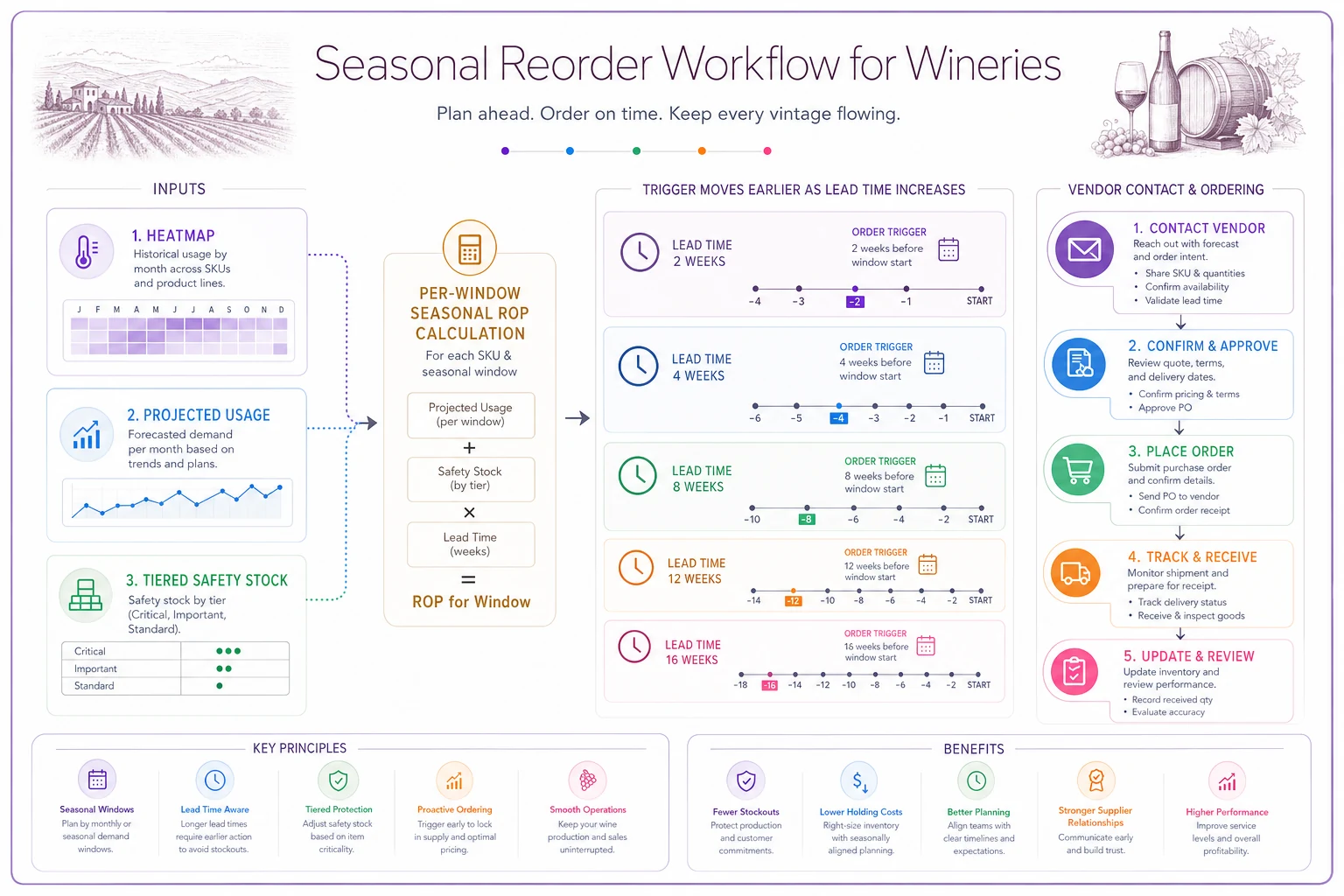
A quick visual of the seasonal ROP workflow.
Here's why the spread matters. Say you're using around 40 cases' worth of glass per week during quiet months but ramping to 200+ during your fall bottling push. If your ROP assumes quiet-month usage but you're heading into the fall ramp with an 8-week lead time on glass, you'll trigger the order far too late. By the time it arrives, you've already missed the run.
Recalculate the ROP for each window and the trigger moves earlier automatically as you approach the hot season. That's the whole point — the reorder logic anticipates the ramp instead of reacting after the fact.
A Vendor-Contact Cadence That Isn't Just "Call When Low"
Reorder points tell you when to order. They don't tell you when to talk. Those are different jobs, and conflating them is a common failure.
The best-run procurement operations run a contact cadence that's independent of the reorder trigger. You're checking in with critical vendors before you need anything — specifically to catch shifting lead times, price changes, and capacity constraints while you still have room to react.
-
Tier 1 vendors — monthly touchpoint, weekly in the pre-bottling ramp. Sixty to ninety days before a major run, confirm their current lead time (not the quoted one — the actual one), their production capacity for your window, and any raw-material issues on their end. This is when you catch the "actually we're at 12 weeks right now" surprise before it becomes a crisis.
-
Tier 2 vendors — quarterly touchpoint, plus a confirmation before each order. Enough contact to stay aware of changes without burning too much time.
-
Tier 3 vendors — as needed. Commodity items with backup sources. A confirmation at order time is plenty.
What separates smooth operations from scrambling ones: the cadence is scheduled and proactive, not triggered by low inventory. By the time your reorder point fires, you should already know your vendor's real lead time for that window — because you asked three weeks ago, not because you're finding out now while you're already in a hurry.
This is also where a shared system earns its keep. When lead times, contact dates, and per-window reorder points live in one place instead of a buyer's head and a spreadsheet, the cadence actually survives staff turnover and the chaos of busy season. AI-assisted operational platforms can flag when a vendor touchpoint is overdue or when a quoted lead time drifts outside your planned window — small nudges that keep the calendar honest without piling on manual tracking work.
Worked Example: A Bottling Run That Almost Went Sideways
A mid-size winery bottling a Cabernet release in early September — roughly 3,000 cases, custom-printed labels, natural cork, imported bottles.
The static-policy version (what usually happens):
The buyer uses a year-round ROP built on average lead times. Glass at "5 weeks average," labels at "3 weeks," cork at "4 weeks." Orders trigger in early August.
Except it's August. The heatmap reality is glass at 8 weeks, labels at 6 weeks, cork at 6 weeks. Every long-lead item was ordered 3–4 weeks too late. Glass arrives mid-September. The run slips two weeks, which cascades into the next scheduled bottling, the release date to distributors moves, and rush freight on part of the order adds a few thousand dollars in costs. The schedule compression also raises changeover risk on the line.
The dynamic-policy version:
-
Imported bottles (14–16 wk during the Jul–Sep window)
order by mid-May
-
Custom labels (6–8 wk)
order by mid-July
-
Natural cork (6–8 wk)
order by mid-July
-
Capsules and cartons (shorter lead, lower risk)
order early-to-mid August
The Tier 1 vendor cadence means the buyer confirmed the bottle supplier's actual lead time back in April, caught that it had crept to 16 weeks, and pulled the order forward a week to compensate. Safety stock is set at the higher hot-season buffer, so even a partial shipment delay doesn't stop the run.
The difference isn't a fancier formula. It's that the trigger dates and buffers were built around when the bottling actually happens and what lead times actually look like that month. The static version fails not because the buyer was careless, but because the tool they were using couldn't see the season.
The line-level side of this — sequencing runs and avoiding costly changeovers once materials arrive — is worth reading alongside this piece, since procurement timing and bottling run batching are really two halves of the same problem.
Building the Calendar: A Practical Checklist
If you're setting this up from scratch, work through these in order:
-
[ ] Pull 12+ months of actual delivery data for each material category (not quoted lead times — actual)
-
[ ] Build the lead-time heatmap by material × month
-
[ ] Assign each material to a risk tier (impact × supply reliability)
-
[ ] Set window-specific safety stock levels per tier
-
[ ] Map your bottling calendar for the next 12 months, including known releases
-
[ ] Work backward from each bottling date to calculate per-window reorder triggers
-
[ ] Define the vendor-contact cadence by tier, with calendar reminders
-
[ ] Assign a clear owner for each vendor relationship
-
[ ] Schedule a monthly review to adjust the heatmap as new data comes in
That last point matters more than it looks. The heatmap is a living document. Every late shipment and every shifted lead time is data that should feed back in. A calendar you build once and never touch drifts out of reality within a season.
When This Level of Rigor Makes Sense — and When It Doesn't
This makes sense when: you're running multiple bottling runs a year, you use custom or imported packaging, you're selling through distributors with firm release dates, or you've already been burned by a packaging delay. The coordination cost of the system is far lower than the cost of one stalled run.
This is overkill when: you're a small producer doing one bottling a year with standard components you can source locally in a week. A simple checklist and a couple of vendor calls do the job. Don't build a heatmap for four SKUs and one annual run — you'll spend more time maintaining it than it saves.
Who should not do this yet: if your inventory records aren't reliable in the first place, fix that before layering seasonal reorder logic on top. Dynamic reorder points calculated from bad usage data just fail faster and more confidently. Getting your inventory states and allocation rules clean — the kind of groundwork covered in inventory allocation governance — is the prerequisite, not an optional companion.
Where It All Connects
Procurement isn't really a standalone function. Your reorder points depend on your bottling calendar, which depends on harvest and fermentation timing, which feeds your release schedule and distributor commitments. When any one of those shifts, the procurement calendar should shift with it.
That's the real weakness of static reorder policies: they treat packaging as if it exists in a vacuum, disconnected from the rest of the season. A dynamic, risk-tiered approach ties buying decisions back to the actual operational calendar — so glass gets ordered because a specific run is coming, buffered by how unreliable that supplier gets during that specific month, confirmed by a vendor conversation that happened before anyone was in a hurry.
You don't need software to start. A spreadsheet with a heatmap and a set of window-specific reorder dates already puts you ahead of most operations. But as you scale to more SKUs, more runs, and more vendors, keeping all of that current by hand becomes its own bottleneck — and that's where centralizing the calendar, the lead-time history, and the vendor cadence in one operational platform stops being a nice-to-have and starts being the thing that prevents the exact delays this whole system is designed to avoid.
Ready to elevate your winery management?
Join 500+ wineries using Corkyly to increase operational efficiency, boost customer loyalty, and grow sales.