

Most allocation disasters don't start with a shortage. They start with ambiguity. Two people looked at the same inventory number and made two different promises. The DTC manager sold 40 cases of the reserve Pinot to the club before the distributor rep finished writing up an order for 30 of the same cases. Now someone's getting an apology email, and someone's margin just took a hit because you're eating expedited freight to make both parties whole.
Winery inventory allocation governance is the boring layer that prevents that. It's not software, it's not a spreadsheet, and it's definitely not "we'll just check with each other." It's a set of explicit rules that say: this wine, in this state, can only be sold through these channels, in these quantities, under these approval conditions. Get that layer right and most of your channel conflict quietly disappears.
Let me walk through how the whole thing fits together, where it usually breaks, and what changes when you grow past a certain size.
The core problem: your inventory number lies to almost everyone
The number in your inventory system is almost never the number that's actually available to sell. A case sitting in the warehouse could be:
-
Physically on hand but promised to the club's fall shipment
-
Bottled but not yet TTB-released
-
Allocated to a distributor PO that hasn't shipped
-
Held back for the tasting room's by-the-glass program
-
Reserved for a wine club member's standing "always ship me the library stuff" note
So when your DTC lead sees "820 cases available" and your national sales manager sees the same 820, they're both wrong — and they're both about to make promises against inventory that's already spoken for.
This problem is invisible until you cross roughly the 5,000–8,000 case mark or add a third serious channel. Below that, one person usually holds the whole picture in their head. Above it, that person becomes a bottleneck, then a liability, then they take a vacation and everything falls apart.
The fix isn't a better number. It's better states. Instead of one available-to-sell figure, every lot needs to carry an explicit status that tells you what it can and can't do.
Step one: define your inventory states explicitly
You can't allocate wine you haven't categorized. Most wineries operate with two informal states — "we have it" and "we don't" — and that's the root of half the chaos.
Streamline your winery operations effortlessly.
Corkyly helps you track, manage, and optimize every step from vine to bottle.
- Vineyard & production tracking
- Customer relationship management
- Inventory & sales analytics
No credit card required
A workable state model for a multi-channel producer usually looks like this:
| State | What it means | Sellable? | Who can commit it |
|---|---|---|---|
| In process | Bottled, not yet TTB-released or labeled | No | Nobody |
| Uncommitted | Released, no channel claim | Yes | Requires allocation approval |
| Channel-allocated | Assigned to DTC / club / wholesale / export bucket | Within that channel only | Channel owner |
| Order-committed | On a confirmed order or shipment | No | Locked |
| Library/hold | Intentionally reserved (verticals, comps, reserve) | No, without override | Owner/GM only |
"Uncommitted" is the dangerous state, not "sold." Uncommitted inventory is what everybody fights over because it looks free. The whole point of allocation governance is to move wine out of uncommitted and into a channel bucket deliberately, on a schedule, rather than letting it get grabbed by whoever emails fastest.
Wineries with the worst channel conflict almost always have the largest uncommitted pools sitting unallocated for weeks. The wine isn't the problem. The unassigned state is.
Step two: map states to channel allocation rules
Once states exist, you write the rules that connect them to channels. This is where governance actually earns its keep — you're pre-deciding conflicts instead of resolving them in real time.
A realistic allocation policy for a producer doing DTC, wine club, wholesale, and a little export might read something like this:
-
Reserve/small-lot wines (under ~300 cases)
70% club and DTC, 20% tasting room, 10% uncommitted for owner discretion. No wholesale without GM sign-off.
-
Core tier (1,000+ cases)
40% wholesale, 35% DTC/club, 15% tasting room, 10% uncommitted buffer.
-
Library releases
100% DTC and club, hard-locked from wholesale entirely.
The percentages matter less than the fact that they exist before the wine is released. When your national sales manager asks for 150 cases of the reserve for a key distributor, the answer isn't a negotiation — it's "that tier caps wholesale at 10%, so we've got about 30 cases you can pitch, and anything above that needs the GM."
That single change kills an enormous amount of internal friction. Nobody feels cheated because the split was decided by policy, not by whoever had the loudest week.
One mistake that shows up constantly: wineries set channel percentages but never define what happens to the buffer. That 10% uncommitted pool needs an expiry rule — "if not claimed within 60 days of release, it rolls into DTC" — or it just becomes a slush fund people argue over anyway.
Step three: attach order-routing SLAs
Allocation rules tell you who can sell what. SLAs tell you how fast a commitment gets honored and what happens when it doesn't. Without them, allocation is just a suggestion.
The routing part is straightforward once states exist. An order comes in, the system checks the channel bucket, and if there's allocated inventory available, it moves to order-committed. If the channel bucket is dry but uncommitted exists, the order triggers an approval instead of an automatic fill. That approval step is the entire ballgame — it's the moment where you either protect your allocation discipline or blow it up.
-
Wholesale PO acknowledgment
confirmed or flagged short within 1 business day.
-
Club shipment allocation lock
wines pulled from uncommitted and locked at least 14 days before the club run.
-
DTC backorder resolution
any oversell resolved within 48 hours — either fulfilled from buffer or the customer is contacted with an alternative.
-
Override turnaround
any request to pull from a hard-locked state gets a yes/no from the GM within 1 business day, not "whenever."
At 4,000 cases, a missed acknowledgment is an awkward phone call. At 40,000 cases across three states and an importer, that same miss cascades into freight consolidation failures, distributor chargebacks, and depletion reporting gaps. The cost of ambiguity grows fast.
If you're tracking the wrong metrics around all this, none of it shows up until it's expensive. Worth revisiting your operational KPIs and the formulas that actually move margins so allocation health is something you can see on a dashboard instead of discovering after a bad month.
Here’s a simple diagram of the order-routing workflow to clarify how orders move between states and approvals.
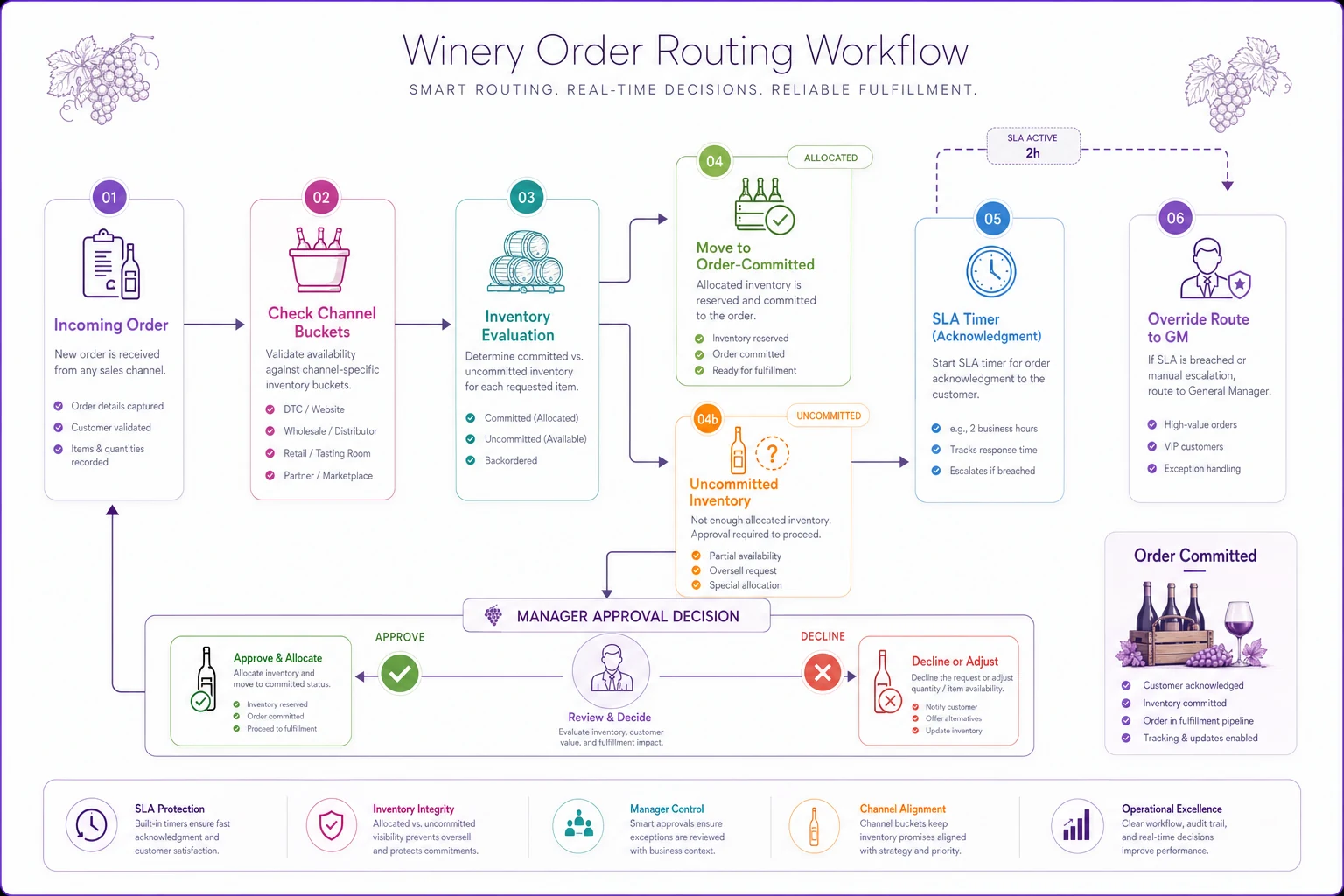
The graphic shows the decision points and SLA gates that keep routing predictable.
Step four: assign role-level responsibilities
Rules with no owner are just documents. Every state transition needs a named role that's allowed to trigger it, and — this is the part people skip — a named role that isn't.
-
Cellar/production lead
moves wine from in-process to uncommitted at release. Cannot allocate to channels.
-
Ops or inventory manager
executes channel allocations per policy, locks club runs, manages the buffer.
-
Channel owners (DTC, wholesale, tasting room)
commit orders within their allocated bucket only.
-
GM/owner
sole authority on overrides, hold releases, and cross-channel reallocation.
Most allocation blowups aren't people breaking rules — they're people making decisions that were never clearly assigned to anyone. When the tasting room manager pulls six cases of reserve for a walk-in prospect, and nobody ever said tasting room can't touch reserve allocation, that's a governance gap, not a bad employee.
Separating "who moves wine into a state" from "who commits it to an order" is the single most protective structure you can build. It creates a natural check without adding a bureaucratic approval on every transaction.
Step five: the monthly reconciliation ritual
This is where governance stops drifting. Policies decay. Buffers get raided quietly. A distributor order got fulfilled from the wrong bucket three weeks ago and nobody caught it. The monthly reconciliation is what catches drift before it compounds.
-
[ ] Physical count vs. system count by SKU and state
-
[ ] Uncommitted pool age report — anything sitting past its roll-over window
-
[ ] Channel allocation actuals vs. policy percentages (where did we actually sell vs. where we said we would?)
-
[ ] Every override logged that month, with reason and approver
-
[ ] SLA misses — acknowledgments, backorders, club locks that slipped
-
[ ] Library/hold movements — anything pulled and why
The valuable move here is comparing policy to actuals. If your core tier was supposed to be 40% wholesale and you actually shipped 62% wholesale, that's not necessarily wrong — but it should be a decision you're making on purpose, not discovering. Maybe demand shifted and the policy needs updating. Maybe your DTC channel is starving and you didn't notice. The reconciliation surfaces the drift; the conversation decides whether it's signal or leak.
Reconciliation also feeds directly into traceability. When you know exactly which lot went to which channel in which quantity, a recall or a quality hold gets a lot less terrifying. If that side of the operation is shaky, the block-to-bottle traceability playbook pairs naturally with this framework — states and lots are two halves of the same record.
A real scenario: what this looks like in practice
Take a producer making around 12,000 cases, split across DTC, a club of roughly 900 members, and wholesale in four states. Before formalizing any of this, they ran on one shared inventory sheet and a lot of Slack messages.
The recurring damage: two or three oversells a month, usually reserve wines the club and a distributor both wanted. Each resolution meant either eating expedited freight or disappointing a customer. The messier cost was time — the ops manager estimated close to a full day a week just refereeing who could sell what.
After putting in explicit states, channel percentages, and a monthly reconciliation, oversells dropped to maybe one every couple of months, and each one had a clear owner and a fast resolution path. The bigger win was quieter: the ops manager got that time back, and the reserve wines stopped being a monthly source of internal tension because the split was already decided. Nobody was negotiating in the moment anymore.
No dramatic revenue jump. Less waste, less friction, and a team that stopped stepping on each other.
Where operational software fits — without pretending it's magic
You can run this framework on spreadsheets for a while. Plenty of wineries do. But once you have more than a couple of people committing inventory at the same time, the manual version starts to leak — a spreadsheet can't enforce a state, it just displays one.
This is where an operational platform with AI-assisted automation earns its place: not by making decisions for you, but by enforcing the rules you already wrote. State transitions get locked to the right roles. An order against a dry channel bucket triggers an approval automatically instead of silently overselling. The uncommitted-pool age report and the SLA-miss list build themselves for the monthly reconciliation instead of eating your ops manager's Friday. The governance is yours; the software just refuses to let people quietly break it.
Software doesn't replace allocation governance — it makes it hold up under real-world speed and volume.
When this framework makes sense (and when it's overkill)
Do this if: you're running two or more serious channels, you've hit oversells or channel conflict more than once, or you're past the point where one person can hold the whole inventory picture in their head. Also do it if you're about to add a channel — export or a new distributor is exactly when informal allocation collapses.
Skip most of it if: you're a single-channel, small-production operation where the owner touches every order personally. At that scale, formal states and SLAs add ceremony without solving a real problem. Write down your reserve holds and move on.
Be careful if: you're growing fast. The trap isn't building this too early — it's building it too late, then trying to install governance during your busiest allocation window, which is like changing tires at highway speed.
The takeaway
Allocation conflict feels like a people problem — someone oversold, someone hoarded, someone didn't communicate. It almost never is. It's a states-and-ownership problem. When every lot carries an explicit state, every channel has a pre-decided share, every transition has a named owner, and every month you reconcile policy against reality, the fights just don't have anywhere to start.
Build the framework while it's still slightly premature, keep the reconciliation ritual sacred, and let the rules absorb the pressure that would otherwise land on your people. That's the whole game.
Allocation conflict feels like a people problem — someone oversold, someone hoarded, someone didn't communicate. It almost never is. It's a states-and-ownership problem. When every lot carries an explicit state, every channel has a pre-decided share, every transition has a named owner, and every month you reconcile policy against reality, the fights just don't have anywhere to start.
Build the framework while it's still slightly premature, keep the reconciliation ritual sacred, and let the rules absorb the pressure that would otherwise land on your people. That's the whole game.
Ready to elevate your winery management?
Join 500+ wineries using Corkyly to increase operational efficiency, boost customer loyalty, and grow sales.