

The winery owner sat across from me with three spreadsheets open, a wine-stained clipboard full of tank logs, and that particular brand of panic that comes from having 85,000 cases to manage and no clue where seventeen barrels of 2021 reserve cabernet had gone. The wine was somewhere in his facility—physically, it existed. But which tanks? Which barrels? Had someone blended it with something else? Nobody could say for certain.
This wasn't some mom-and-pop operation either. They were producing across twelve different labels, the kind of place that should have this sorted out. But I've watched this exact scenario play out at dozens of wineries. Your traceability system works perfectly until the moment you actually need it—during a recall, in the middle of harvest chaos, or when an auditor shows up with a clipboard and four hours to prove compliance.
Most wineries treat traceability like car insurance. They know they need it, pay for the bare minimum, and hope they never have to use it. Then harvest hits, everyone's pulling sixteen-hour days, and that careful system you planned gets replaced with sticky notes on tank doors and Sharpie numbers on masking tape.
The real problem? When the FDA calls about glass fragments in a specific bottle, you get exactly four hours to provide complete documentation showing every step that wine took from vineyard block to bottle. Four hours to trace backwards through months of movements, blends, and treatments. Most wineries can't do it in four days.
The harvest handoff disaster
Picture this scene that happens at about 70% of wineries every September.
Picking crews show up at dawn with bins marked "Block 7 - Merlot" in Sharpie. By noon, when those grapes hit the crusher, someone's relabeled them "Lot M-3" because that's how the cellar team tracks everything. The winemaker calls it "Tank 12 Merlot" in his notes. The barrel room logs show "2022 Estate Merlot - Barrels 47-63." Eighteen months later, the bottling line prints "Batch 20240315-B" on every cork. Now try connecting those dots when the state health department calls about elevated lead levels in a specific bottle. You're digging through three Excel files, a notebook that got soaked during crush 2022, and trying to remember if "Block 7" was the vineyard near the highway or the one by the creek.
That winery with the missing seventeen barrels? They'd transferred the wine twice during aging, blended it with two other lots for trials, then separated it back out—but nobody updated the master spreadsheet after the second transfer. The wine was sitting right there in barrels 127-143, labeled with the wrong vintage on masking tape that was already curling at the edges.
The custody chain had broken four times:
-
Field to crush pad (bin relabeling)
-
Fermentation to barrel (lot number change)
-
First racking (no documentation)
-
Trial blend and separation (spreadsheet never updated)
Each break created a black hole where product could disappear from records while sitting directly in front of you.
Why spreadsheets turn into expensive fiction after fifty barrels
Spreadsheets work fine when you're managing twenty barrels and making 5,000 cases annually. You can hold most of the important details in your head, and when something looks off, you know immediately what actually happened.
Streamline your winery operations effortlessly.
Corkyly helps you track, manage, and optimize every step from vine to bottle.
- Vineyard & production tracking
- Customer relationship management
- Inventory & sales analytics
No credit card required
Watch what happens as you scale up. Growing from 10,000 to 30,000 cases doesn't just triple your spreadsheet rows—the complexity multiplies exponentially. Multiple pick dates for the same block. Partial tank fills. Wine club micro-lots. Barrel trials that might become production wines. Custom crush clients whose fruit runs through your equipment alongside yours.
The spreadsheet that worked at 10,000 cases becomes actively dangerous at 30,000. Not because spreadsheets can't handle the data—they can. But because the human processes around updating, verifying, and reconciling that data completely break down under production pressure.
One winery lost track of $340,000 worth of Pinot Noir because two people were updating the same file with different naming systems. The assistant winemaker used "PN-West-2022" while the cellar master logged "22PNW." Both entries sat there in the spreadsheet. Nobody realized they were tracking the same wine twice until bottling, when they came up 900 cases short.
Spreadsheets don't enforce consistency. They won't stop you from entering "Barrel 45" when you meant "Barrel 54." They don't flag when the same lot number appears in two different locations. They definitely won't alert you when someone forgets to log a transfer completely.
The persistent lot-ID architecture that actually survives harvest
After seeing hundreds of traceability systems fail, here's what works: a persistent identification system that follows the product, not the container.
Year + Block + Pick Date + Sequence = Persistent Lot ID
Example: 2024-B7-0915-01
That's 2024 harvest, Block 7, picked September 15th, first lot of the day.
This ID never changes. When those grapes become must, it's still 2024-B7-0915-01. When that must ferments in Tank 12, it's still 2024-B7-0915-01, just with metadata showing "Current Location: Tank 12." When you blend it with three other lots, the blend gets a new ID, but the system maintains connections to all four original lots.
Container changes become metadata updates, not identity changes. Too many wineries recreate identity at each stage. Grapes are "Bin 47," become "Tank 8," then "Barrels 15-30," then "Bottling Batch 5." Each transformation breaks the chain. When something goes wrong, you're archaeologically excavating through layers of different naming schemes.
Building your recall playbook before you need it
The middle of a recall is exactly the wrong time to figure out your traceability system. The FDA gives you four hours for initial documentation. Your distributor is calling wanting specific case numbers. The grocery chain wants exact Julian date codes.
A functional recall playbook starts with this question: Can you trace from a bottle code to a vineyard block in under thirty minutes?
Here's the recall that broke a 50,000-case Sonoma winery:
Customer reports glass fragments in a bottle. They send a photo of the label and cork code: "L23-247-B". The winery needed to determine every bottle from that run, which retailers got those cases, what caused the contamination, and whether other runs used the same materials. They had bottling records. They had shipping records. But connecting bottling codes to specific distributors required manually cross-referencing three systems that all used different date formats. Fourteen hours to develop a complete recall list. Several hundred cases had already sold to consumers.
Your recall playbook needs these timeframes:
Immediate identification (30 minutes):
-
Bottling code → production lot
-
Production lot → all bottling codes
-
Bottling codes → case numbers
-
Case numbers → shipment records
Trace-back investigation (2 hours):
-
Production lot → source barrels/tanks
-
Source containers → treatment records
-
Treatment records → additive lots
-
Source barrels → vineyard blocks
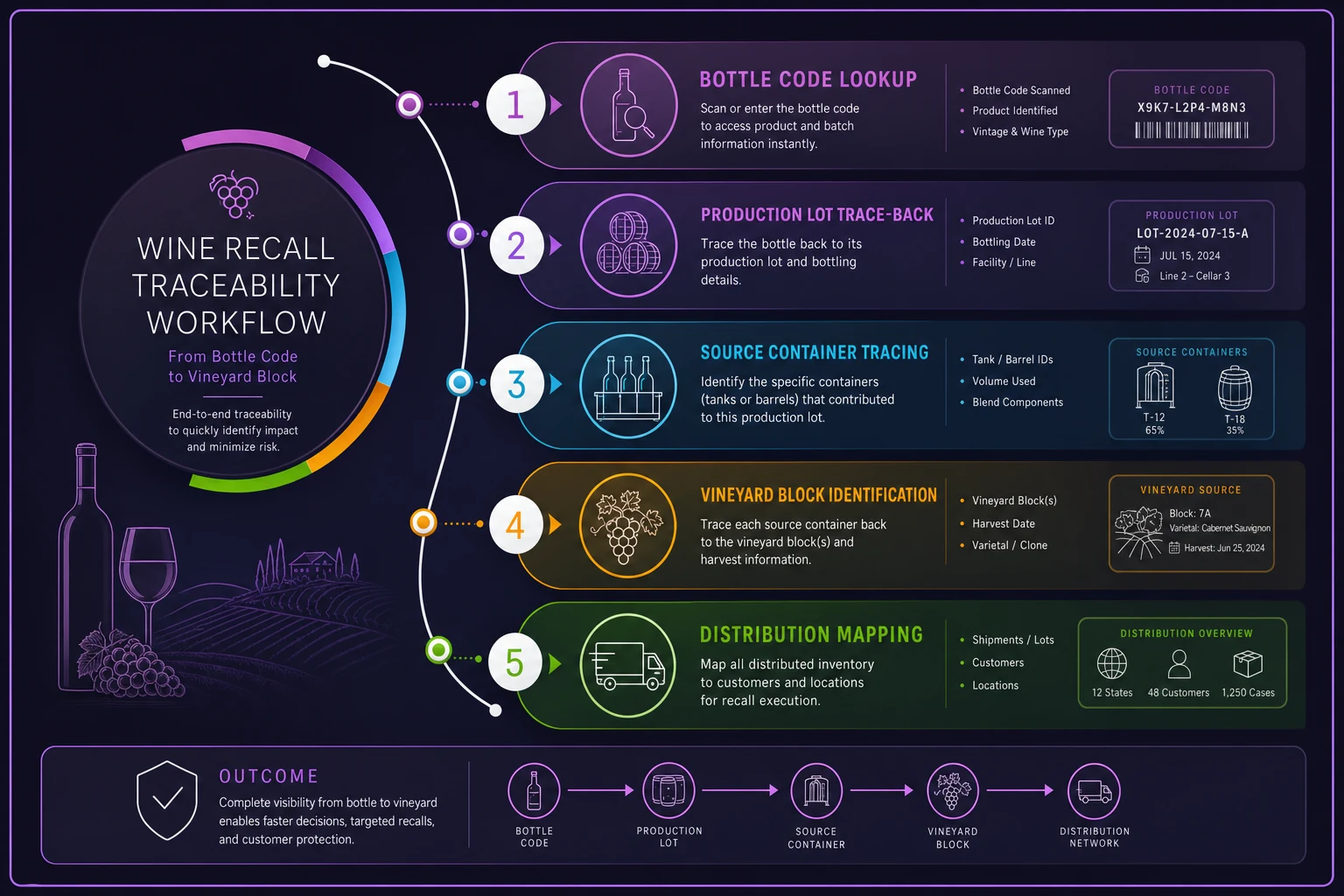
This visual summarizes the recall trace-back steps and key data touchpoints.
Distribution mapping (4 hours):
-
Case numbers → distributor shipments
-
Distributor shipments → retail locations
-
Distribution timeline
-
Estimated consumer sales
A Paso Robles winery runs recall drills quarterly. They pick a random bottle code and race through complete trace-back. First drill took six hours and exposed seventeen gaps in documentation. By the fourth drill: 47 minutes with complete records.
The metadata template progression from block to bottle
Information requirements change dramatically as wine moves through production, but most wineries try tracking everything everywhere, creating massive logs that nobody updates.
Vineyard/Harvest Stage:
-
Lot ID (persistent)
-
Block/vineyard designation
-
Variety and clone
-
Pick date and time
-
Crew/company
-
Bins/tons
-
Brix/pH/TA at receipt
-
Spray records (last 90 days)
-
Organic/sustainable certification
Fermentation Stage:
-
Previous data plus
-
Crush date/time
-
Destination vessel
-
SO2 additions
-
Yeast strain and lot
-
Fermentation temperatures
-
Additions (nutrients, enzymes)
-
Cap management protocol
-
Press fraction designation
Aging Stage:
-
Previous data plus
-
Transfer dates and destinations
-
Barrel manufacturer and toast
-
SO2 adjustments
-
Racking dates
-
Topping wine source
-
Blending trials
-
Lab results at each racking
-
Fining agents and lots
Pre-bottling Stage:
-
Previous data plus
-
Final blend components and percentages
-
Filtration specifications
-
Final lab panel
-
Stability trials
-
Label approval numbers
-
Cork/closure lot numbers
-
Bottle lot numbers
Bottling Stage:
-
Previous data plus
-
Bottling date and line
-
Julian date code
-
Case configuration
-
Pallet configuration
-
QC hold samples pulled
-
Mobile bottler records (if applicable)
-
Case numbers assigned
Each stage builds on the previous one. You're not recreating documentation—you're adding layers to an existing record. The persistent lot ID ties everything together.
One thing most wineries miss: recording who made each entry and when. When auditors ask why SO2 levels changed between dates, "I don't know who wrote this" isn't acceptable. Every entry needs a name and timestamp.
When small operations become compliance nightmares
The transition from small to medium production is where traceability usually collapses completely. At 5,000 cases, the owner/winemaker knows every barrel personally. At 25,000 cases, you've got assistant winemakers, cellar hands, and seasonal workers all touching the same lots. The informal system that worked for two people becomes dangerous when eight people share responsibilities.
| Production Level | Typical Tracking Method | Common Failure Point |
|---|---|---|
| Under 5,000 cases | Owner's notebook | Owner goes on vacation |
| 5,000-10,000 cases | Notebook + Excel | First employee hired |
| 10,000-20,000 cases | Multiple spreadsheets | Departments stop communicating |
| 20,000+ cases | Software or constant crisis | System doesn't match workflow |
The breaking point isn't really about case volume. It's when informal communication stops working. When you can't yell across the cellar "Did you rack Tank 7 yet?" When the person who took initial measurements isn't doing the blending. When harvest crews change year to year.
A Napa custom crush facility learned this hard way. Managing fifteen clients' wines across 400 barrels with Excel plus winery software that didn't quite fit their workflow. During 2022 harvest, they accidentally blended two clients' Cabernet lots. Same vineyard designation, same pick date, different owners. The Excel sheet showed adjacent barrels. Someone misread "227-229" as "227-239."
They discovered the mistake four months later during bottling prep. Untangling that blend cost $180,000 in settlements and two major clients.
The software transition (without losing your mind)
Most wineries shop for features instead of mapping their actual workflows first. Then they force their process into whatever the software expects, usually during harvest when everyone's too busy to learn new systems.
Migration that actually works:
Document your current system first, broken as it might be. Not the system you want—the one you're actually using. Where does information live now? Who enters it? When? What never gets entered because it's too much hassle?
Run parallel systems for at least one complete production cycle. Yes, double entry. Yes, your team will complain. But cutting over cold turkey during harvest is how wineries lose entire vintages worth of records.
Best implementation time? January through March, after bottling but before next vintage kicks in. You've got recent production fresh in memory without crushing pressure.
Features matter less than workflow integration. The fanciest blockchain traceability system is worthless if cellar workers won't use it. Wineries spend $50,000 on software that sits unused because it takes ten clicks to record a pump-over.
Modern AI-powered operational platforms can watch for patterns humans miss. Like when the same lot appears in two locations simultaneously. Or when recorded volumes don't match between transfers. Or when someone enters pH of 38 instead of 3.8. These systems create safety nets around human error without requiring perfect data entry.
The winery with seventeen missing barrels implemented cloud-based cellar management that enforces lot tracking at every transfer. No option to move wine without documenting source and destination. Persistent lot IDs generate automatically. The system won't let you put 1,000 gallons into a 750-gallon tank.
Their recall drill time went from "we actually can't do this" to under an hour. More importantly, they haven't lost track of a single lot in three years.
Making traceability work during harvest scramble
Theory meets reality when you're processing 100 tons in a day with crews that have been up since 4 AM. This is when even the best systems fall apart—unless they're designed for chaos from the start.
The secret: making the right thing the easy thing. If proper documentation requires finding a computer, logging in, navigating three menus, and entering data into twelve fields, it won't happen during harvest. If it requires pulling out a phone, scanning a QR code, and confirming a transfer, it might work.
One Central Coast winery revolutionized harvest traceability with laminated cards and dry-erase markers. Sounds primitive? Every bin gets a laminated card with QR code linked to its persistent lot ID. Crews write pick times and row numbers directly on cards with dry-erase markers. Someone photographs every card as bins get dumped. Photos become backup for digital entry that happens later, when there's time to sit at computers.
QR codes link to simple mobile forms. Three fields: current location, destination, quantity. Everything else—variety, block, pick date—is encoded in the persistent lot ID. Takes seconds to update, even with grape-sticky fingers.
What made it work: they accepted that harvest documentation would be imperfect and built reconciliation into the system. Every evening, someone reconciles photo records with digital entries. Mismatches get flagged for morning investigation. They don't expect real-time perfection; they expect traceability within 24 hours.
Building redundancy without drowning in paperwork
The worst thing about most traceability systems isn't that they fail—it's that they fail silently. You don't realize the chain is broken until months later when you actually need to trace something.
Smart redundancy means capturing the same information different ways that can validate each other. Not duplicate entry into multiple systems—that doubles work and errors. Different capture methods that create checkpoints.
A Russian River winery tracks fermentation three ways:
-
Cellar workers log pump-overs and punch-downs on tank tags
-
Lab enters daily samples into LIMS system
-
Winemaker maintains fermentation curves in production software
These aren't duplicates—they're different perspectives on the same lots. When lab shows samples from Tank 12 on October 3rd, but cellar logs show Tank 12 was pressed October 1st, you catch the error immediately. Either the sample was mislabeled, or pressing wasn't logged correctly.
Making these crosschecks automatic is key. AI-powered systems excel at pattern matching. They flag when labs test lots that don't exist in production records. When bottling shows more wine than source tanks ever contained. When the same lot appears in two places simultaneously.
Manual crosschecks might happen weekly if you're lucky. Automated validation happens instantly, catching problems while you can still fix them instead of explaining them to auditors six months later.
Ready to elevate your winery management?
Join 500+ wineries using Corkyly to increase operational efficiency, boost customer loyalty, and grow sales.