
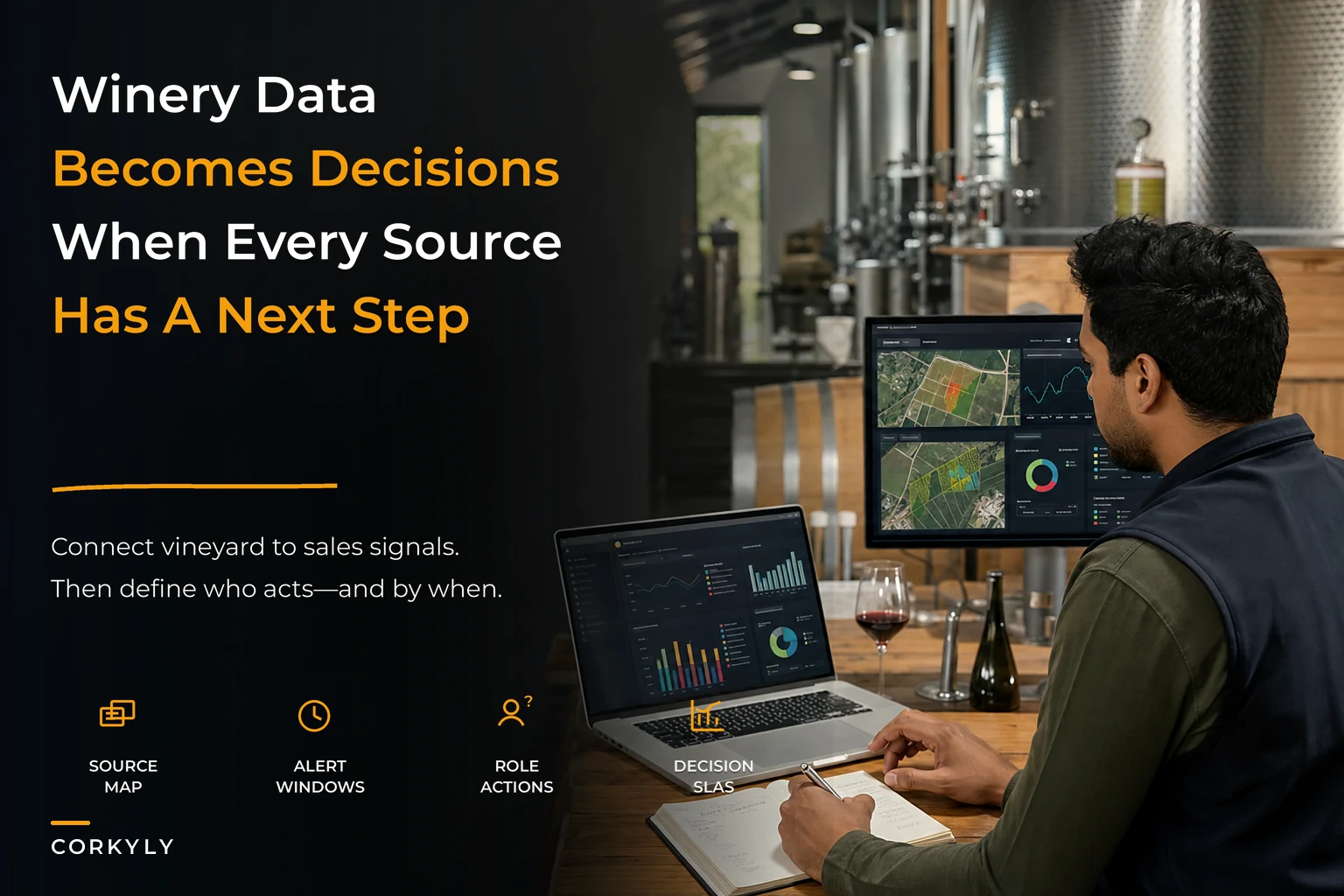

Most wineries don't have a data problem. They have a wiring problem. The vineyard collects readings, the lab runs its panels, the cellar logs every punch-down and pump-over, and the sales team tracks depletions in some spreadsheet nobody else can find. Each piece exists. What almost never exists is the connective tissue — the part that turns four separate streams into one picture someone can actually act on before the window closes.
That's the difference between a winery that has data and one that runs on it. And the gap between those two states isn't a software purchase. It's a progression. You move through stages, and at each stage a different thing breaks. Skip a stage and the thing that breaks next hits harder, because you never fixed what was underneath it.
This roadmap covers four maturity stages — what each source contributes at each stage, how alerts get wired, what decision SLAs look like, and the triage rituals that keep the whole thing honest. Think of it less as a ladder and more as a diagnostic. You can be at Stage 3 in the cellar and Stage 1 in sales, and that mismatch is usually where the real money leaks.
The four stages, at a glance
Most wineries live somewhere between Stage 1 and Stage 2 and assume they're further along than they are.
| Stage | What it looks like | Data flow | Decision speed | Typical failure |
|---|---|---|---|---|
| 1 — Recorded | Data exists, lives in separate books/sheets | Manual, siloed | Days to weeks | "Where's that number?" |
| 2 — Visible | Dashboards per department, still manual updates | Batch, delayed | 1–3 days | Everyone sees different truths |
| 3 — Connected | Sources linked, role dashboards, alerts fire | Near-real-time | Hours | Alert fatigue, no SLA |
| 4 — Governed | Alerts tied to owners, SLAs, triage rituals | Automated, accountable | Minutes to hours | Complacency, drift |
The label isn't the point. What matters is noticing that as you move down the table, the bottleneck shifts. At Stage 1, the bottleneck is finding the number. At Stage 4, it's discipline — keeping the rituals alive after the novelty wears off.
Stage 1 — Recorded: the data exists but nobody can assemble it
At Stage 1, every source is doing its job in isolation. The vineyard manager keeps spray logs and irrigation notes, often on paper or a phone. The lab spits out TA, pH, VA, free and total SO₂ into a notebook or a PDF from the analyzer. The cellar crew writes ferment temps and Brix on a whiteboard or a clipboard clipped to the tank. Sales tracks orders in the POS and depletions in a distributor portal.
Streamline your winery operations effortlessly.
Corkyly helps you track, manage, and optimize every step from vine to bottle.
- Vineyard & production tracking
- Customer relationship management
- Inventory & sales analytics
No credit card required
None of these talk to each other. The tell is a specific sentence you'll hear in the office: "Give me twenty minutes, I'll find it."
The real cost at this stage isn't the missing dashboard — it's the reconciliation tax. A typical example: the cellar master pulls a lab result showing a lot creeping toward VA trouble, but the sampling date on the lab sheet doesn't line up with the tank log, and now someone spends half a morning figuring out whether the VA reading is from before or after the last topping. The number existed the whole time. The context didn't.
Stage 1 is survivable at 3,000 cases. At 15,000 cases across a dozen lots, the reconciliation tax compounds. Every lot you add multiplies the number of "which version is right" conversations. You don't feel it as one big failure — you feel it as a slow bleed of afternoons.
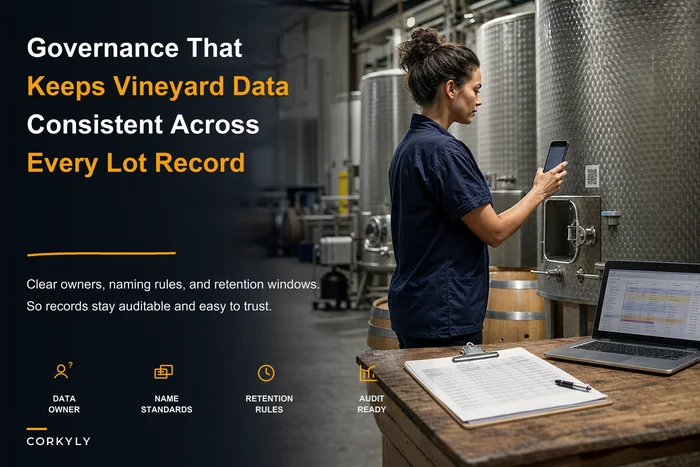
If you're at Stage 1, the only move that matters is standardizing how records are named and owned before you connect anything. Connecting messy sources just spreads the mess faster. Getting your naming, ownership and retention rules sorted first is boring work, and it's the single highest-leverage thing you can do before touching a dashboard.
Stage 2 — Visible: everyone has a dashboard, and they all disagree
Stage 2 is where most wineries feel proud and then get quietly confused. Each department now has some view. The lab has a chemistry tracker. The cellar has a ferment board. Sales has a depletions report. The vineyard has a spray and irrigation log in an app.
The problem is they're built independently, updated on different cadences, and defined differently. The vineyard's "Block 7" is the cellar's "Tank 12 lot" is sales' "Estate Cab" — and nobody wrote down that those three things are the same fruit. So when the owner asks a cross-cutting question — what's our true cost and current inventory on the estate Cab program? — three people give three answers, all defensible, all slightly wrong.
-
A lot passes lab spec but the cellar dashboard shows it's already been allocated to a blend, and sales has already promised it to a distributor — three green dashboards, one impossible commitment.
-
Harvest intake numbers on the cellar board don't match the yield estimates the vineyard logged, and nobody notices until month-end reconciliation, when the tonnage variance is too large to explain easily.
The fix isn't more dashboards. It's a shared vocabulary — a single map that says this block feeds these lots which become these SKUs. Without that spine, every dashboard is an island. This is also the stage where people start measuring the wrong things, because the easy number is visible and the right number is buried. There's a whole discussion of which KPIs actually move margins versus which just look busy that applies directly here.
Stage 3 — Connected: sources link, role dashboards appear, alerts start firing
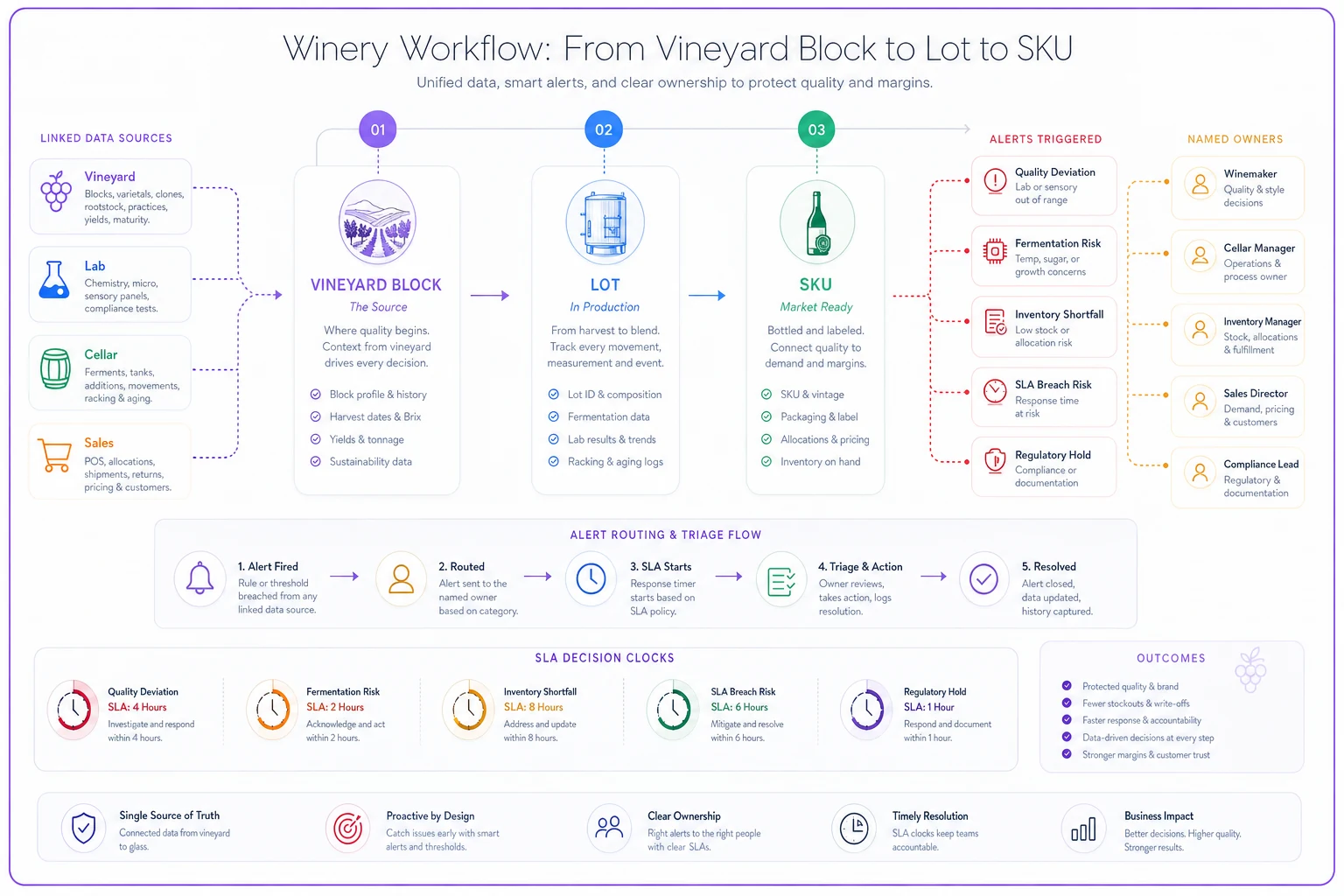
Stage 3 is the first stage that actually feels different. The four sources are linked through a shared spine — block to lot to SKU — so a lab result automatically ties to the right tank, which ties to the right vineyard block, which ties to the right sales program.
Dashboards get built by role instead of by department:
-
Vineyard manager view block-level phenology, irrigation status, spray intervals, pest thresholds, and how each block's fruit is tracking against its intended lot.
-
Winemaker/cellar view ferment curves, chemistry trends per lot, blend composition, and tank availability against the harvest schedule.
-
Sales lead view live inventory by SKU tied to actual cellar states (not last month's guess), depletions, and allocation headroom.
-
Owner view the cross-cutting one — cost per lot, margin per SKU, and where the constraint is this week.
Alerts start firing too. A ferment stalls, an alert goes out. VA crosses a threshold, an alert goes out. A SKU's allocation drops below a set floor, an alert goes out. That shift — from "someone remembers to check" to "the number tells you" — is the real upgrade of Stage 3. AI-powered operational platforms are useful here precisely because automated monitoring can watch multiple thresholds across sources simultaneously without anyone having to log in and look.
But Stage 3 without discipline creates alert fatigue faster than Stage 2 created confusion. When everything fires an alert, nothing does. The winemaker starts ignoring the ferment alerts because most of them are false alarms from a sensor placement issue. The sales lead mutes the inventory alerts because they fire every time someone opens a case for a tasting.
A common pattern: a winery wires up 40 alerts in the first month at Stage 3, feels great about it, and by week six the whole team has muted most of them. They're technically at Stage 3 and functionally back at Stage 2 — with a false sense of security layered on top, which is worse than where they started.
Alerts without ownership and thresholds without SLAs are noise with good intentions.
Stage 4 — Governed: alerts have owners, decisions have deadlines
Stage 4 is the difference between a system that tells you and a system you actually run on. Three things get added at this stage, and all three are organizational, not technical.
1. Every alert has a named owner. Not a department — a person, with a backup. The VA-threshold alert goes to the winemaker, backed by the cellar lead. The allocation-floor alert goes to the sales lead, backed by the ops manager. If an alert fires and nobody's name is on it, it doesn't exist.
2. Every decision type has an SLA. This is the piece almost nobody has, and it's what separates real operations from dashboards-as-decoration. An SLA is simply: when this alert fires, a decision must be made and logged within X. Here's a starting framework:
| Alert type | Severity | Decision SLA | Owner | Escalation if missed |
|---|---|---|---|---|
| Ferment stall / temp excursion | Critical | 2 hours | Winemaker | Owner, same day |
| VA / microbial trend breach | High | Same day | Winemaker | Cellar lead + owner |
| Allocation floor breach | High | 24 hours | Sales lead | Ops manager |
| Yield vs. intake variance | Medium | 3 days | Ops manager | Owner at month-end |
| Spray interval / compliance | Critical | 4 hours | Vineyard mgr | Owner + compliance |
Name an owner (and a backup) before you automate an alert — ownership is the smallest step that prevents alert inertia.
The exact numbers matter less than the fact that they exist and everyone agreed to them. An SLA turns "we'll get to it" into "the clock is running."
3. Triage and experiment rituals. This is the heartbeat — the short standing rhythm that keeps the system honest:
-
Daily 10-minute triage (harvest/ferment season) walk the critical and high alerts from the last 24 hours. For each — decided, in progress, or escalated? Anything past SLA gets flagged.
-
Weekly cross-source review vineyard, cellar, lab, and sales looking at the same role dashboards. The point is catching cross-cutting conflicts — the promised-but-allocated lot problem — before they become commitments.
-
Monthly reconciliation yield vs. intake, allocated vs. depleted, cost per lot vs. plan. This is where drift surfaces.
-
Experiment log when someone tries something — a new ferment temp profile, a different pick-decision trigger, a revised allocation rule — it goes in a log with a hypothesis and a check-back date. Six months later you can actually tell whether it worked instead of arguing from memory.
The unique failure at Stage 4 isn't chaos — it's complacency. The system runs smoothly and people stop questioning it. Thresholds set for a cool vintage don't get revisited in a hot one. An alert owner leaves and nobody reassigns their alerts. The rituals get skipped during crush because everyone's slammed, which is exactly when you need them most. Stage 4 isn't a destination; it's a discipline.
A real scenario: the mid-size estate stuck between Stage 2 and 3
An estate winery, roughly 18,000 cases, 22 lots across two vineyards. Good people, good fruit, dashboards everywhere — solid Stage 2. Their recurring pain was allocation collisions: lots getting promised to distributors while still earmarked for a reserve blend, and vice versa. It happened three or four times a quarter, and each collision meant an awkward call, a scramble, or a lot pulled from a program at the last minute.
They didn't buy more dashboards. They built the block-to-lot-to-SKU spine, wired inventory alerts to actual cellar states, and assigned the allocation-floor alert to the sales lead with a 24-hour decision SLA and a weekly cross-source review.
Within a quarter or so, allocation collisions dropped to roughly one — and that one got caught in the weekly review before anything was promised. The month-end reconciliation, which used to eat most of a day chasing tonnage and inventory variances, came down to an hour or two because the variances surfaced weekly instead of monthly. Nobody's revenue tripled. What changed was quieter than that: fewer surprises, fewer scrambles, and a team that stopped arguing about whose number was right.
When pushing to the next stage makes sense — and when it doesn't
Moving up a stage costs real effort, and it's not always worth it.
When it makes sense:
-
You're adding lots or SKUs faster than your current setup can reconcile — complexity is outgrowing the wiring.
-
You're making cross-source decisions (allocation, blending, pick timing) and getting burned by conflicting numbers.
-
You've got the people to own alerts and hold the rituals. Stage 4 with no one to run triage is worse than a disciplined Stage 3.
When it's a bad idea:
-
Your foundation is messy. Connecting Stage 1 records into Stage 3 alerts just automates the confusion.
-
You're a small, tight operation where the winemaker sees everything anyway. A 4,000-case single-vineyard producer may run beautifully at a clean Stage 2 — forcing Stage 4 rituals on three people is bureaucracy for its own sake.
-
You can't commit to the rituals. Alerts and SLAs you'll ignore are worse than not having them, because they breed false confidence.
If your naming and ownership rules aren't settled yet, don't be thinking about Stage 3. Sort the foundation first. Everything above assumes your sources agree on what "Block 7" means.
The checklist: where are you actually?
Run through this honestly per source, not for the winery as a whole. The mismatches between sources are the most useful part of the exercise.
-
[ ] Can any team member find any operational number in under five minutes without asking someone?
-
[ ] Do vineyard, cellar, lab, and sales use the same names for the same fruit/lot/SKU?
-
[ ] Is there a written map connecting blocks to lots to SKUs?
-
[ ] Do dashboards update automatically, or does someone paste numbers in?
-
[ ] When something crosses a threshold, does an alert fire — or does someone have to notice?
-
[ ] Does every alert have a named owner and a backup?
-
[ ] Does every decision type have a time-bound SLA that people actually honor?
-
[ ] Do you hold a triage ritual during crush without fail?
-
[ ] Is there an experiment log so you can tell what actually worked last vintage?
If you're checking most of the top boxes and none of the bottom ones, you're a strong Stage 2 pretending to be a Stage 3. That's the most common place to be — and being honest about it is the whole point.
Where this leaves you
The winery analytics maturity roadmap isn't about buying the fanciest platform. It's about matching your wiring to your complexity, and being honest about which stage you're actually at per source. The vineyard, lab, cellar, and sales don't fail because the data is missing — they fail at the seams, where one source's truth is supposed to hand off to the next and doesn't.
The wineries that run well aren't the ones with the most dashboards. They're the ones where every alert has a name on it, every decision has a clock, and the weekly review catches the collision before it becomes a phone call to a distributor. Start with the foundation, connect deliberately, and don't wire an alert you're not willing to own. The stage you're at matters far less than whether you're honest about it.
The wineries that run well aren't the ones with the most dashboards. They're the ones where every alert has a name on it, every decision has a clock, and the weekly review catches the collision before it becomes a phone call to a distributor. Start with the foundation, connect deliberately, and don't wire an alert you're not willing to own. The stage you're at matters far less than whether you're honest about it.
Ready to elevate your winery management?
Join 500+ wineries using Corkyly to increase operational efficiency, boost customer loyalty, and grow sales.