


Three weeks ago, a vineyard manager in Paso Robles told me they spent four hours reconstructing spray history for a single block because their viticulturist saved files as "Block7spray" while their compliance officer searched for "B7pesticide_application." Different names, same data, zero connection. The organic certification auditor wasn't impressed.
This disconnect between vineyard and cellar data happens everywhere. Walk into any winery office and you'll find harvest samples labeled "CSeast9-15" in one spreadsheet and "CabSauvBlockESept15" in another. Same fruit, different records, broken traceability. Then the winemaker calls it "Tank 12 source" while accounting needs it as "2024CSLot47" for cost analysis.
Most wineries treat data governance like equipment maintenance—something to think about after things break. Your assistant winemaker creates a new fermentation template because they can't find last year's version. Your vineyard crew chief starts tracking irrigation in a personal notebook because the shared drive is chaos. Your compliance manager builds shadow spreadsheets because they don't trust the "official" records.
The operational cost hits harder than people realize. When you can't quickly pull five years of spray records for a sustainability audit, you're looking at 20-30 hours of reconstruction work. When barrel data lives in three different formats across two cellar workers' computers, your monthly inventory takes twice as long. When nobody knows whether "ML complete" means malolactic fermentation finished or just inoculated, you're making blending decisions on assumptions.
Why vineyard and cellar data turns into operational quicksand
The fragmentation starts innocently. Your vineyard foreman creates a spray log that makes sense to them. Your cellar master builds a fermentation tracker that matches their workflow. Your lab tech designs a sample database that fits their testing sequence. Each system works perfectly in isolation.
Then harvest hits and everything collides.
The vineyard crew logs pick data by block number and date. The receiving crew records it by variety and tonnage. The cellar team tracks it by tank destination. Lab enters it by sample ID. Accounting needs it by contract grower. Five departments, five naming systems, zero coordination.
This isn't a technology problem. Plenty of wineries with expensive software still have data chaos. Most operations never establish who actually owns specific data categories. Is spray timing vineyard data or compliance data? Who decides the format for fermentation records—the winemaker or the assistant who actually enters it? When the TTB wants three years of production records and your cellar team has turned over twice, who even knows where to look?
The scaling problem makes it worse. A 5,000-case operation might survive with loose data practices. The winemaker remembers which lots went where, the vineyard manager keeps everything in their head, one person handles compliance. But hit 15,000 cases and those mental systems collapse. New staff can't access institutional knowledge. Audits become archaeological expeditions. Simple questions like "What was our average Brix at harvest for Cab blocks over the last five years?" turn into multi-day projects.
Year one: "We'll organize everything after harvest." Year three: "We need to standardize, but we're too busy." Year five: "We should probably hire someone to fix our data." Year seven: crisis audit, failed traceability exercise, or recall scare forces emergency reconstruction of years of records.
Most wineries think upgrading software will solve the problem. It won't. You can't buy your way out of structural chaos with better spreadsheets or fancier databases.
Field naming standards that actually stick (because nobody follows the 47-page manual)
Forget complex naming taxonomies. The wineries with functional data governance use dead-simple standards that people actually follow. The key is making the right way easier than the wrong way.
Streamline your winery operations effortlessly.
Corkyly helps you track, manage, and optimize every step from vine to bottle.
- Vineyard & production tracking
- Customer relationship management
- Inventory & sales analytics
No credit card required
Start with blocks and vineyard locations. Pick one format and enforce it everywhere. Block naming follows a simple pattern: [Year planted][Variety][Block number]. So you get 2018CS12, not Block12, not CabSauv12, not B-12-CS.
This seems basic until you realize most operations have three different block numbering systems—the original planting map, what the crew chief calls them, and whatever got entered into your compliance software.
For spray and treatment records, timestamp everything consistently using this format: [Date][Block][Material][Application type]. Example: 2024-03-152018CS12SulfurFoliar.
The date-first format means files automatically sort chronologically. The block identifier ties directly to your master list. The material name uses the exact product label name, not abbreviations or trade names that change.
Fermentation and cellar operations need parallel structure. Lot tracking follows [Vintage][Variety][Lot number][Current vessel], like 2024PN047T15. Process records use [Date][Lot][Process][Operator initials], such as 2024-10-122024PN047InoculationJM.
Lab data follows the lot with this format: [Date][Lot][Analysis type][Replicate if needed]. Example: 2024-10-152024PN047MLChromatography.
Every identifier builds on previous ones. You can trace from a lab report back through cellar operations to the specific vineyard block without translation tables or institutional knowledge.
Use dropdowns tied to the master block list in entry templates to eliminate typos and local abbreviations.
The enforcement mechanism matters more than the standard itself. Create template files with the naming convention pre-filled. Lock the folder structure so people can't create random subdirectories. Set up your software to reject entries that don't match the format. Make compliance automatic, not aspirational.
Data ownership matrices that prevent the "whose job was that?" spiral
Clear ownership prevents data rot. But most wineries never explicitly assign data responsibilities, assuming everyone knows their role. They don't.
Build an ownership matrix that answers three questions for every data type: Who creates it? Who maintains it? Who approves changes?
Vineyard Data Ownership
| Data Category | Creator | Maintainer | Approver | Backup Owner |
|---|---|---|---|---|
| Block maps/boundaries | Vineyard Manager | GIS Contractor | Owner/GM | Vineyard Foreman |
| Spray/treatment records | Applicator | Compliance Manager | Vineyard Manager | PCA |
| Irrigation logs | Irrigator | Vineyard Foreman | Vineyard Manager | Assistant Manager |
| Harvest chemistry | Lab Tech | Lab Manager | Winemaker | Assistant Winemaker |
| Yield estimates | Vineyard Manager | Vineyard Manager | Winemaker | Owner/GM |
Cellar Data Ownership
| Data Category | Creator | Maintainer | Approver | Backup Owner |
|---|---|---|---|---|
| Fermentation logs | Cellar Worker | Cellar Master | Winemaker | Assistant Winemaker |
| Barrel records | Cellar Master | Cellar Master | Winemaker | Cellar Worker |
| Bottling records | Bottling Lead | Production Manager | Winemaker | Assistant Winemaker |
| Blend records | Winemaker | Assistant Winemaker | Winemaker | Lab Manager |
| Addition logs | Cellar Worker | Cellar Master | Winemaker | Compliance Manager |
The backup owner matters when your cellar master quits mid-harvest or your compliance manager goes on maternity leave. Someone needs to know where the files live and how to maintain continuity.
But ownership without access control means nothing. Your spray applicator shouldn't be able to delete three years of records accidentally. Your newest cellar worker shouldn't modify locked fermentation data from previous vintages. Set up permission levels that match ownership.
Create levels include adding new records. Edit allows modifying existing records with version tracking. Approve means locking records as final. Delete access should be nearly nonexistent. View provides read-only access for everyone else.
This seems paranoid until someone accidentally overwrites your entire 2023 harvest chemistry dataset the week before your organic audit.
Retention schedules that match both compliance and operational reality
TTB wants three years. Your sustainable certification needs five. Your insurance company says seven. Your winemaker wants forever. Without a clear retention schedule, you either keep everything (data hoarding) or delete randomly (compliance nightmare).
The practical approach: keep the longest required retention period for each category, then add one year as buffer.
Regulatory-Driven Retention Timeline
-
TTB Basic Records
3 years minimum (keep 4)
-
Pesticide/Chemical Applications
7 years for California (keep 8)
-
Organic Certification Records
5 years (keep 6)
-
Employee Safety Training
5 years (keep 6)
-
HACCP/Food Safety
2 years past product expiration (keep 3)
Operational Retention Guidelines
-
Harvest Chemistry
Permanent (needed for vintage comparisons)
-
Fermentation Curves
10 years (useful for style consistency)
-
Blend Records
Permanent (brand history)
-
Vineyard Yields
Permanent (replanting decisions)
-
Weather/Irrigation
10 years (climate analysis)
The trick is automating retention so nobody has to remember to delete or archive. Set up folder structures by year, then script automatic archival. Active folders contain the current vintage plus one prior. Archive folders hold 2-10 years old data as read-only. Deep storage handles 10+ years with compressed, off-site backup.
Most operations skip the deletion step entirely, which creates its own problems. When you have 15 years of daily tank samples cluttering your system, finding anything recent becomes impossible. Build deletion into your calendar.
January involves archiving previous vintage cellar operations. March requires deleting tank samples older than 3 years. June means archiving spray records to compliance folders. September calls for cleaning up harvest prep data from 5+ years ago.
Low-friction enforcement: templates and workflows that make compliance automatic
The best data governance system is one nobody notices they're following. This means building compliance into daily workflows, not adding extra steps.
Start with template files that enforce standards automatically. Instead of hoping people name things correctly, create pre-formatted templates with filenames pre-populated with dates, tank numbers in dropdown menus (preventing "Tank 12" when it should be "T12"), lot numbers auto-pulled from active fermentation lists, and required fields highlighted until completed.
Your spray record template pulls block names from a master list—no manual entry, no variations. Your fermentation log template carries forward the previous day's data, only requiring updates to what changed. Your lab analysis template auto-calculates key metrics and flags outliers.
The workflow integration matters more than the template design. If your cellar team has to open three programs to log one pumpover, they'll skip it. If your vineyard crew needs to return to the office to enter spray data, it won't happen accurately. Build data capture into existing routines through QR codes on tanks that link directly to the correct template, mobile-friendly forms for vineyard data entry, automatic data sync from lab equipment to database, and daily email summaries requiring manager confirmation.
Morning Cellar Routine with Built-in Data Governance
-
Scan tank QR code (opens correct template)
-
Enter temperature and Brix (required fields)
-
Select additions from dropdown (standardized naming)
-
Submit form (auto-saves with correct filename)
-
Manager receives summary email by 10am
-
Any missing data flags automatically
-
Weekly report compiles all submissions
Visual workflow of the morning cellar routine:
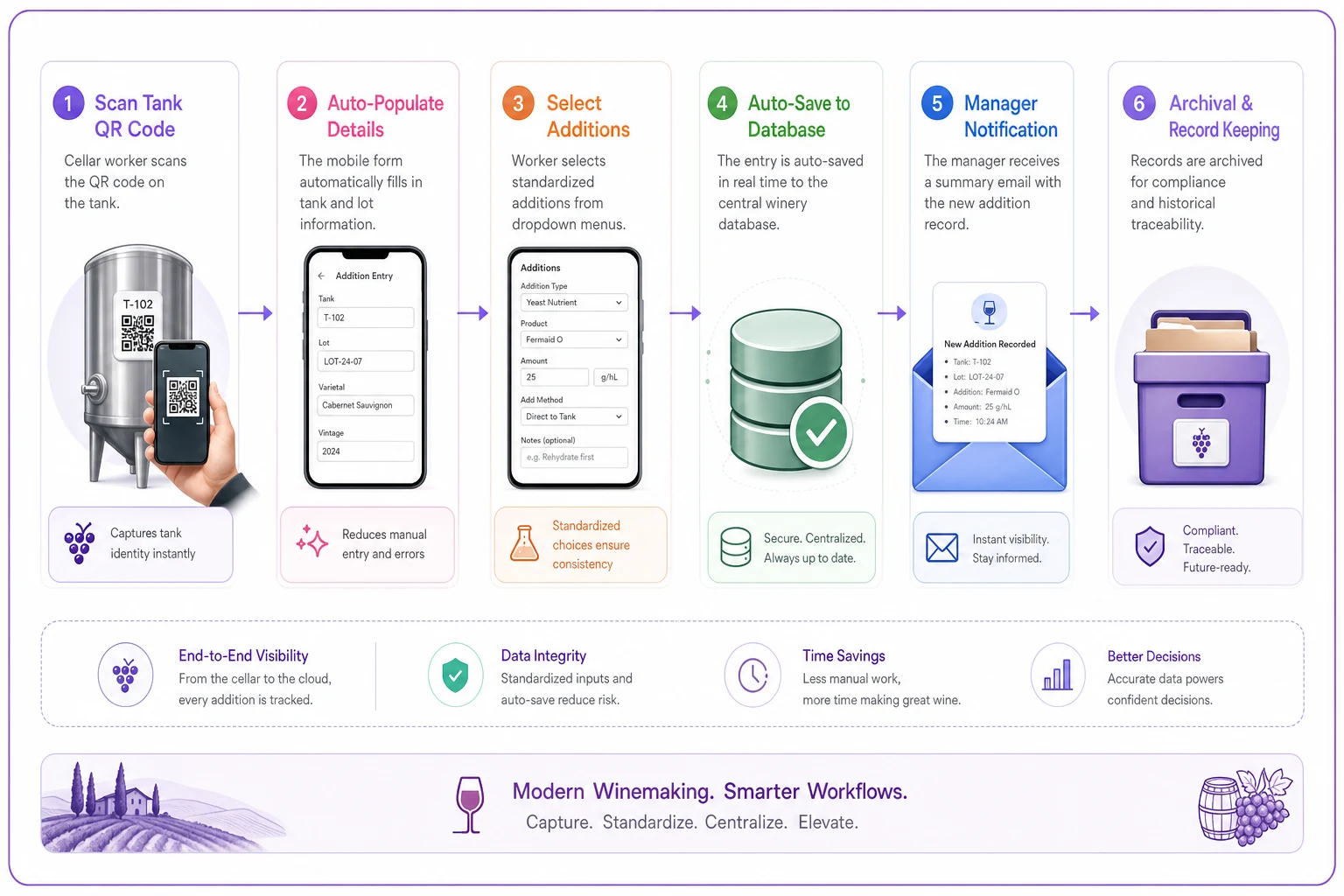
The enforcement comes from making non-compliance harder than compliance. When the only way to log a fermentation is through the template, naming standards become automatic. When managers get automatic alerts about missing data, gaps get filled quickly.
Cross-department visibility without the political warfare
Data silos create operational blindness. The winemaker doesn't know what the vineyard sprayed last week. The compliance manager can't access current tank configurations. The CFO has no visibility into cellar additions affecting COGS. Everyone protects their spreadsheets like state secrets.
The solution isn't forcing everyone into one system—that usually fails spectacularly. Instead, create read-only dashboards that pull from source data without requiring department surrender.
Set up hub-and-spoke visibility where each department maintains their source data (ownership preserved), automated scripts pull key metrics to shared dashboards, read-only access prevents accidental changes, and updates happen automatically overnight.
Your vineyard dashboard shows recent spray applications pulled from compliance system, current irrigation status from SCADA or logs, harvest projections from vineyard estimates, weather data from station feed, and upcoming work orders from planning calendar.
Your cellar dashboard displays active fermentations with current status, tank configuration and capacity, recent additions and treatments, upcoming bottling schedule, and current barrel inventory.
The compliance dashboard aggregates days since last spray by block, PHI/REI status for all applications, upcoming audit requirements, missing or incomplete records, and certification deadline countdown.
Crucially, nobody can edit these dashboards—they only display. This removes the fear of other departments messing with "my" data while providing the visibility everyone needs.
Making data governance work when everyone claims they're too busy
The standard excuse: "We'll fix our data systems after harvest/bottling/pruning/budbreak." Translation: never. Data governance only works when it reduces work, not adds to it.
Start with the highest-pain audit or compliance requirement. If your organic certifier regularly flags incomplete spray records, fix that first. If inventory reconciliation takes three days every month, start there. Pick one specific problem that currently wastes 10+ hours monthly.
For a 8,000-case winery struggling with organic compliance documentation, the process looks like this:
Week 1-2: Establish spray record ownership. The vineyard manager owns creation while the compliance manager owns retention. Create a single spray log template and lock down folder structure.
Week 3-4: Standardize block naming. Map all variations currently in use, pick single standard format, update all active documents, and create reference sheet for crew.
Week 5-6: Build enforcement workflow. Install QR codes on spray rigs with links to templates, set up daily email summaries to compliance, create weekly missing data reports, and establish monthly audit prep checklists.
Week 7-8: Train and adjust. Run morning tailgate training for crew, have compliance manager review process, adjust template based on feedback, and lock in process before next spray.
This focused approach delivers visible results in two months, not two years. Once people see spray audits dropping from 20 hours to 2 hours, they'll buy into expanding the system.
AI-powered operational software: where automation makes governance invisible
The wineries getting data governance right are increasingly turning to operational platforms that bake standards into the software itself. Instead of hoping people follow naming conventions, the system enforces them automatically. Instead of manually compiling reports, AI agents pull and organize data continuously.
Modern operational software handles the thankless governance tasks including automatic file naming based on your standards, instant flags when someone deviates from established formats, continuous backup and version control, automated retention and archival, and real-time missing data alerts.
More importantly, these platforms eliminate the friction that makes governance fail. When your cellar worker scans a tank QR code, the system knows which template to open, what lot is inside, and what data is required. When your vineyard foreman logs a spray application, the software automatically checks it against your permitted materials list and PHI requirements.
AI automation particularly helps with extracting data from inconsistent historical records, identifying duplicate or conflicting entries, standardizing abbreviations and shortcuts, flagging suspicious data patterns, and generating compliance reports automatically.
The best implementations feel invisible. Your team follows their normal workflow while the system handles governance in the background. No extra steps, no complicated training, no constant reminders about proper formatting.
The real cost of chaotic data (and what improves when you fix it)
A Sonoma operation with 400 acres and 30,000 cases spent roughly $67,000 last year on data-related inefficiencies. Not IT costs—pure operational waste from duplicate work, missed opportunities, and audit scrambles.
They burned 180 hours reconstructing spray records for sustainability audit, 96 hours monthly reconciling inventory across systems, 240 hours annually preparing various compliance reports, lost 3 days of production from incorrect blend documentation, paid $8,000 in rush fees for missing TTB documentation, and handled 2 customer complaints from incorrect tech sheets.
After implementing basic data governance, spray record reconstruction dropped to 12 hours (versus 180), monthly inventory reconciliation fell to 8 hours (versus 96), compliance reports required only 60 hours annually (versus 240), production delays from documentation disappeared, rush fees for compliance eliminated, and tech sheets began auto-generating from verified data.
The improvements cascade through operations. When your winemaker can instantly see five years of fermentation curves for similar lots, they make better protocol decisions. When your vineyard manager can quickly analyze spray efficacy across blocks, they optimize applications. When ownership can see accurate cost-per-gallon including all additions and treatments, they price more strategically.
But the biggest gain might be institutional knowledge preservation. When your veteran cellar master retires, their 20 years of fermentation wisdom doesn't walk out the door. When your compliance manager takes another job, the next person doesn't start from scratch rebuilding traceability systems. Good data governance transforms from compliance burden into competitive advantage. Your operation responds faster to market changes, optimizes production more precisely, and scales growth without operational chaos.
Ready to elevate your winery management?
Join 500+ wineries using Corkyly to increase operational efficiency, boost customer loyalty, and grow sales.