

The gap between "we found some leafhoppers" and "we sprayed block 7 on the 14th" is where most vineyard pest programs quietly fall apart. Somebody scouts, sees a few pests, gets nervous, and calls for a spray. Or the opposite: a real threshold gets crossed, nobody flags it, and two weeks later you're staring at a defoliated canopy edge on your best Cab block.
Neither of those is a knowledge problem. Most vineyard managers know the pests. What they're usually missing is a numeric line in the sand — a specific count that triggers a specific response, and a response ladder that starts with the least aggressive option instead of jumping straight to a broad-spectrum material.
That's the piece that makes vineyard IPM thresholds actually work in the field: not the biology, but the decision architecture around it.
Why "spray when it looks bad" quietly destroys your program
The problem with eyeballing pressure is that it drifts. Early in the season a scout might call two mites per leaf "fine." By August, after a few hot weeks and some crew fatigue, that same scout calls two mites per leaf "we should probably do something." Same number, different decision. Nothing in the vineyard changed except mood and the calendar.
What tends to happen across a lot of operations is that this drift almost always errs toward over-spraying. It feels safer to spray than to hold. Nobody gets fired for spraying a block that maybe didn't need it. People do get chewed out for a block that got hammered. So the incentive quietly pushes every ambiguous call toward the tank.
The fix isn't more discipline. It's removing the judgment call from the moment of stress and putting it into a table you built ahead of time, when nobody was panicking.
Build the numeric threshold table before the season, not during it
A threshold table is boring and that's the whole point. It should be specific enough that two different scouts standing in the same row reach the same decision.
Streamline your winery operations effortlessly.
Corkyly helps you track, manage, and optimize every step from vine to bottle.
- Vineyard & production tracking
- Customer relationship management
- Inventory & sales analytics
No credit card required
Here's the shape of one for a typical North Coast red program. Your actual numbers should come from your farm advisor and local extension — these are illustrative of the structure, not universal truths.
| Pest | Sampling unit | Watch level | Action threshold | First response |
|---|---|---|---|---|
| Western grape leafhopper | nymphs per leaf (avg of 20 leaves) | 5–10 | 15+ nymphs/leaf pre-veraison | Beneficials check → soft material if predators absent |
| Pacific/Willamette mite | mites per leaf (avg of 20) | 3–5 | 7–8/leaf with <1 predator mite | Restore predator ratio → oil/soft miticide only if ratio fails |
| Vine mealybug | males per pheromone trap/week | 5–20 | Sharp rise + crawlers on trunk | Mating disruption first, targeted material second |
| Grape berry moth | moths per trap/week | 3–5 | Sustained catch + degree-day timing | Bt / targeted ovicide at model-predicted window |
| Powdery mildew | risk index (Gubler-Thomas or similar) | index 40–60 | index 100 or symptoms found | Tighten sulfur/oil interval before stepping up |
Two things matter more than the exact figures.
First, the sampling unit is fixed. "A lot of leafhoppers" means nothing. "Average of 20 leaves, three panels per block, nymphs counted on the underside" means something a second person can reproduce. If your unit isn't nailed down, your threshold is fiction.
Second, notice the watch level sits well below the action level. The watch number isn't a trigger to spray — it's a trigger to scout more often. That single distinction prevents most of the panic spraying, because it gives the pressure somewhere to go besides the tank.
The conservative, non-chemical-first ladder
The action threshold tells you when to respond. The ladder tells you how, and it should always start at the bottom rung.
A general-purpose ladder looks like this:
-
Confirm the count. Re-scout or have a second person verify before anything else. A surprising share of "threshold exceeded" calls don't survive a recount, especially late in a long scouting day.
-
Check the beneficials. Predator mites, spiders, lacewing larvae, parasitized mummies. If the good bugs are present and climbing, the ratio may resolve on its own. Spraying broad-spectrum here is the classic own-goal — you kill the thing that was about to fix your problem.
-
Cultural or mechanical adjustment. Leaf pulling for airflow, adjusting irrigation to reduce vine stress that favors mites, dust control on end rows. Vine stress and mite outbreaks track together more than people expect, which is one reason your water decisions and your pest decisions shouldn't live in separate binders — the block-ranking approach to irrigation under constrained water directly affects which blocks flare up first.
-
Soft materials. Horticultural oils, sulfur, Bt, insecticidal soaps, mating disruption. Selective, short residual, low collateral damage.
-
Targeted conventional material. Only when the soft rung failed or the count is climbing fast enough that soft won't hold.
-
Broad-spectrum. The rung you're trying almost never to reach.
The rule that makes this work: you don't skip rungs without a written reason. If the ladder says try oil first and you go straight to a conventional miticide, fine — but the note in the record has to say why (crawlers already at economic density, weather window closing, whatever). That one habit does more to reduce overuse than any single product choice, because it forces the person to articulate the jump instead of defaulting to it.
Sampling cadence templates that match the pest, not the calendar
Fixed weekly scouting sounds disciplined but it wastes labor early and misses spikes late. Cadence should tighten as risk climbs.
A workable template:
-
Dormant to budbreak trap placement, baseline checks. Low effort.
-
Budbreak to bloom every 10–14 days, full block rotation. You're establishing the season's baseline counts here.
-
Bloom to veraison weekly for most pests; twice weekly for anything sitting in its watch band. This is where the watch-level trigger earns its keep — a block hits watch, its cadence doubles automatically, no meeting required.
-
Veraison to harvest weekly, plus tighter attention on mealybug and berry moth where bunch-zone damage and contamination risk peak.
-
Post-harvest wind-down checks, note which blocks needed the most intervention so next year's plan starts smarter.
The pattern worth stealing: cadence is a function of the count, not the date. A block sitting quietly gets scouted less. A block flirting with threshold gets watched closely. This is the opposite of the flat weekly schedule most crews run, and it's how you free up scouting hours for the blocks that actually need eyes.
If you're already pulling NDVI or thermal layers, those maps can tell you which blocks to scout harder before you even walk in — stress signatures often precede visible pressure. Turning those layers into a prioritized scouting route is covered in prioritizing vineyard work from NDVI and thermal maps.
Escalation rules: who decides, and how fast
A threshold table is useless if the person who finds the count can't act on it. Most delays aren't biological — they're organizational. The scout texts the manager, the manager is in a tasting, the reply comes at 6pm, the applicator is already gone for the day, and now you've lost 48 hours on a pest that doubles in a week.
Write escalation rules that name the decision-maker at each level:
-
Watch level crossed scout increases cadence and logs it. No approval needed.
-
Action threshold crossed, soft-material response scout or crew lead can trigger the first ladder rung within the pre-approved material list. Manager notified, not asked.
-
Skipping a rung / conventional material manager approval required, with the written reason.
-
Broad-spectrum manager plus whoever handles compliance/residue timing signs off, because now you're into PHI and re-entry interval territory that touches harvest scheduling.
The principle: push the low-risk decisions down and reserve approvals for the decisions that actually carry risk. When every spray needs a manager's blessing, the manager becomes the bottleneck and the whole program slows to the speed of one busy person's inbox.
A real scenario
A mid-size operation — around 90 acres, mostly reds, family-run with two full-time vineyard staff and seasonal crew. Their pattern before fixing this: roughly 8–9 cover sprays a season, heavy reliance on two chemistries, and a recurring late-season mite flare on the warmest hillside blocks that got treated reactively every August.
The problem wasn't the pests. Scouting notes lived in a notebook, thresholds were "in the manager's head," and every ambiguous count defaulted to a spray because that felt safer.
They did three things. Fixed the sampling unit (20 leaves, three panels, counted the same way every time). Built a threshold table with watch and action levels split apart. Wrote a non-chemical-first ladder with the skip-a-rung reason requirement.
First season, sprays dropped to around 6. The two hillside mite flares got caught at watch level, cadence doubled automatically, and the predator-mite check on rung two meant one of them resolved without any material at all. Nothing dramatic. Just fewer tank fills, less wear on their overworked chemistries, and records that actually explained why each decision got made.
That last part mattered more than the spray count. When their certifier came through, the notes answered the questions before they were asked.
When a strict threshold program makes sense — and when it doesn't
When it makes sense:
-
You farm enough blocks that scouting decisions get inconsistent across people
-
You're managing resistance and need to justify every use of your key chemistries
-
You're in a certification program where defensible records matter
-
You've noticed your spray count creeping and suspect over-application
When it's overkill:
-
A tiny estate block one person scouts and sprays themselves — the table lives in their head reliably because it's one head
-
Situations where regulatory or contract requirements already dictate a rigid calendar spray you can't deviate from
Who should be careful: operations that adopt the table but never revisit the numbers. Thresholds drift with variety, region, and season. A table you built three years ago and never touched can be as misleading as no table at all. Review it against last season's outcomes every winter.
Where the records come in
None of this survives contact with a busy harvest season if it lives on paper. The threshold table, the cadence, the ladder, the escalation rules — they only reduce overuse if the count-to-decision loop is fast and the reasoning gets captured at the time of the decision, not reconstructed a week later.
That's where AI-powered operational software earns its spot. A scout enters a count on a phone in the row, the system compares it to the threshold table, flags watch vs. action, tightens the cadence on that block automatically, and routes the escalation to the right person.
The written reason for skipping a rung gets attached to the spray record at the moment of decision — not because the software is doing anything complicated, but because the whole point of a threshold program is removing judgment from the stressful moment, and a platform that enforces the ladder and logs the reasoning does exactly that.
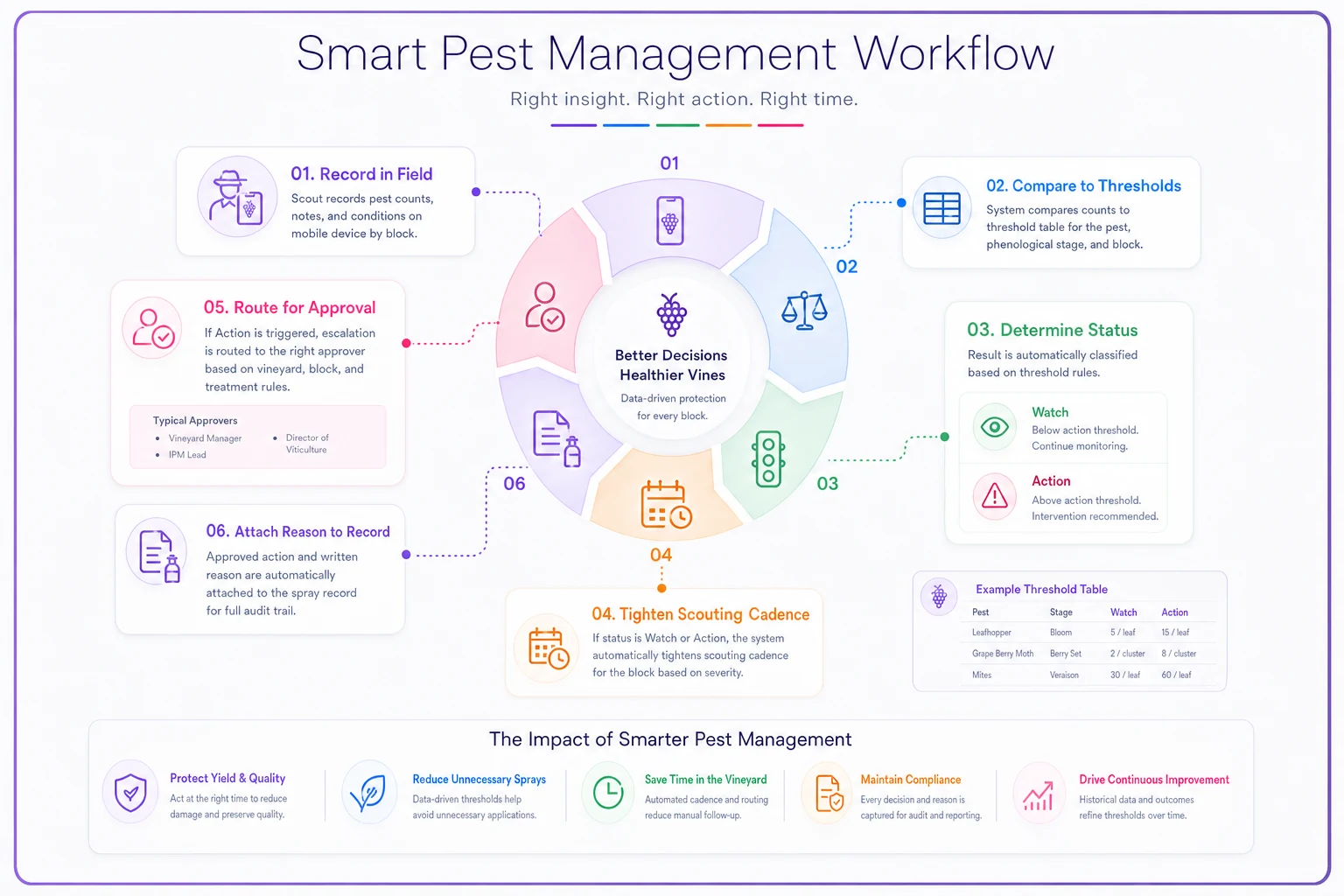
When the system enforces those steps and captures the notes in real time, the record answers the question of "why" without reconstructing events later.
The payoff isn't just fewer sprays. It's that six months later, when someone asks why block 7 got treated on the 14th, the answer is right there: the count, the threshold it crossed, the rung you tried first, and the reason you moved when you did. That's a defensible program — and it usually turns out to be a cheaper one, too.
Ready to elevate your winery management?
Join 500+ wineries using Corkyly to increase operational efficiency, boost customer loyalty, and grow sales.