

The dangerous moment in yield estimation isn't the number itself. It's the confidence you attach to it. A vineyard manager walks a block, grabs a mental average, and calls the buyer with "we're looking at about 4.2 tons an acre on the Cab." That number gets written into a purchase contract, and suddenly a rough guess is carrying legal and financial weight it was never built to hold.
The gap between "my estimate" and "my estimate plus or minus how much" is where wineries lose money every single harvest. Sometimes it's a shortfall penalty. Sometimes it's a tank you emptied out for fruit that never fully materialized. Sometimes it's the opposite — you underestimated, sold the surplus at spot prices weeks too early, and left $18k on the table.
This piece is about the small, boring math that closes that gap. Not modeling. Not a data-science project. A pre-harvest yield estimation protocol you can actually run with a clipboard and a phone calculator in the last 7–10 days before pick, and defend when someone questions it.
The mistake that starts everything: sampling like you're confirming, not measuring
Most block sampling in the field is quietly rigged. Not on purpose — it's just human. Someone walks the outside two rows because they're easiest to reach, picks vines that "look about right," and skips the scrawny corner near the road because it's obviously not representative.
That last decision is the killer. That corner is representative. The whole point of sampling is that you don't get to decide which vines count. The moment you start choosing, your sample stops describing the block and starts describing your expectations.
In practice, this shows up as estimates that are consistently optimistic by 8–15%. Not random error — a lean, every year, in the same direction. When a block over-delivers it feels like a nice surprise, so nobody investigates. When it under-delivers, weather gets blamed. The sampling bias never gets caught because the feedback is asymmetric.
The fix is to remove judgment from vine selection before you ever walk the row. Decide your sample vines with a rule, not an eye.
A simple, honest sampling layout
You don't need a randomized statistical design. You need a systematic one that a crew can execute the same way twice.
Streamline your winery operations effortlessly.
Corkyly helps you track, manage, and optimize every step from vine to bottle.
- Vineyard & production tracking
- Customer relationship management
- Inventory & sales analytics
No credit card required
-
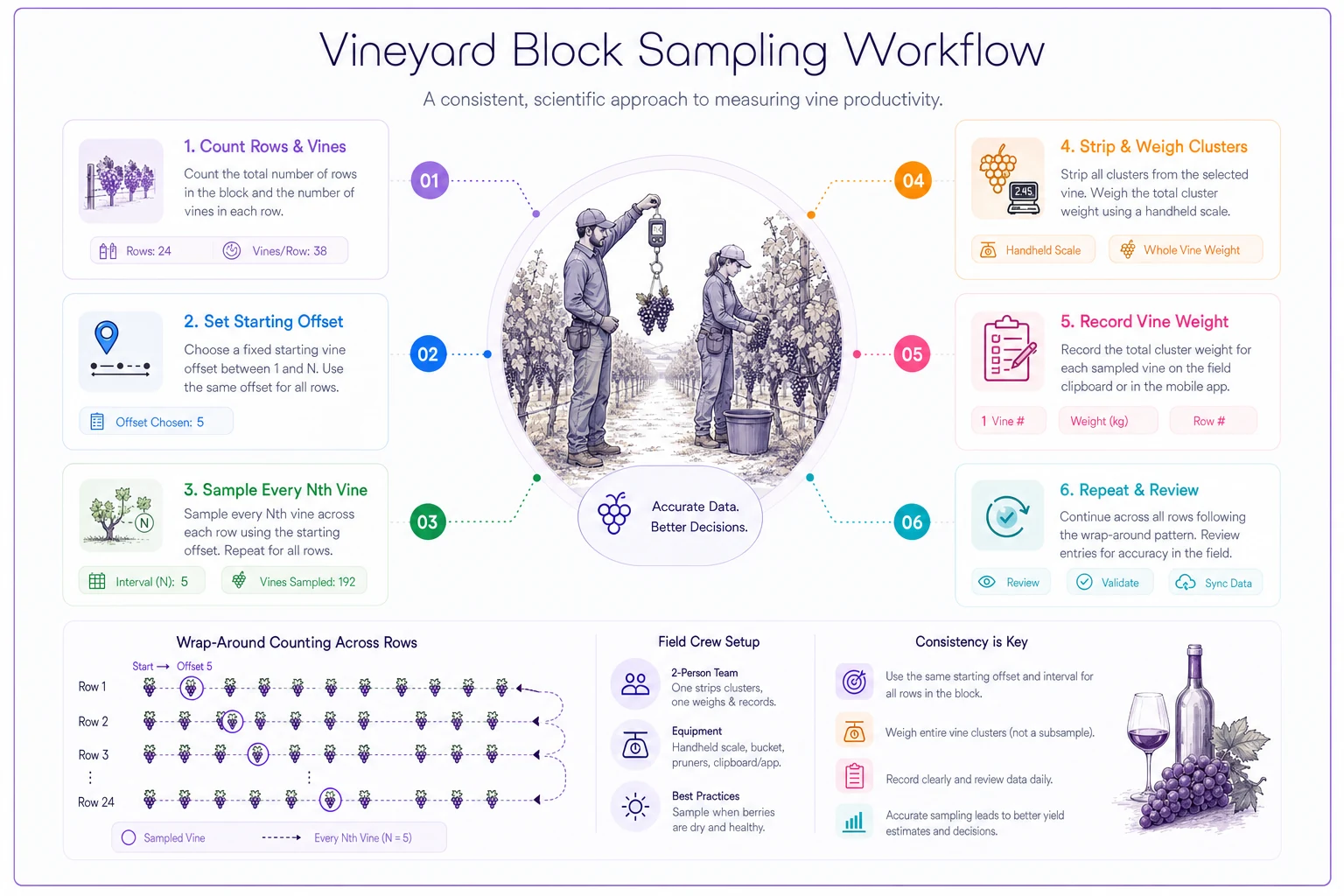
Count your rows and vines. Say the block is 40 rows, roughly 110 vines per row. That's about 4,400 vines.
-
Pick a sampling interval. For a block that size, sample every Nth vine to land on 40–60 sample vines total. Sampling every 88th vine gets you ~50 samples spread across the whole block.
-
Use a fixed starting offset. Start at vine 12 in row 1, then count forward at your interval, wrapping across rows. This forces you through interior rows, edge rows, weak corners, and vigorous middles without picking any of them.
-
Weigh whole vines, not clusters you like. Strip and weigh every cluster on each sample vine. Counting "average clusters" and multiplying is where a second bias sneaks in — heavy vines carry more and bigger clusters, so cluster-count math understates the spread.
-
Record each vine weight separately. You need the individual numbers, not just the total, because the spread between vines is what tells you how much to trust the average.
That last point is where almost everyone cuts the corner. They write down one total and one average. Then they have no way to answer the only question that matters: how wrong could this be?
Write the sampling interval and starting offset on the crew clipboard so everyone follows the rule consistently.
Here's a quick visual of the sampling workflow to run in the field.
That last point is where almost everyone cuts the corner. They write down one total and one average. Then they have no way to answer the only question that matters: how wrong could this be?
The confidence check that takes two minutes
You don't need a stats degree. You need to know roughly how tight your estimate is, so you know how much cushion to build into a contract.
-
Average fruit weight per vine
4.1 kg
-
Vine weights ranging from about 2.3 kg up to 6.8 kg
-
A standard deviation (the spread) of roughly 1.2 kg
Margin ≈ 2 × (standard deviation ÷ √sample size) So: 2 × (1.2 ÷ √50) = 2 × (1.2 ÷ 7.07) = 2 × 0.17 ≈ 0.34 kg per vine.
That means your true average vine weight is very likely between 3.76 kg and 4.44 kg — roughly a ±8% band on your per-vine number.
Now scale it to the block. 4,400 vines × 4.1 kg = about 18,040 kg, or roughly 19.9 tons. Your ±8% band puts the block somewhere between 18.3 and 21.5 tons.
Why the spread matters more than the average
Two blocks can have the same 4.1 kg average and behave completely differently.
| Metric | Block A (uniform) | Block B (patchy) |
|---|---|---|
| Avg vine weight | 4.1 kg | 4.1 kg |
| Std deviation | 0.6 kg | 1.9 kg |
| Margin on mean (50 vines) | ±0.17 kg (~4%) | ±0.54 kg (~13%) |
| Estimated block tons | ~19.9 | ~19.9 |
| Defensible range | 19.1–20.7 t | 17.3–22.5 t |
Same headline number. Wildly different risk. If you signed the same tight contract on both, Block B is a coin-flip on whether you deliver, and the average told you nothing about that. The practical read: a wide spread means either sample more vines or contract more conservatively. A patchy block isn't a bad estimate — it's an honest one telling you it needs a bigger cushion.
Turning the range into a contract number
This is the step that separates a field estimate from a business decision. You have a range. Now you have to pick the number you'll actually commit to, and that number depends entirely on which way the penalty cuts.
-
If the contract penalizes shortfall (you owe money or lose the buyer if you under-deliver), commit near the bottom of your defensible range. On Block B above, you'd promise closer to 17.5–18 tons, not 20. You'd rather over-deliver and negotiate the surplus than eat a shortfall penalty.
-
If you have flexible buyers and spot demand is strong, you can commit nearer the middle and hold the upside for spot sales.
-
If cellar capacity is the binding constraint, the estimate feeds tank planning, not sales — and here the top of the range matters, because that's the fruit you have to physically handle if the block over-delivers.
Worth naming explicitly: the same estimate produces different contract numbers depending on which constraint is tightest. Managers who commit "the estimate" as a single figure are ignoring that. The number you write down should already have the penalty structure baked in.
A real scenario: the 62-ton block that became 71
A mid-sized producer in a warm inland AVA — around 140 acres, selling roughly a third of their fruit under contract — had a Petite Sirah block contracted at 62 tons based on a walk-through estimate.
Their old method was eyeball plus last year's number. This season they ran a systematic sample: every 90th vine, 48 vines total, individual weights recorded. The average came in high, and — more importantly — the spread was tight, standard deviation around 0.7 kg. The margin of error worked out to roughly ±4%, putting the block between about 68 and 74 tons, centered near 71.
The contracted 62 was low by nearly nine tons. Nine tons of Petite Sirah they'd already mentally committed to a bulk buyer at a soft price.
Because they caught it eight days out with a defensible range — not a hunch — they had time to line up tank space and hold the surplus for a better spot deal instead of dumping it. The extra tonnage cleared somewhere in the $14k–$17k range above what the original contract would have captured. The sampling took two people about half a day.
The lesson wasn't "sample more." It was that a tight confidence band gave them the nerve to act on the number instead of hedging.
When this protocol actually makes sense
When this protocol actually makes sense
-
Blocks going into fixed-tonnage contracts with penalties either direction
-
Blocks where cellar intake timing depends on knowing size in advance — the same coordination problem that shows up in harvest logistics across multiple microclimates, where an under-called block jams the crush pad and an over-called one strands trucks
-
Any block where last year's number and this year's canopy clearly don't match
When this protocol actually makes sense
When it's a bad idea (or overkill)
When it's a bad idea (or overkill)
-
Tiny estate blocks you're keeping whole regardless — the estimate doesn't change any decision, so precision is wasted labor
-
Blocks with severe uneven ripening where you'll pick in multiple passes; a single pre-harvest number misrepresents fruit you'll harvest across two weeks anyway
-
When you genuinely don't have half a day per contracted block. In that case, sample the highest-dollar blocks and accept eyeball estimates on the low-stakes ones. Don't pretend to precision you didn't measure.
When it's a bad idea (or overkill)
Who should not lean on this alone
If your yield history is chaotic year to year — new plantings, recent trellis changes, blocks recovering from stress — a single week-before sample won't save you, because you have nothing stable to sanity-check against. Pair the field numbers with the vigor patterns you're already seeing in your imagery.
Reading a block's uniformity from NDVI and thermal layers turned into actual tasks tells you before you sample whether to expect a tight or a patchy spread — which in turn tells you how many vines to weigh. That sequencing matters. Going into a sample blind about canopy variability means you might under-sample a genuinely patchy block and walk away with false confidence.
Keeping the numbers usable across blocks
The quiet failure of yield estimation isn't the math — it's that the numbers live in three different notebooks and a text thread, so nobody can compare this year to last, or one block to its neighbor. When you record individual vine weights, sample interval, date, and the resulting range in one consistent place, the estimate becomes something you can actually audit.
That's where a shared operational platform earns its keep: not by doing the sampling for you, but by making sure the standard deviation you calculated in the field is sitting next to the contract you signed. So next year you can see exactly how far off you were and why. AI-assisted operational software can flag when a block's sampled range is unusually wide compared to prior seasons, or when the contracted tonnage sits outside the defensible range you recorded — the kind of cross-season pattern matching that's genuinely tedious to do manually across 20 or 30 blocks.
Estimates you can't compare are just guesses with extra steps.
The short version
Run the sample with a rule, not an eye. Record every vine weight, not just the total. Do the two-minute margin calculation so you have a range instead of a point. Then pick your contract number from the end of that range the penalty structure tells you to fear.
The whole thing fits in a morning. What it buys you is the ability to defend a tonnage commitment when the buyer pushes back — and the nerve to hold surplus fruit for a better price instead of panic-selling a number you were never sure of in the first place.
The whole thing fits in a morning. What it buys you is the ability to defend a tonnage commitment when the buyer pushes back — and the nerve to hold surplus fruit for a better price instead of panic-selling a number you were never sure of in the first place.
Ready to elevate your winery management?
Join 500+ wineries using Corkyly to increase operational efficiency, boost customer loyalty, and grow sales.