
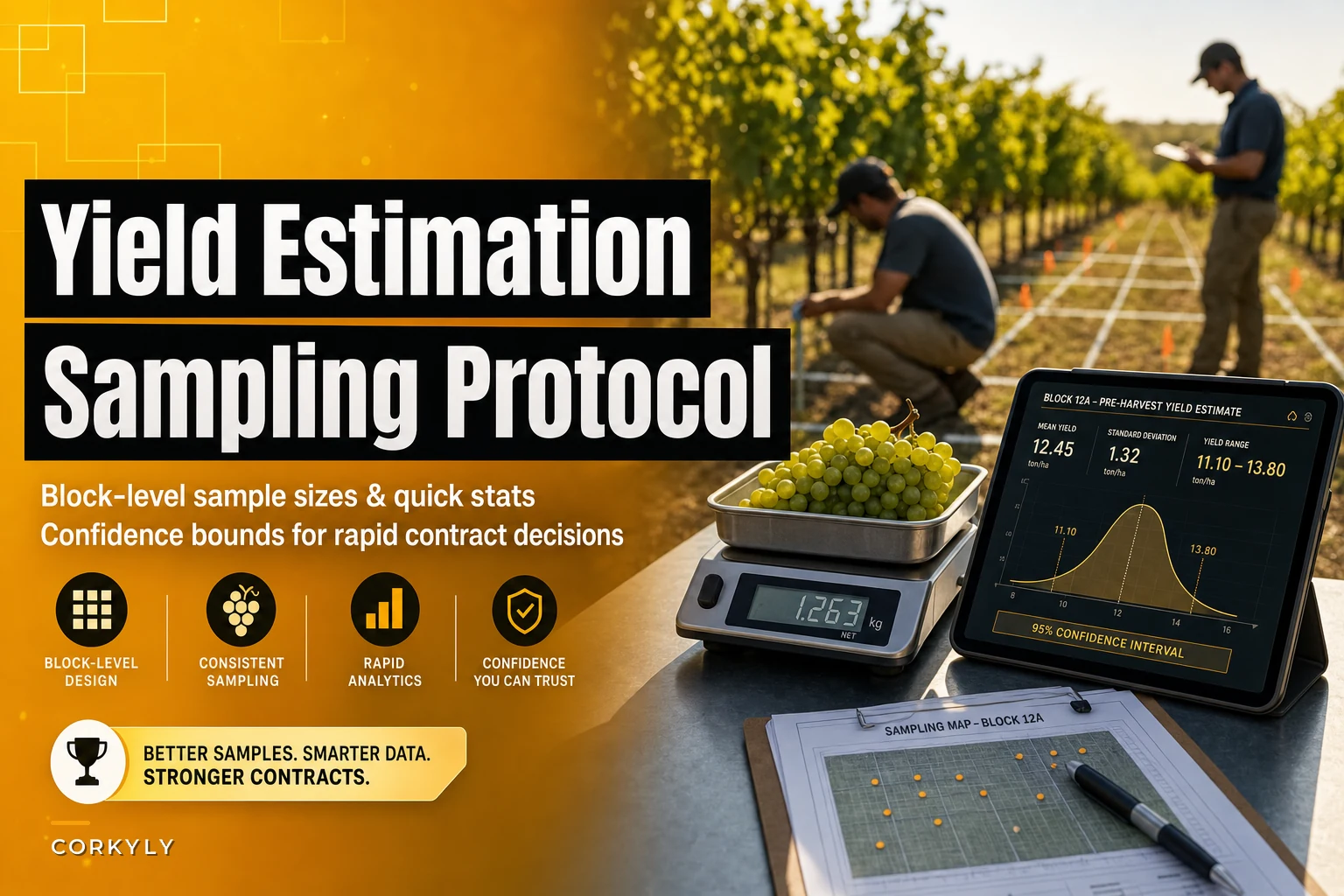

There's a specific kind of pain that shows up in mid-August: a buyer calls asking for a firm tonnage commitment on a Cabernet block, and the number you give them ends up being off by 18%. If you overpromised, you're scrambling to buy fruit or eating a penalty. If you underpromised, you left money on the table and the buyer moved their crush allocation elsewhere. Either way, the problem wasn't the vineyard — it was the sampling.
Most yield estimation goes wrong not because people don't count clusters, but because they count them badly and then treat one guess as gospel. This post covers the actual protocol: how many vines to sample per block, how to attach a defensible confidence range to your estimate, and how to run the math fast enough that a crew can do it in the field the week before picking starts.
The real reason August estimates blow up
The core issue is variability. A block isn't uniform. You've got vigor differences from soil changes, an end row that always ripens weird, a low spot that held water, a stretch near the road that gets dusted every time a truck goes by. When someone walks the block, eyeballs "a good year," and multiplies last year's per-acre number by a fudge factor, they're ignoring all of that variance.
The second problem is sample placement. People sample where it's convenient — near the equipment shed, along the headland, the first few rows off the access road. Those vines are almost never representative. Edge vines get more light and airflow and tend to carry more fruit. If your sample is 60% edge vines, your estimate runs hot.
The third one is quieter: nobody writes down the spread. They record an average cluster count and an average cluster weight, produce a single tonnage figure, and hand it over with zero sense of how wide the real range is. A single number implies certainty you don't have. When a buyer hears "42 tons," they plan for 42 tons. When they get 34, that's on you.
What a defensible estimate actually needs
Three inputs, each with its own variability:
Streamline your winery operations effortlessly.
Corkyly helps you track, manage, and optimize every step from vine to bottle.
- Vineyard & production tracking
- Customer relationship management
- Inventory & sales analytics
No credit card required
-
Cluster count per vine (or per unit length of canopy)
-
Average cluster weight at the sampling date
-
A growth-to-harvest adjustment factor for the weeks between sampling and pick
Estimated tons = (vines per acre × clusters per vine × cluster weight in grams × acres) ÷ 907,185 (That divisor converts grams to US tons. Use 1,000,000 if you're working in metric tonnes.)
The hard part isn't the multiplication. It's knowing how many vines to sample so your cluster count and cluster weight aren't garbage, and then translating the spread in your samples into a confidence range you can actually defend.
Sample size: how many vines per block
The honest answer is "it depends on how uneven the block is," but you need working numbers, not a statistics lecture. The practical rule: the more variable the block, the more vines you count — and blocks vary more than people expect.
A rough starting table for cluster counts, assuming you're sampling individual vines spread across the block:
| Block uniformity | Visual sign | Vines to count | Cluster weight samples |
|---|---|---|---|
| Very uniform | Even vigor, one soil type, flat | 20–30 vines | 50–80 clusters |
| Typical | Some vigor variation, minor slope | 40–60 vines | 100 clusters |
| Uneven | Mixed soils, low spots, vigor bands | 70–100 vines | 150+ clusters |
| Highly variable | Old block, replants, patchy | 100–150 vines | 200+ clusters |
Two things people get wrong with this table. First, they pick "very uniform" because it means less work, even when the block clearly isn't uniform. If you can see vigor bands from the end of the row, you're in the "uneven" category. Second, they under-sample cluster weight. Cluster count is cheap to gather; cluster weight is where a lot of the error hides, because a heavy year and a light year can differ by 30–40% on the exact same cluster count. Weigh more clusters than you think you need.
Divide the block into a rough grid and sample the same number of vines from each zone.
If your remote-sensing layers already show vigor zones, use them. We've written before about how to turn UAV and remote-sensing layers into daily tasks, and vigor maps are genuinely useful here — they tell you where the block breaks into different populations so you can sample each one instead of averaging across them blindly.
Turning your samples into a confidence range
This is the part most operations skip, and it's also the part that makes your number defensible. You don't need a statistics degree. You need the mean and standard deviation of your cluster counts, and the same for cluster weights.
-
Calculate the average cluster count across your sampled vines.
-
Calculate the standard deviation — most phones and every spreadsheet do this with one function (
STDEV). -
Divide the standard deviation by the square root of your sample size. That's your standard error.
-
Multiply the standard error by 2 for a roughly 95% confidence margin.
-
Express your estimate as a range, not a point.
A worked example. Say you counted clusters on 50 vines in a Chardonnay block and got an average of 38 clusters per vine, with a standard deviation of 9. Standard error = 9 ÷ √50 ≈ 1.27. Times 2 = about 2.5. So your cluster count is 38 ± 2.5 — meaning you're reasonably confident the true block average sits somewhere between 35.5 and 40.5 clusters per vine.
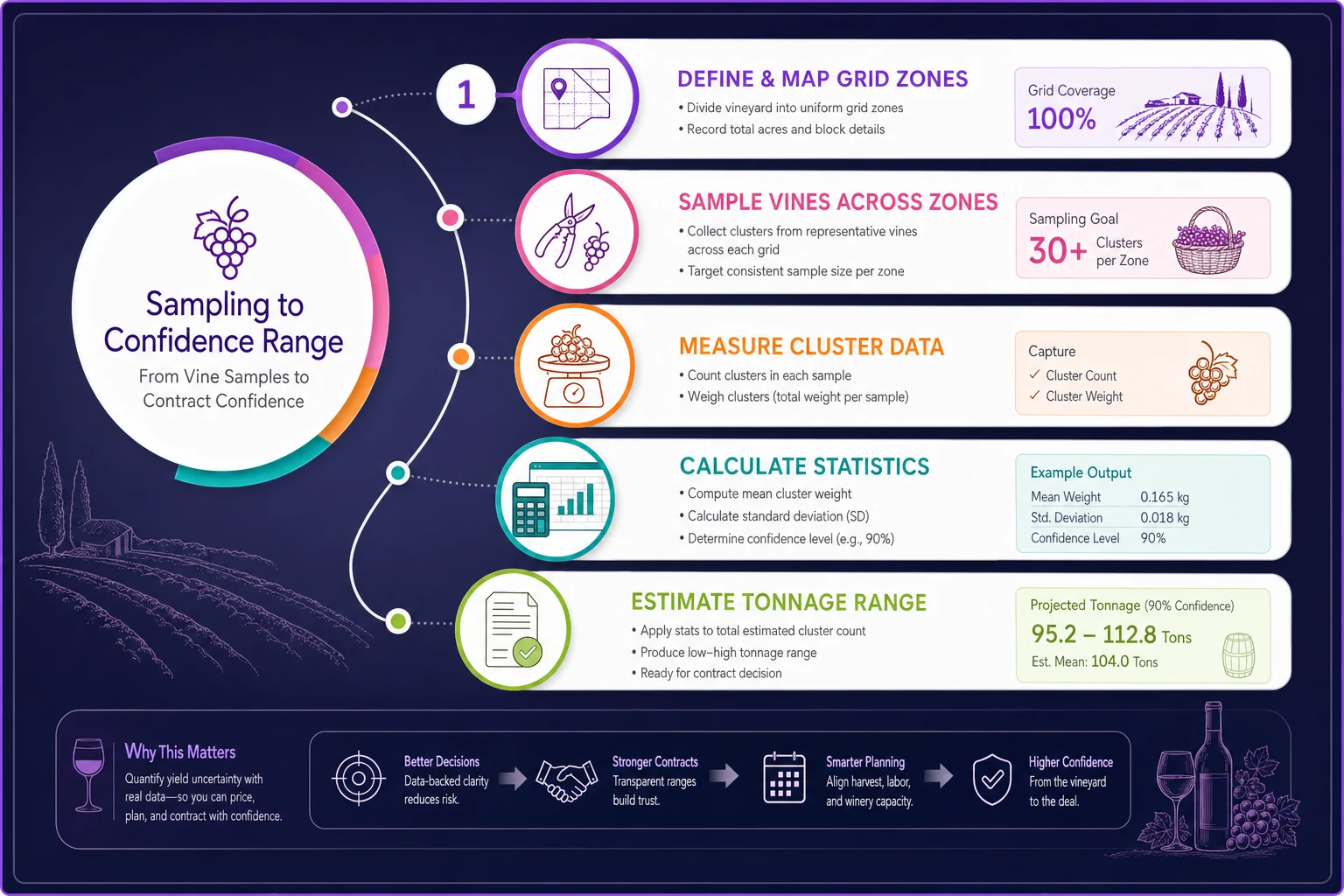
This diagram shows the sampling and calculation steps in sequence so the crew and manager can follow the process quickly.
Push that through the tonnage math with your cluster weight and acreage, and you get a tonnage range instead of a single number. That range is what you bring to the contract conversation. Telling a buyer "38–44 tons, most likely around 41" is more useful — and more defensible — than "42 tons" that turns out wrong.
The growth adjustment nobody documents
Sampling four weeks out means clusters are still gaining weight. If you don't account for that, you'll underestimate. The standard move is applying a lag-phase adjustment factor based on days from sampling to expected pick and the typical berry weight gain for that variety in your area.
The mistake is treating last year's factor as this year's truth. A hot September changes the weight-gain curve. A cool, drawn-out finish does the opposite. What tends to work is keeping a simple log per variety per block: sampling-date cluster weight, harvest-date cluster weight, and the ratio between them. After a few seasons you've got block-specific adjustment factors that beat any generic table. Until then, apply both an optimistic and a pessimistic factor and let it widen your confidence bounds honestly rather than pretending you know the exact multiplier.
When this level of rigor makes sense — and when it doesn't
When it's worth it: any block under contract, any block where you're deciding whether to buy or sell fruit, and any variety where cluster weight swings a lot year to year. If a wrong number costs you money or a relationship, sample properly.
When it's overkill: small estate blocks you're crushing yourself, where a miss just means shuffling tank space. You still want a decent estimate, but running 100 vines and confidence intervals on a two-acre block you control end to end isn't necessary.
Who should skip the heavy version: if you've got one uniform block, a stable variety, and five years of clean records showing your estimates land within 5%, don't overthink it. The protocol scales down. The point isn't ceremony — it's matching sampling effort to how much the decision costs if you're wrong.
A real scenario
A family-run winery in a warm inland district had a repeated problem with an 11-acre Zinfandel block sold to an outside buyer. For three seasons their pre-harvest estimate ran high — they'd forecast around 55 tons and deliver closer to 44. The buyer stopped trusting their numbers and started discounting the commitment, which hurt planning on both sides.
The issue was sampling location and cluster weight. The crew had been counting the first 25 vines off the road — the most vigorous, best-lit vines in the block — and using a cluster weight borrowed from a heavier variety by habit. Both inputs ran hot.
The fix wasn't complicated. They moved to a grid of roughly 60 vines across four vigor zones, weighed 150 clusters instead of guessing, and reported a range with a confidence bound. That season they forecast 46–52 tons, most likely 49, and delivered around 48. The buyer got a number they could actually plan against, and the discount on future commitments went away. Nothing about the vineyard changed. The sampling did.
Tying the estimate to harvest logistics
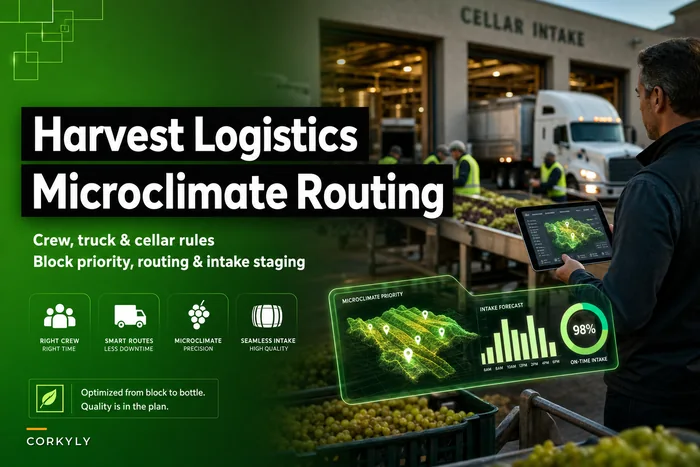
A yield range isn't just a contract input — it drives crew size, truck rotations, and cellar intake scheduling. If your confidence bound tells you a block could come in anywhere from 46 to 52 tons, you plan intake capacity for the top of the range and staffing for the middle. Feeding those ranges into your intake plan is how you avoid the bottleneck problems we covered in harvest logistics for multiple microclimates — you can't sequence pick days and press capacity sensibly if every block estimate is a single fragile number.
This is also where keeping estimates, sample records, and adjustment factors centralized pays off. When per-block sampling history, cluster weight logs, and confidence ranges live in one operational system rather than scattered across notebooks and text messages, next season's estimate starts from real data instead of memory. The growth-adjustment factors sharpen every year. The math stays simple; the record-keeping is what compounds.
The short version
Count enough vines for how uneven the block actually is. Sample across zones, not off the headland. Weigh more clusters than feels necessary. Report a range with a confidence bound instead of a single number, and let a wide range be a warning rather than something to hide.
Keep the sampling-to-harvest weight ratios per block so your adjustment factors improve every season.
Do that, and the August phone call stops being a gamble. You hand the buyer a number that holds — and when the fruit comes in, it lands inside the range you promised.
Ready to elevate your winery management?
Join 500+ wineries using Corkyly to increase operational efficiency, boost customer loyalty, and grow sales.