



Most vineyard managers already pull petiole or leaf-blade samples. The problem isn't sampling — it's the two-week gap between "lab report shows low potassium" and someone actually mixing a corrective and putting it on the block. During that gap the vine keeps developing, the deficiency deepens, and by the time the correction goes out, you've already lost the window where it would have done the most good.
This piece is narrow on purpose. Compressing that gap: a tight sampling protocol you can run without overthinking, clear thresholds so you're not sitting around debating whether a number is "kind of low," and immediate corrective recipes — material, dose, and timing — matched to growth stage and varietal sensitivity. That's the whole scope. Not soil chemistry theory, not fertigation program design. Just: sample, read, act, re-check.
The short sampling protocol (so you stop re-sampling badly)
The single most common reason tissue data is unreliable isn't lab error. It's inconsistent sampling. One year someone grabs blades, the next year petioles, and the tissue type changes the numbers enough that your "trend" is basically fiction. Pick a tissue and a timing and lock it in.
Two sampling windows carry almost all the decision value:
-
Bloom (petiole opposite the basal cluster) best for nitrogen, phosphorus, potassium, and the early micronutrient read. This is your action window — corrections here still change the current season.
-
Veraison (petiole or blade, same as prior years) best for confirming potassium status heading into ripening and catching late magnesium issues. Corrections here are mostly about protecting fruit quality, not fixing vigor.
Practical rules that keep the data clean:
-
Sample one block at a time, and only compare a block to itself over years — never block-to-block across different soils.
-
Pull 60–75 petioles per block, walking a diagonal, avoiding edge rows and any obviously stressed or virused vines.
-
Sample at the same phenological stage each year, not the same calendar date. A 10-day heat swing wrecks calendar-based comparisons.
-
Bag, label with block + date + tissue type, and get it on ice. Petioles degrade faster than most people assume.
-
Keep the same lab. Different labs use different extraction methods, and their "adequate" ranges won't line up.
If you're using imagery to decide which vines to scout, that's a separate but complementary workflow — worth reading how to turn UAV and remote-sensing layers into daily tasks so your sampling points are tied to where the canopy is actually telling you something rather than pulled at random.
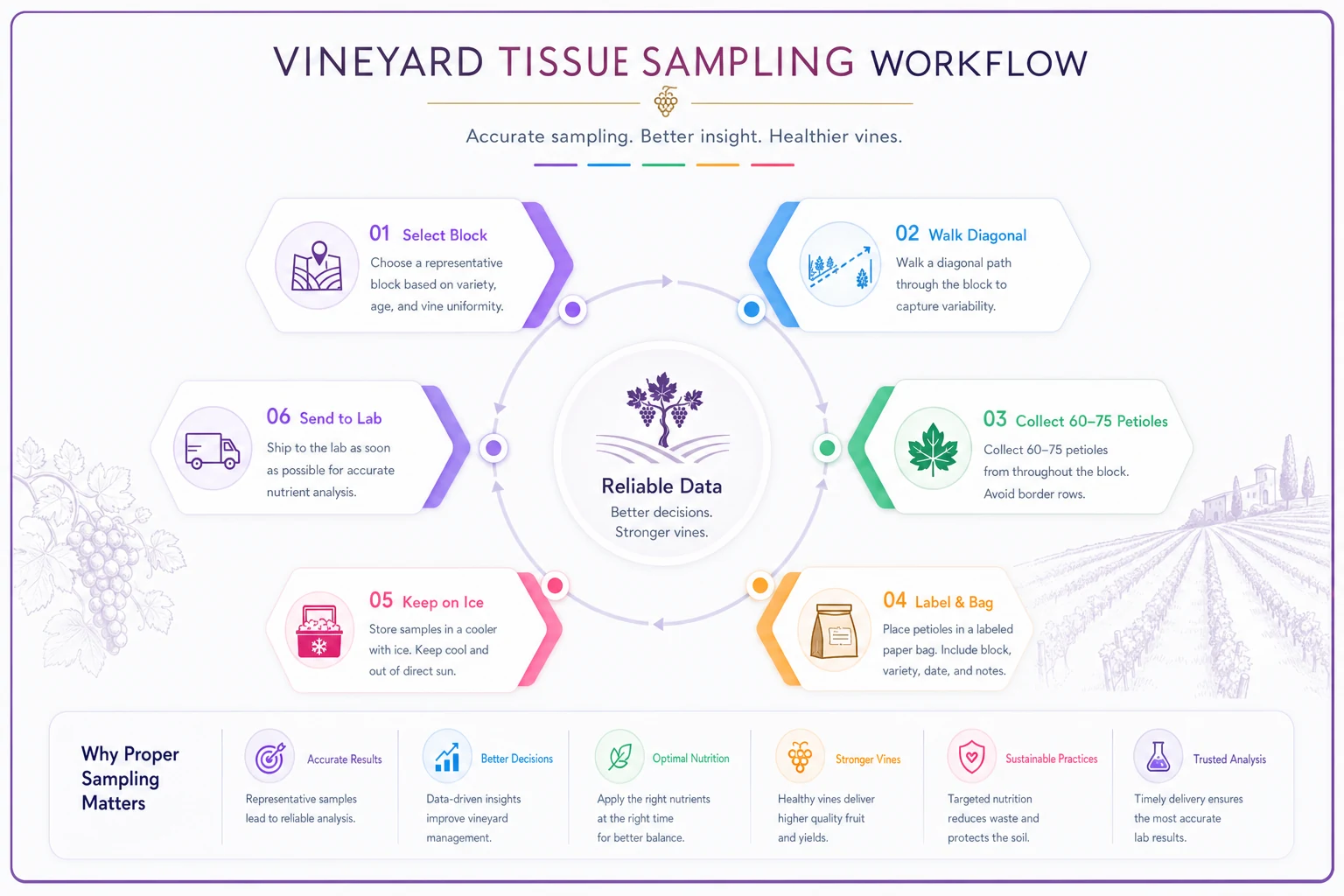
A visual checklist of these steps helps keep procedures consistent.
Interpretation thresholds without the hand-wringing
Labs hand you a range labeled "adequate," but ranges vary and managers freeze on borderline numbers. Build a simple three-tier read so a borderline value triggers a defined response instead of a debate.
Streamline your winery operations effortlessly.
Corkyly helps you track, manage, and optimize every step from vine to bottle.
- Vineyard & production tracking
- Customer relationship management
- Inventory & sales analytics
No credit card required
For a bloom petiole, a workable interpretation grid looks like this:
| Nutrient | Deficient (act now) | Marginal (correct + recheck) | Adequate |
|---|---|---|---|
| Nitrogen (%) | < 0.8 | 0.8–1.1 | 1.1–2.2 |
| Potassium (%) | < 1.2 | 1.2–1.5 | 1.5–2.5 |
| Magnesium (%) | < 0.25 | 0.25–0.35 | 0.35–0.8 |
| Phosphorus (%) | < 0.15 | 0.15–0.25 | 0.25–0.5 |
| Zinc (ppm) | < 15 | 15–25 | 26–50 |
| Boron (ppm) | < 25 | 25–35 | 35–70 |
Two things people get wrong here. First, potassium and magnesium fight each other — a "marginal" magnesium number sitting next to a high potassium number is a real deficiency in the making, not a coincidence. Read them as a pair. Second, boron has a narrow window; the gap between deficient and toxic is smaller than for anything else on the list, so under-correct rather than over-correct and re-check before you go again.
The tier that matters most operationally is Marginal. That's where most blocks land, and it's the one people ignore because it's not scary enough. The rule that saves you: marginal always gets a light corrective plus a mandatory follow-up sample. Never "wait and see" a marginal reading.
Immediate corrective recipes, tied to growth stage and varietal sensitivity
A recipe is only useful if it names the material, the dose, and the timing — and adjusts for how sensitive the variety actually is. Thin-skinned, tight-cluster varieties like Pinot Noir and some Chardonnay clones react faster to potassium and magnesium swings than thick-skinned high-vigor varieties, so you correct them earlier and gentler.
Foliar is your fast lever because it acts within days; soil and fertigation corrections are your durable lever but lag by weeks. For an in-season deficiency caught at bloom, foliar buys you the current vintage while a soil amendment sets up next year.
Nitrogen (marginal at bloom):
-
Foliar low-biuret urea, roughly 2–3 lb per 100 gal, one application, avoid hot afternoons to prevent leaf burn.
-
Sensitive varieties
split into two lighter passes 10 days apart rather than one heavy shot.
Potassium (deficient at bloom or veraison):
-
Foliar potassium sulfate or mono-potassium phosphate, 3–5 lb per 100 gal, applied in the cooler part of the day.
-
On tight-cluster reds heading into veraison, prioritize this — low K shows up as poor color and uneven ripening, and by then a soil application is too late for the current crop.
Magnesium (marginal-to-deficient):
-
Foliar Epsom salts (magnesium sulfate), 8–12 lb per 100 gal, two applications 10–14 days apart.
-
If potassium is high on the same report, plan a soil magnesium amendment for post-harvest; the foliar is only holding the line.
Zinc (deficient, common on sandy or high-pH sites):
-
Foliar chelated zinc at label rate, best applied pre-bloom for fruit-set benefit; a bloom application still helps the canopy.
Boron (deficient, but tread carefully):
-
Foliar boron, low rate (roughly 0.5 lb actual B per acre), pre-bloom for set. Do not stack multiple boron sprays without a follow-up tissue check — this is the one where over-correction actually hurts.
Tank-mixing note: don't combine a foliar micronutrient with a high-pH spray or certain fungicides without a jar test first. The number of corrections that failed because the material precipitated in the tank is higher than most people would guess.
A quick worked example
A 6-acre block of Pinot Noir on a gravelly bench. Bloom petioles come back potassium 1.3% (marginal) and magnesium 0.24% (deficient), with potassium sitting on the higher side relative to magnesium compared to prior years. Left alone, this is a color and ripening problem waiting to happen on a variety that punishes you for it.
The action: foliar magnesium sulfate at around 10 lb/100 gal, two passes 12 days apart, starting within a week of the report. Skip a heavy potassium push because K is only marginal and adding more deepens the magnesium antagonism. Flag a soil magnesium amendment for post-harvest. Then a confirmation petiole sample at veraison.
At veraison the re-check shows magnesium back up around 0.31% and potassium holding — not perfect, but out of the deficiency zone and moving the right direction. Cost of the two foliar passes was minor relative to what uneven ripening across the block would have done to the fruit sort at intake. The point isn't the exact numbers; it's that a defined recipe went out in days instead of weeks.
Follow-up sampling cadence and templates
The correction is half the job. The other half is proving it worked, because a foliar application that didn't move the number tells you the problem is in the soil or the tank.
-
Deficient reading re-sample 3–4 weeks after correction, same tissue, same block.
-
Marginal reading re-sample at the next natural window (bloom → veraison) rather than a special trip.
-
Failed correction (number didn't move) stop repeating the same foliar. Re-check spray records and tank pH before re-applying, then investigate the soil.
A tissue action record for each block only needs a handful of fields, and keeping it consistent is what makes multi-year trends usable:
-
Block ID + varietal + growth stage
-
Tissue type (petiole/blade) + sample date
-
Nutrient values + tier (deficient / marginal / adequate)
-
Corrective material, dose, application date, applicator
-
Follow-up sample date + result
-
Notes (weather, tank pH, tank-mix partners)
Keep the action record fields identical to your spray log to speed cross-checking.
That last set of fields — dose, date, applicator — overlaps with your spray records for a reason. When a correction and its follow-up live in the same record, you can actually answer "did that magnesium program work" a year later instead of guessing.
Where this connects to the rest of your data
Tissue readings shouldn't live in a spreadsheet nobody opens until next spring. When block-level tissue results, corrective actions, and follow-up samples are captured in the same system that holds your spray and phenology records, the pattern-finding gets easier — you start seeing which blocks chronically run low on magnesium and treat it as a program rather than a surprise every June.
This is also where fruit-chemistry decisions downstream get cleaner. The same discipline that makes a tissue report actionable is what makes lab chemistry actionable at the cellar; if that's relevant to your operation, the approach in integrating lab analyses into blending decisions applies the same pass/fail thinking to must and wine. AI-assisted operational platforms earn their keep here by flagging a marginal result and auto-scheduling the follow-up sample so it doesn't fall off someone's mental checklist — a small nudge that closes the loop you'd otherwise forget to close.
When to act fast, when to wait, and who should ignore a reading
Act immediately when: the deficiency is on a sensitive variety heading into a critical stage — potassium or magnesium on tight-cluster reds before veraison, zinc or boron before bloom for fruit set. These windows don't reopen.
Correct but don't panic when: a number is marginal, the variety is high-vigor and forgiving, and you're outside a critical stage. Light foliar plus a scheduled re-check is enough.
Don't chase a reading when: the value is inside adequate range but not at the top. Pushing an already-adequate nutrient higher is how you create antagonism problems — the classic potassium-over-magnesium trap — that generate next year's deficiency report. Adequate is the target, not a starting line.
The managers who get the most out of tissue testing aren't the ones sampling most often. They're the ones who turned each report into a specific tank mix and a specific follow-up date, and kept the record consistent enough that three years of data actually mean something. Sample, read against a fixed threshold, apply the recipe in days, re-check. That loop is the whole value — everything else is detail.
Ready to elevate your winery management?
Join 500+ wineries using Corkyly to increase operational efficiency, boost customer loyalty, and grow sales.