

Your lab sends pH readings showing 3.82 on Tank 47. Your winemaker tastes it three days later at the blending trial, completely unaware the wine's already drifting toward instability. Meanwhile, your assistant winemaker's comparing VA levels across 12 different lots using handwritten notes from three different lab reports formatted completely differently.
This disconnect between lab analysis and blending decisions happens in nearly every mid-sized winery producing 20,000+ cases annually. The lab generates data, emails get sent, PDFs pile up, but when your team sits down for actual blending trials, they're working from memory and taste alone while critical chemistry sits buried in someone's inbox.
The lab sends numbers; the blending room needs answers. Without a clear connection between those two outputs, you're asking your team to make million-dollar decisions based on fragments.
The real cost of disconnected lab data workflows
Most wineries treat lab data and blending decisions like separate universes. Your lab manager runs analyses on Monday, emails results Tuesday, and by Thursday's blending session, nobody's actually integrated those numbers into the decision framework.
A winemaker requests analysis on 8 lots being considered for a reserve blend. The lab runs them over two days because the spectrophotometer needs recalibration halfway through. Results come back in different formats - some as PDF attachments, others pasted into email bodies, one verbal because the printer jammed.
The lead winemaker creates their own tracking sheet, manually entering values. But they miss that Lot 23 has residual sugar at 0.4 g/L because it was mentioned in the email text, not the attached report. During blending trials, they blend 23 into the dry program. Two months later, you've got refermentation issues in 1,200 cases.
This pattern creates three expensive problems. Chemistry mistakes require downstream fixes - adding tartaric after bottling prep because nobody caught the pH drift, or dealing with protein instability because the heat stability test got lost. Each fix costs roughly $2-8 per case in materials and labor.
Your team wastes time translating between systems. A typical 50,000-case winery spends about 15 hours weekly just moving lab data around - copying from LIMS printouts into Excel, reformatting for blending sheets, creating summary tables for tasting notes. That's basically a part-time position worth $35k annually doing nothing but data entry.
You miss optimization opportunities. When Cabernet Lot A shows perfect chemistry but sits in Tank 14 while you blend inferior Lot C because nobody connected the lab report to the blending trial, you're literally leaving money in steel.
Why standard lab reports fail at blending time
Lab reports work great for compliance and technical records. They're terrible for making real-time blending decisions. The format serves the lab's needs - documenting that tests were run, showing certification numbers, providing legally required information. But watch a winemaker try to use these reports during an actual blending session and you'll see the problem immediately.
Streamline your winery operations effortlessly.
Corkyly helps you track, manage, and optimize every step from vine to bottle.
- Vineyard & production tracking
- Customer relationship management
- Inventory & sales analytics
No credit card required
A winemaker evaluating 6 different lots for a Bordeaux blend needs to compare the same parameter across all lots instantly. Instead, they're flipping between 6 different PDFs, each formatted differently depending on which tech ran the analysis. The malic acid might be on page 2 of one report, page 1 of another. Some reports show TA as g/L tartaric, others as percentage. The mental gymnastics required just to compare basic chemistry across lots is ridiculous.
The timing disconnect makes things worse. Labs run analyses when samples arrive and equipment's available. Blending happens on the winemaking schedule. By the time you're tasting, that lab data might be 10 days old. For parameters like VA or free SO2, those numbers have already shifted. You're making decisions on stale data without even realizing it.
Even when timing aligns, the presentation kills usability. A typical lab report lists 30+ parameters in a single column. For blending, you need maybe 8 of those, but you need them across multiple lots in a comparison view. No lab report formats data this way because that's not what lab reports are designed to do.
Building submission templates that actually prevent problems
The fix starts before samples even reach the lab. Most submission forms are generic nightmares that ask for everything and clarify nothing. Create specific templates for specific purposes.
For pre-blending analysis, your submission template should include:
Sample identification section:
-
Lot/tank number (mandatory)
-
Volume in tank/lot
-
Target blend program (Reserve/Estate/Fighting Varietal)
-
Days since last SO2 addition
-
Current storage temperature
Required analyses with thresholds:
-
pH (flag if >3.65 for reds, >3.45 for whites)
-
TA (flag if <5.5 g/L)
-
VA (flag if >0.5 g/L)
-
Free SO2 (flag if <20 mg/L)
-
Residual sugar (flag if >2 g/L for dry programs)
-
Malic acid (flag if >0.5 g/L for ML complete lots)
Routing logic:
-
If any parameter exceeds threshold
Email winemaker immediately
-
If all parameters pass
Add to standard weekly report
-
If RS detected in dry program lot
Text winemaker within 2 hours
This template connects samples to intended use immediately. The lab knows this is for blending, not routine monitoring. It establishes pass/fail logic upfront so problems surface fast instead of hiding in reports. It creates automatic routing rules so critical issues interrupt the right person immediately.
Make Lot/tank number mandatory to prevent misidentified samples from entering the workflow.
Your lab team needs about 20 minutes to set up these templates initially. After that, submission takes less time than current methods because the winemaker isn't writing novels in the "special instructions" field trying to explain what they actually need.
Pass/fail thresholds that match your quality tiers
Generic threshold rules waste everyone's time. Your $8 fighting varietal and $65 reserve need completely different chemistry parameters. But most wineries apply the same lab thresholds across all programs, which either over-alerts on cheap wine or under-alerts on premium lots.
Set up tiered thresholds based on your actual programs:
Value tier ($8-15 retail):
-
pH
3.5-3.8 (wider acceptable range)
-
VA
<0.7 g/L (higher tolerance)
-
Brett
<500 cells/mL (some character acceptable)
-
Free SO2
15-30 mg/L (basic protection)
Premium tier ($25-45 retail):
-
pH
3.55-3.7 (tighter control)
-
VA
<0.5 g/L (lower tolerance)
-
Brett
<100 cells/mL (minimal acceptable)
-
Free SO2
20-35 mg/L (better protection)
Reserve tier ($50+ retail):
-
pH
3.6-3.65 (precise target)
-
VA
<0.4 g/L (strict limit)
-
Brett
Not detected (zero tolerance)
-
Free SO2
25-35 mg/L (optimal protection)
These thresholds integrate directly into your lab workflow. When Tech A runs analysis on Lot 47 marked for Reserve program, the system automatically applies Reserve thresholds. If VA hits 0.42 g/L, it triggers an alert even though that same level would pass for your value tier.
Thresholds need seasonal adjustment. During crush when you're processing 50 lots daily, you might loosen non-critical thresholds to reduce alert fatigue. In January when you're doing final blending, tighten everything because you have time to address issues properly.
A 30,000-case winery in Paso shifted to tiered thresholds and cut their alert volume by roughly 60% while actually catching more real problems. They stopped getting alerts about acceptable VA levels in their $12 wines while catching critical pH drift in their reserve program faster.
Creating standardized summary pages for blending meetings
The typical blending meeting involves someone reading numbers from various reports while others taste and take notes. Half the room doesn't even hear the chemistry because they're focused on sensory evaluation. This split-attention approach guarantees you'll miss critical connections between chemistry and taste.
Build a single-page blending summary that displays only what matters for that specific session. Not 30 parameters across 8 pages - just the 6-8 values that actually affect blending decisions, formatted for instant comparison.
| Lot ID | Vol (gal) | pH | TA | VA | Free SO2 | RS | Malic | Alert Status |
|---|---|---|---|---|---|---|---|---|
| T-47 | 2,800 | 3.72 | 6.2 | 0.38 | 22 | <0.5 | 0.1 | ⚠️ pH high |
| T-52 | 3,200 | 3.61 | 6.8 | 0.32 | 28 | <0.5 | 0.2 | ✓ Pass |
| T-38 | 1,900 | 3.58 | 7.1 | 0.45 | 18 | <0.5 | 0.1 | ⚠️ SO2 low |
| B-12 | 2,400 | 3.63 | 6.6 | 0.29 | 31 | <0.5 | 0.1 | ✓ Pass |
This format lets your team see chemistry patterns instantly. Tank 47's pH issue jumps out. Tank 38's SO2 deficiency is obvious. During tasting, when someone says "I'm getting some oxidative notes on 38," everyone immediately sees the low SO2 correlation.
But add blend chemistry predictions directly on this sheet. If you're considering 40% T-47, 35% T-52, 25% B-12, the summary shows predicted blend chemistry at the bottom. Now you know before blending that you'll need acid additions, not after you've already moved 5,000 gallons.
Update these summaries in real-time during the meeting. As winemakers adjust blend percentages, the predicted chemistry updates instantly. This removes the "we'll calculate that later" delay that kills blending momentum.
Workflow automation for surfacing outliers before disasters
Finding outliers after they've become problems is expensive. Finding them before blending is operational gold. Most wineries rely on someone manually reviewing lab reports to catch issues. This works great until your lab manager takes vacation during critical blending week.
Build trigger-based workflows that surface outliers automatically. Not just email alerts - actual workflow routing that ensures problems reach the right person with context for action.
Step 1: Data entry triggers evaluation
When lab tech enters results, system immediately compares against lot-specific thresholds.
Step 2: Contextual routing based on severity
-
Minor deviation (within 10% of threshold)
Add to weekly summary
-
Moderate deviation (10-20% over)
Email cellar master within 4 hours
-
Critical deviation (>20% over)
Text winemaker immediately, create action ticket
Step 3: Automatic context gathering
System pulls the last 3 analyses for that lot, showing trend direction. Is VA climbing? Has pH been drifting? This context transforms a number into actionable intelligence.
Step 4: Addition recommendations
-
High pH → Suggests tartaric addition with calculation
-
Low SO2 → Calculates addition for target molecular SO2
-
High VA → Flags for sensory evaluation before blending
Step 5: Follow-up scheduling
Critical issues automatically schedule resampling. If you add SO2 today for low free levels, system schedules retest for 48 hours later.
Here's a visual of the automated workflow.
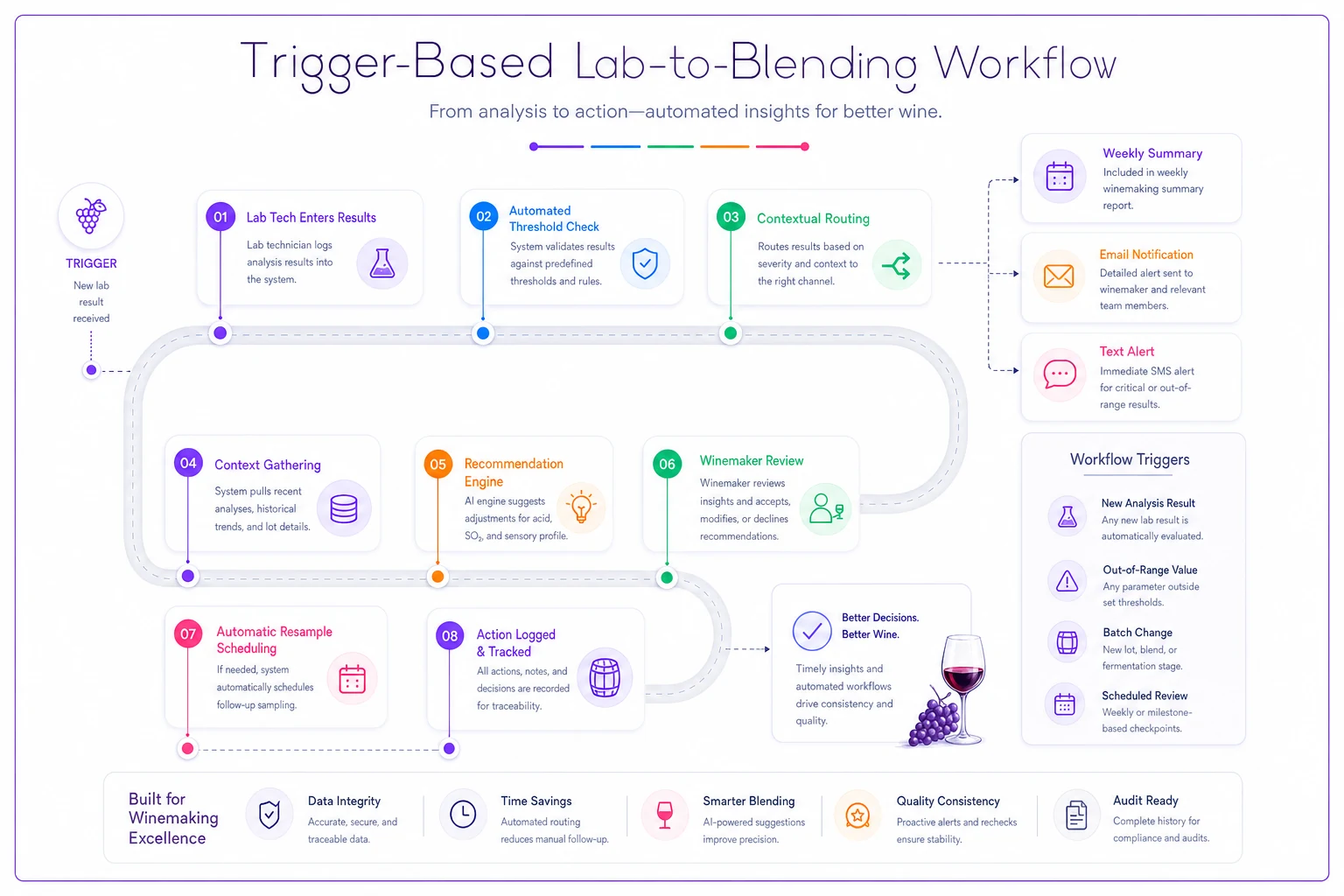
This workflow caught a developing VA problem in a 5,000-gallon Merlot lot three weeks before scheduled blending at a winery in Santa Barbara. Traditional manual review would've caught it maybe a week before, after the VA had climbed another 0.15 g/L. Early intervention saved roughly $40k worth of wine from being downgraded.
The compound effect of integrated lab data
When lab data flows directly into blending decisions, several things happen that transform your entire production approach.
Your team stops making chemistry mistakes that require expensive fixes. No more emergency acid additions post-blending. No more surprise refermentations from residual sugar you missed. No more Brett blooms because someone didn't notice the pH creeping toward 4.0. Each prevented mistake saves $3-10 per case in fixes and downgrades.
Blending becomes faster. A typical 8-lot blending session that took 4 hours drops to about 2.5 hours when chemistry is instantly visible and comparable. Your highest-paid people spend less time hunting for data and more time making quality decisions.
You start optimizing blends based on both sensory and chemistry. That slightly bretty lot with perfect chemistry becomes a 5% addition that adds complexity without risk. The beautiful Cabernet with borderline VA gets limited to 15% max inclusion. You're making informed tradeoffs instead of hoping chemistry works out.
Building this system with the tools you have
You don't need a massive software installation to integrate lab data and blending decisions. Start with three concrete improvements to your existing workflow.
-
Standardize your lab report format. Pick one template, train everyone on it, and reject reports that don't follow it. This alone cuts data translation time by about 40%.
-
Create threshold rules in Excel or Google Sheets. Basic conditional formatting that turns cells red when parameters exceed limits. It's not fancy, but it works and takes 30 minutes to set up.
-
Build one summary template for blending meetings. Test it in your next session. Refine based on what winemakers actually reference during tasting. Within three sessions, you'll have a format that transforms how your team makes blending decisions.
Modern operational software makes this integration automatic - pulling lab data directly from LIMS, applying rule-based thresholds, generating blending summaries instantly, and routing alerts without human intervention. But even manual improvements using templates and basic workflows will transform your blending precision.
The operational reality of chemistry-driven blending
Most wineries think they're making chemistry-informed blending decisions. In reality, they're making sensory decisions and hoping chemistry follows. This backwards approach works until it doesn't - usually discovering problems after 10,000 gallons are already blended.
Integrating lab data isn't about replacing sensory evaluation. It's about giving your winemakers complete information when it matters. When they taste oxidation hints, they immediately see the SO2 levels. When they notice pH brightness, they know exactly where they stand numerically.
The wineries getting this right treat lab data as a living part of the blending process, not historical documentation. Their templates ensure consistent data capture. Their thresholds prevent chemistry surprises. Their workflows surface problems before they become disasters.
Your lab runs thousands of analyses annually. Each result represents operational intelligence that could prevent problems or improve quality. But if that data sits in PDFs and spreadsheets while your team makes million-dollar blending decisions, you're essentially flying blind with instruments available.
The integration between lab analysis and blending decisions determines whether you're making informed production choices or expensive guesses. Templates and workflows that bridge this gap transform chemistry from a compliance requirement into competitive advantage. The question isn't whether to integrate lab data into blending decisions - it's whether you'll do it before or after your next preventable blending mistake costs you $50k in fixes and downgrades.
Ready to elevate your winery management?
Join 500+ wineries using Corkyly to increase operational efficiency, boost customer loyalty, and grow sales.