
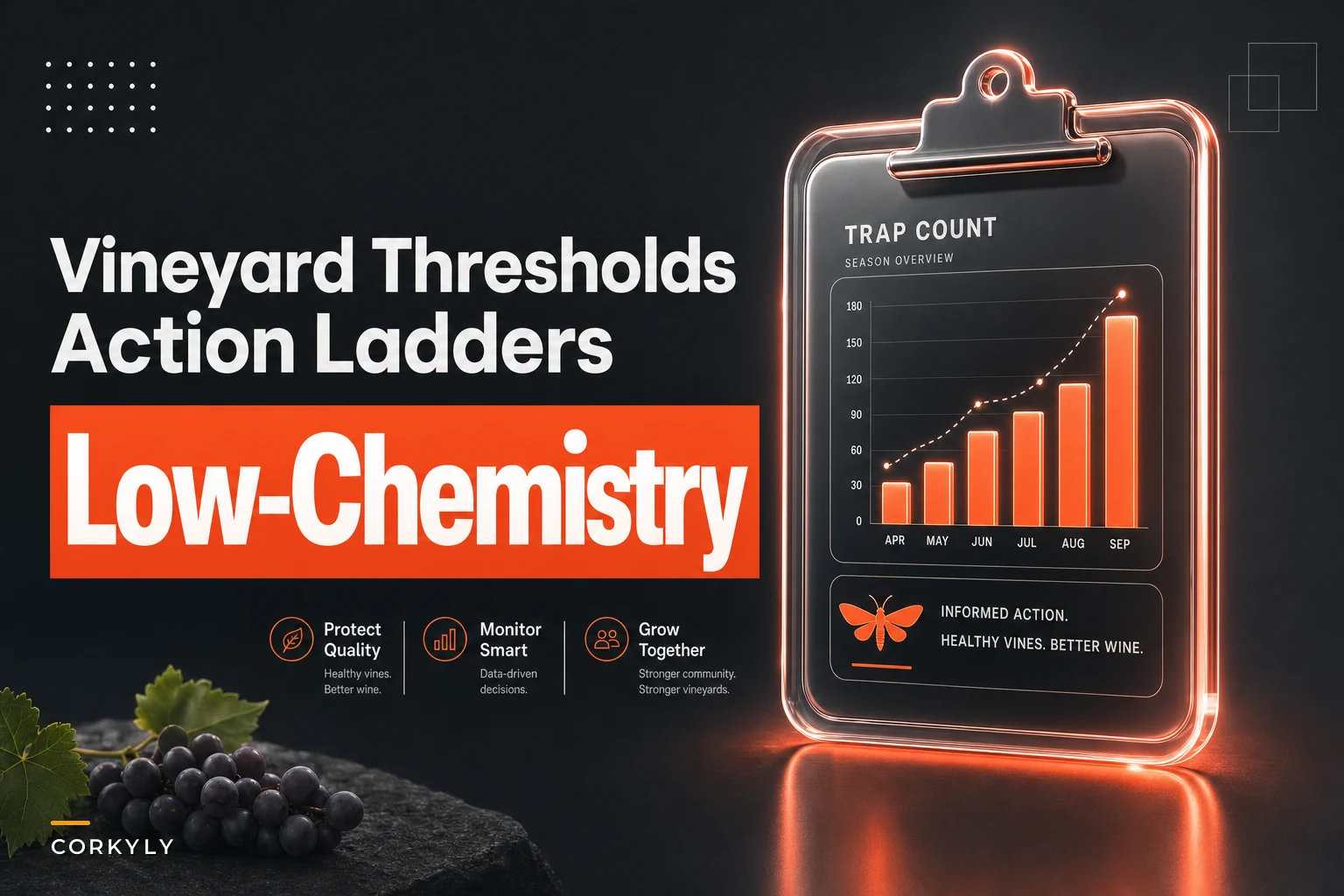

Most vineyard IPM programs fall apart at the same spot: the trap gets checked, someone jots a number on a clipboard, and then nothing happens until pressure is obvious enough that the "response" is a full-block spray. By that point you've lost the whole point of thresholds. You're not managing a pest population anymore — you're reacting to damage.
The gap isn't knowledge. Most managers know their key pests and the general economic thresholds. The gap is that trap counts rarely connect to a specific, pre-agreed action. So the decision defaults to whoever's most nervous that week, and the default is almost always more chemistry than the situation calls for.
This post is about closing that gap — numeric threshold tables that trigger a defined step, conservative ladders that put non-chemical responses first, and a sampling cadence that gives you enough resolution to act early instead of late.
Why trap counts don't turn into action
Walk through what actually happens on most properties. Traps go out for grape berry moth, leafhopper, mealybug, whatever your priority pest is for the region. Someone checks them on a loose schedule — "weekly-ish," which in practice means every 8–11 days once harvest prep gets busy. The count lands in a notebook or a text message. Then it sits there without a rule attached to it.
The number itself isn't the problem. It's that there's no agreed-upon "if X then Y." When a leafhopper count comes in at 14 nymphs per leaf on a sensitive block, three different people will have three different reactions. The cautious manager sprays. The cost-conscious owner waits. The scout shrugs because it's not their call. No one is exactly wrong — there's just no shared rule.
The second issue is resolution. If you only check every 10 days, a population can double between counts and you never see the ramp. You see "fine" and then "not fine," which naturally pushes you toward heavier responses because you already feel behind. Tighter cadence during risk windows is what gives you room to use a soft response and have it actually work.
The core idea: a threshold table that names the step, not just the number
A useful threshold table has three columns most people skip. Everyone writes down the pest and the count. Almost no one writes down what happens at that count and who is responsible. Without those last two, the table is just a monitoring log, not a decision tool.
Streamline your winery operations effortlessly.
Corkyly helps you track, manage, and optimize every step from vine to bottle.
- Vineyard & production tracking
- Customer relationship management
- Inventory & sales analytics
No credit card required
| Pest / stage | Monitoring unit | Watch level | First action (non-chemical) | Escalation trigger | Owner |
|---|---|---|---|---|---|
| Grape leafhopper (nymphs) | Nymphs per leaf, 20-leaf sample | 8–15 | Leaf-pull for airflow, recount in 4 days | >20 avg OR climbing 2 checks in a row | Block scout |
| Grape berry moth | Moths per trap per week | 5–10 | Tighten trap cadence to 4 days, check clusters | Cluster infestation >3% | IPM lead |
| Vine mealybug | Males per pheromone trap | Any detection | Flag block, inspect trunks/cordons, ant control | Crawler activity confirmed | Vineyard mgr |
| Powdery mildew (risk index) | Model index + scout | Moderate | Canopy opening, sulfur if organic-approved | Index high + visible colonies | IPM lead |
| Botrytis (pre-close) | Cluster inspection | Trace | Cluster-zone leaf removal, airflow | >5% clusters affected near close | Block scout |
The point of the "first action" column is that the default response to a watch-level count is almost never a broad-spectrum spray. It's a cultural or monitoring step. That single design choice — making the soft response automatic — is what actually reduces overuse. You stop treating every threshold crossing as a spray decision.
The "owner" column matters too. Ambiguity about who decides is half the reason blocks get over-sprayed. When one named person owns the leafhopper call, you don't get the nervous-triggers-spray dynamic.
Conservative ladders: putting non-chemical responses first
A ladder is just the ordered sequence of responses as pressure climbs. The mistake is building ladders where rung one is already a product. A conservative ladder puts several non-chemical or low-impact rungs before anything broad-spectrum.
-
Watch level reached → recount in 4 days, no action. Half the time the count doesn't climb and you've saved a pass.
-
Confirmed climbing → cultural response first
leaf-pull in the fruit zone to improve airflow and expose nymphs to predators and heat.
-
Still climbing past soft threshold → spot-treat only the hot rows with a selective, soft material. Not the block. The rows.
-
Block-wide pressure confirmed → targeted material at label rate, timed to the vulnerable stage.
-
Broad-spectrum → last rung, only when a selective option has failed or isn't available.
Spot-treating hot rows instead of whole blocks can cut material and re-entry disruption by roughly two-thirds when pressure is localized.
Most blocks that "always get sprayed" are jumping straight from rung one to rung four or five. The intermediate rungs — recount, cultural, spot-treat — are exactly where you save chemistry and money, and they're the rungs people skip because they take more attention than a blanket pass.
Spot-treating hot rows instead of whole blocks is underused because it feels fussy. But on a 12-acre block where pressure is real in maybe 3 acres, you've cut material and re-entry disruption by roughly two-thirds for that event. Do that three or four times a season and it adds up in both cost and your residue picture at harvest.
Sampling cadence templates that give you room to act early
Cadence should not be flat across the season. Checking everything weekly all year wastes scouting hours in low-risk windows and leaves you under-resolved during the windows that matter. Tie cadence to phenology and known risk periods.
-
Early season / pre-bloom every 10–14 days, establish baselines, get traps out and calibrated.
-
Bloom through fruit set weekly. This is where a lot of key-pest generations line up.
-
Active risk window for your priority pest every 3–4 days. For grape berry moth that means around degree-day-driven generation timing; for mealybug it's the crawler emergence window.
-
Pre-close / ripening weekly, with cluster-zone inspections added for botrytis.
-
Post-harvest biweekly, mostly for mealybug and overwintering pressure that sets up next season.
Tighter cadence during risk windows reduces spraying rather than increasing it — you catch the ramp early enough that a soft response has time to work. A cultural step or spot-treatment at 8 nymphs behaves very differently than the same step at 25. Early detection is what makes the conservative ladder credible. Without cadence, the ladder collapses to "spray, because we're already behind."
If you're already pulling remote-sensing layers, uneven vigor and canopy density maps can help you decide where to concentrate scouting hours. There's a practical approach to that in turning UAV and remote-sensing layers into daily tasks — hot canopy zones often overlap with the rows worth checking on the tighter cadence.
Where this maps into spray records
The whole point of thresholds-to-action is that it should feed your spray record, not sit in a separate scouting notebook. Every escalation to a chemical rung should carry the count that triggered it. That's the traceability piece auditors and certifiers actually care about, and it's the thing most operations can't reconstruct after the fact.
The workflow that holds together looks like this:
-
Scout logs the count against the block and date.
-
The count is checked against the threshold table's action column.
-
If the response is cultural or a recount, that gets logged too — "leaf-pull, 8/12 block, recount scheduled." No spray record needed, but the decision is documented.
-
If it escalates to a material, the spray record references the triggering count and the ladder rung.
That last connection — count justifies the application — is what makes your records defensible. And honestly, it's also what forces the discipline. When every spray has to be tied to a documented threshold crossing, the "just in case" passes quietly disappear because there's nothing to point to. Managers who adopt this tend to see their pass counts drop within a single season, not because they're being stingy, but because the reflexive applications never had a number behind them.
This is also where a shared platform beats a clipboard. When counts, thresholds, and applications live in one place, the escalation rule gets checked the moment a count is entered instead of during a monthly review when it's too late to matter. The value isn't the software doing anything clever — it's just that the rule and the record stop living in two different notebooks.
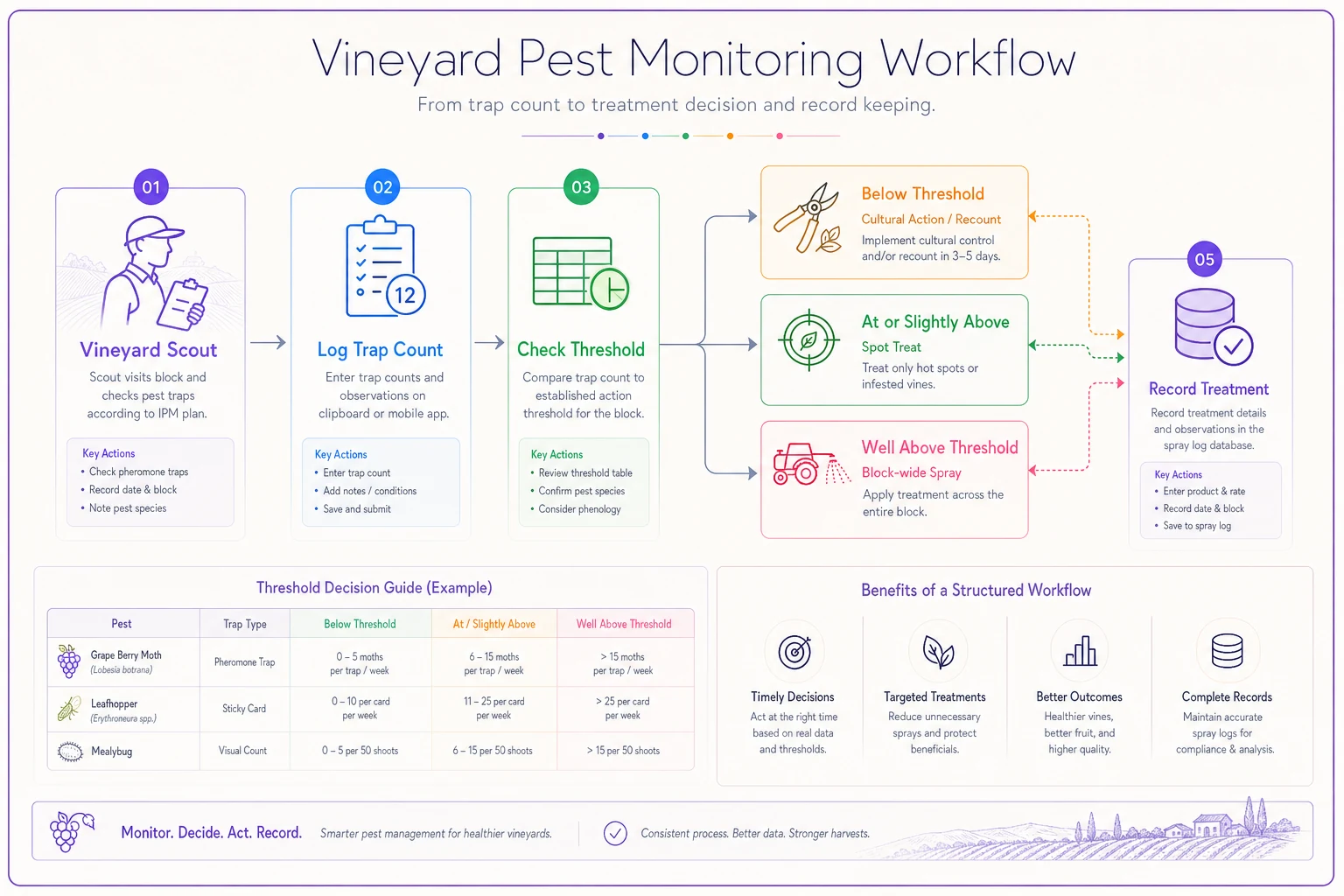
A simple diagram like this helps crews see how counts, actions, and records connect in one place.
A real scenario
A mid-sized operation running about 40 acres across several blocks had a familiar leafhopper problem: two to three broad-spectrum passes most seasons, triggered mostly by whoever walked the vineyard and got nervous. No consistent cadence, counts scribbled on trap cards.
They built a threshold table with named owners and a four-rung ladder, then tightened cadence to every 3–4 days during the leafhopper risk window. First season, two of the blocks that "always" got sprayed hit watch level, held on a recount, and never crossed the soft threshold. One block got a spot-treatment on roughly the worst 4 acres instead of the full 11.
Net for the season: broad-spectrum passes dropped from three to one across the affected blocks, and material spend on that pest fell somewhere in the range of 40–50%. Nothing exotic happened. They just stopped defaulting to the top of the ladder.
When this actually makes sense — and when it doesn't
This approach works best when you have genuine block-level variation and a couple of key pests you can build real ladders around. If your whole property behaves as one unit and pressure is uniform, the spot-treatment and per-block owner logic buys you less.
It's also a bad idea to over-engineer this if your monitoring is unreliable. A conservative ladder built on shaky counts is worse than a simple calendar program, because you'll make soft-response decisions on bad data and get burned. Get your sampling consistent first. Fix cadence and count quality, then build the ladder on top.
And it's not for the manager who wants to remove judgment entirely. Thresholds guide the decision; they don't replace the scout's eyes on cluster health, weather, and whether predators are actually present. The table tells you which rung, not whether to think.
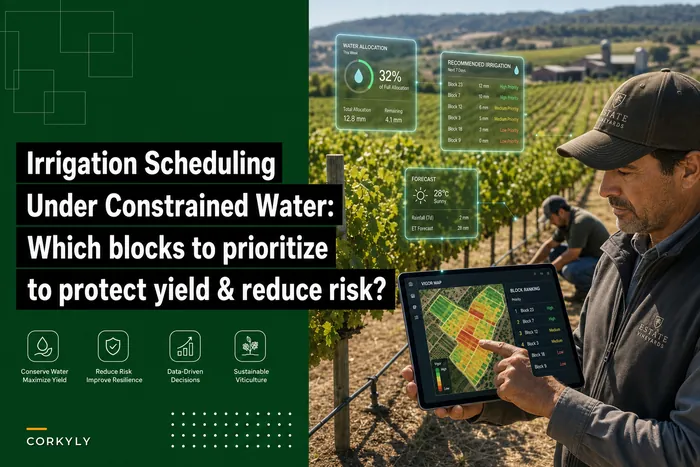
If constrained inputs are already shaping your season — water, labor, or budget — the same block-ranking logic that helps prioritize irrigation under constrained water applies to scouting hours. You put your tightest cadence and your best attention on the blocks where the payoff is highest.
Threshold tables only reduce overuse when they name the action and the owner, not just the number. Ladders only save chemistry when the soft rungs come first and people are willing to sit on a recount. Cadence is what makes the whole thing possible — check often enough during risk windows that a gentle response still has time to work.
Get those three connected to your spray records, and the reflexive "spray because we're behind" pass mostly stops happening on its own. Not because anyone's cutting corners, but because there was never a count behind it in the first place.
Ready to elevate your winery management?
Join 500+ wineries using Corkyly to increase operational efficiency, boost customer loyalty, and grow sales.