
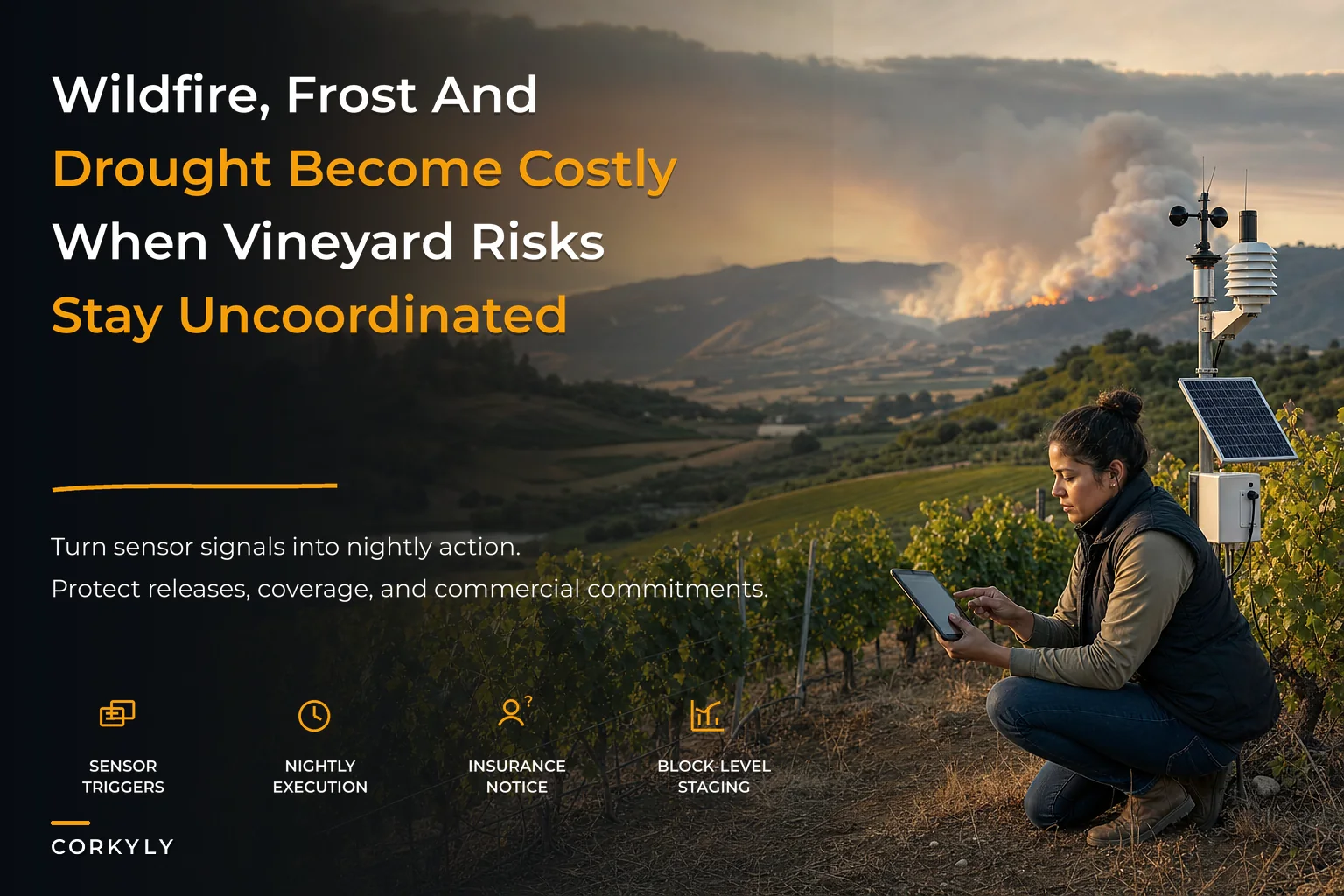

Most estates already have the pieces of an environmental risk program lying around. There's a frost fan someone remembers to start when the phone alerts them. A general sense of which blocks dry out first in August. A folder somewhere with the insurance policy nobody has read since renewal. The problem isn't that vineyard managers don't understand their risks — it's that the knowledge lives in a few people's heads and never connects to a plan that runs on its own.
That gap is where estate environmental risk governance either works or falls apart. Governance isn't a fancier word for "being careful." It's the difference between a frost event that costs you a night of sleep and one that costs you a variety block, a distributor commitment, and a claim you can't properly document six weeks later.
This piece is about the whole chain — from a sensor reading at 2 a.m. to a nightly task list, to the insurance notice you may need to file, to the contract conversation you'll eventually have with a buyer. When those links are connected, wildfire, frost and drought become managed events. When they're not, each one turns into an improvised scramble.
Why environmental risk stays disorganized on most estates
The core reason is that environmental threats don't respect the org chart. Frost is a vineyard problem until it's a yield problem, then a cellar-planning problem, then a sales-allocation problem, then a legal-and-insurance problem. Each of those lives with a different person, and information degrades every time it changes hands.
A typical example looks like this. A smoke event rolls through in mid-September. The vineyard team notes it and keeps picking. Two weeks later the lab flags elevated guaiacol markers on a couple of lots. By then the fruit is fermenting, the winemaker is improvising, and nobody told the sales team that a reserve-tier SKU might not exist this year. The distributor finds out in November. The insurance conversation starts in December, with almost no contemporaneous documentation of when the smoke arrived, how long it lingered, or which blocks were exposed.
None of those people did anything wrong in isolation. The failure is that there was no shared spine holding the event, the response, the paperwork, and the commercial fallout together. The technical response to environmental events is usually decent — it's the coordination and the documentation that quietly destroy value.
There's also a scale problem hiding here. A 15-acre estate with one manager can run environmental risk out of memory and text messages. A 200-acre operation spread across three microclimates cannot. The number of decision points multiplies, the windows shrink, and the people who need to act aren't standing in the same block anymore.
What actually breaks as the estate grows
The failure modes shift as you get bigger. Worth naming them plainly, because the fix for a small estate is not the fix for a large one.
Streamline your winery operations effortlessly.
Corkyly helps you track, manage, and optimize every step from vine to bottle.
- Vineyard & production tracking
- Customer relationship management
- Inventory & sales analytics
No credit card required
| Estate stage | Where environmental risk usually breaks | What it costs |
|---|---|---|
| Small (under ~30 acres) | Everything depends on one person being awake and reachable | Missed frost nights, no documentation trail |
| Mid (~30–100 acres) | Multiple blocks, one plan; response is reactive, not staged | Uneven protection, over-spend on some blocks, none on others |
| Large (100+ acres, multiple sites) | Information doesn't travel fast enough between vineyard, cellar, sales, and insurance | Claim disputes, blown allocations, contract penalties |
The pattern is consistent. Small estates fail on coverage — nobody was there. Mid-size estates fail on prioritization — they treated all blocks the same when they shouldn't have. Large estates fail on coordination and evidence — the response happened but nobody captured it in a way that held up commercially or legally.
That last failure mode is the expensive one. A large estate rarely loses fruit because it didn't know a frost was coming. It loses money because the frost response wasn't logged, the insurer questions the claim, and the sales team already promised wine that got damaged.
The spine: sensor triggers wired to nightly execution plans
Environmental sensors — temperature, humidity, soil moisture, air-quality and smoke indices, wind — generate readings constantly. On most estates those readings live in whatever app came with the hardware, and someone glances at them when they're worried. That's monitoring, not governance.
Governance means each meaningful reading is tied to a defined action and a defined owner before the event happens, and those actions roll up into a plan the estate executes on a nightly basis during risk windows.
A workable version of the workflow looks like this:
-
Sensor thresholds are defined per block, not per estate. Your frost-prone hollow gets a different trigger temperature than your ridge blocks. Your shallow-soil drought blocks get a lower moisture floor than the deep clay sections.
-
A trigger creates a task, not just an alert. When Block 7 crosses its frost threshold, the system doesn't just ping a phone — it generates the specific action ("start fans, deploy crew to lower vineyard, log start time") assigned to a named person.
-
Triggers feed a nightly execution plan. Every evening during a risk window, whoever's on point sees one consolidated plan: which blocks are at risk tonight, what the protective actions are, who's responsible, and what to document.
-
Execution gets logged automatically. Start times, temperatures at action, duration of protection — captured as it happens, not reconstructed later.
-
The record feeds two downstream systems
insurance and commercial.
More on both below.
The reason a nightly cadence matters is that environmental risk is rarely a single dramatic event. Frost season is weeks of marginal nights. Drought is a slow squeeze across a whole season. Wildfire risk is a rolling condition, not a one-time alarm. A nightly plan forces small, staged decisions consistently instead of one panicked call under pressure.
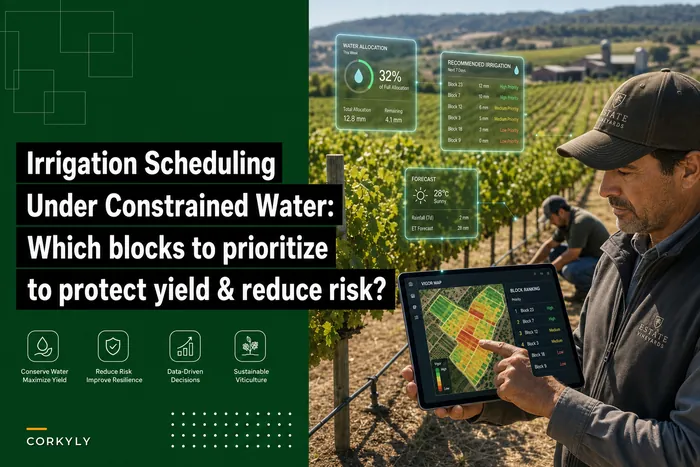
This is also where block-level thinking becomes non-negotiable. If you haven't ranked your blocks by vulnerability and value, the nightly plan has nothing to prioritize against. The logic overlaps heavily with how you'd approach irrigation scheduling under constrained water using a block-ranking checklist — the same ranking that tells you which blocks to water first in a drought is the ranking that tells you which blocks to protect first on a frost night.
The diagram below maps those steps.
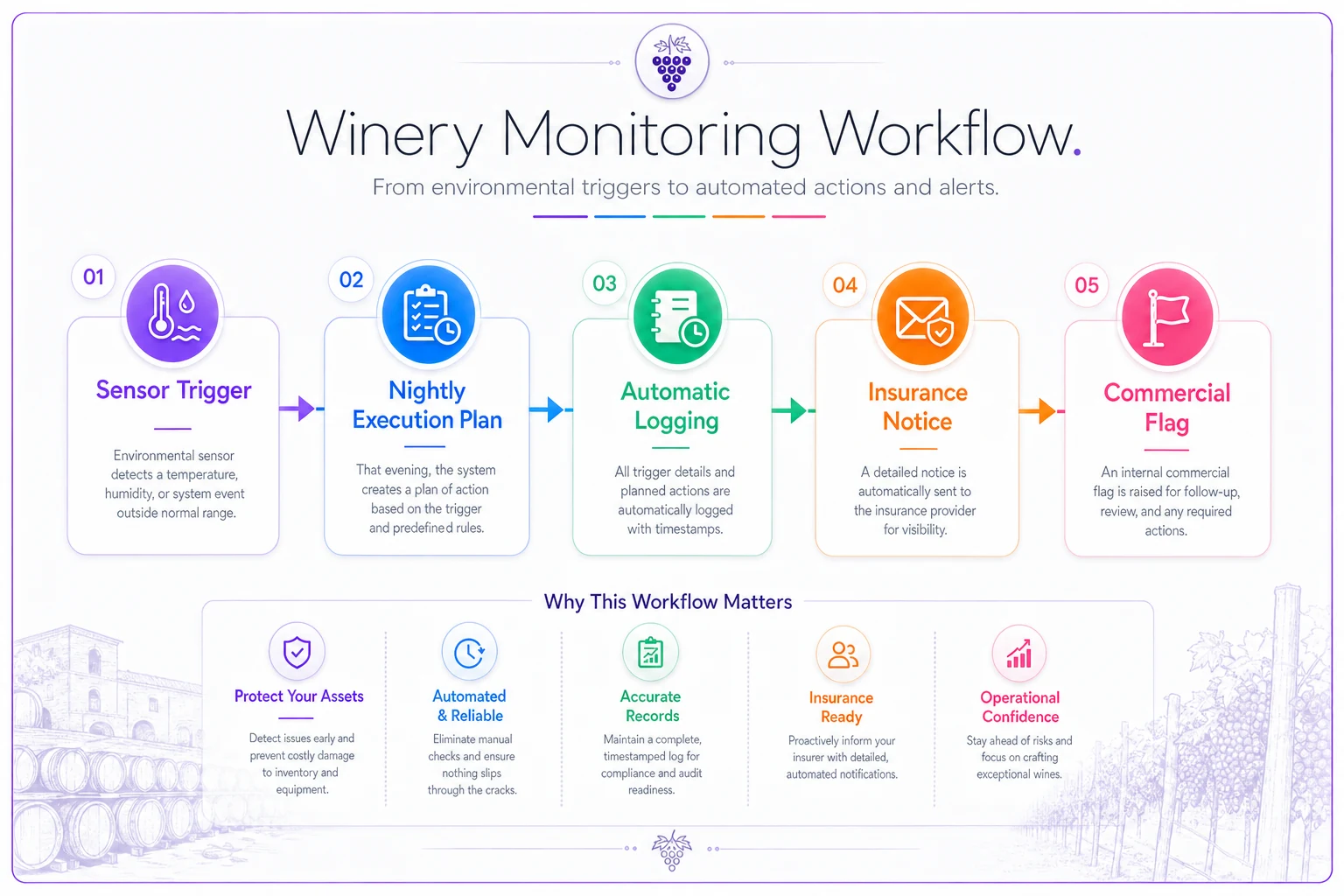
The workflow above isn't complicated, but it only works if all five steps are connected. Most estates have steps one and two. The breakdown happens between three and five, where the log stops and the insurance or commercial implication never gets flagged.
Block-level staging maps: the piece most estates skip
A staging map is a physical, spatial plan that answers: when a threat hits, in what order do we protect, and with what resources?
Most estates have this knowledge informally. The staging map makes it explicit and shareable, which matters enormously when the person executing at 3 a.m. isn't the person who holds the knowledge in their head.
A useful staging map assigns each block:
-
A vulnerability score for each threat type (frost, drought, wildfire/smoke) — they're not the same map
-
The specific protective resource it depends on (which fans, which irrigation zone, which crew staging area)
-
Its commercial weight (is this fruit under contract, allocated to a reserve tier, or flexible?)
-
Access and logistics notes (how fast can a crew or truck actually get there at night, in smoke, on a wet road)
The insight most people miss: your highest-value block and your highest-vulnerability block are frequently not the same block, and your resources can't cover both at once. A staging map forces that decision in daylight, calmly, instead of at 2 a.m. when the frost is settling and you have twenty minutes.
Keep a laminated staging map in the crew truck so the night operator can follow it without guessing.
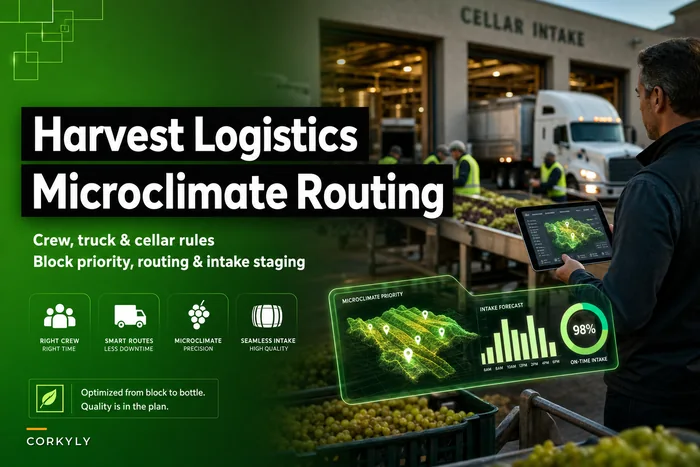
The logistics dimension connects directly to how estates handle harvest logistics across multiple microclimates. If your microclimates ripen and get threatened on different schedules, your staging map and your harvest-crew plan are really the same coordination problem viewed from two angles.
Wiring in insurance-notice templates before you need them
This is the least glamorous part and the one that recovers the most money.
Crop and business-interruption policies almost always carry notice requirements — you're expected to inform the insurer of an event within a defined window, sometimes quite short, and to document conditions contemporaneously. Estates lose legitimate claims not because the damage wasn't real, but because the notice was late or the documentation was thin and reconstructed after the fact.
Pre-built insurance-notice templates fix this by connecting the trigger event to the paperwork. Draft the template once, per policy, and stage it so that when a qualifying event fires, the notice is already 80% filled in from the logged data:
-
Date, time, and duration of the event, pulled from sensor logs
-
Blocks affected and their exposure, from the staging map
-
Protective actions taken and their timing, from the nightly execution log
-
Preliminary damage observations with a defined follow-up assessment date
The insurer is going to test the timeline — so build the timeline automatically. If your sensor logs, execution records, and lab flags all carry timestamps and all live in one place, the notice writes itself and the claim holds. If they don't, you're assembling a defense from memory months later.
One caution worth repeating: read your actual policy notice windows. Some smoke-related and business-interruption coverages have surprisingly tight reporting requirements, and "we were busy dealing with the fire" is not a defense the adjuster accepts.
Commercial contingencies: release delays and label claims
The commercial side is where environmental events quietly cost the most, because the losses show up months later and tend to get blamed on the wrong things.
Two contingencies deserve pre-planned playbooks.
Release delays. A drought-stressed or smoke-affected vintage may need to sit longer, get declassified, or skip a tier entirely. If your sales and distribution commitments assume a normal release calendar, an environmental event turns into a breach conversation. The contingency plan should define, in advance, the decision points: at what quality threshold does a lot get held, declassified, or pulled from an allocation? Who signs off? Who tells the distributor, and by when?
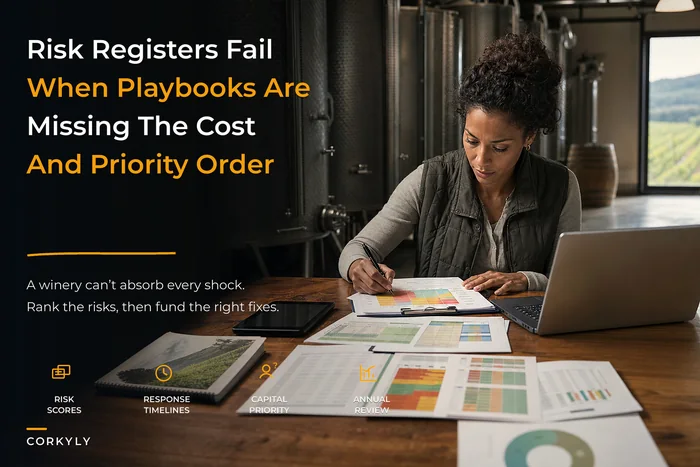
This ties straight into the discipline of a broader operational resilience framework built around a risk register and contingency playbooks. Environmental release delays aren't a separate crisis — they're one entry in that register, with a playbook attached.
Label claims. Estate, vineyard-designate, single-block, organic, sustainability-certified — every claim on your label makes an implicit promise about where and how the fruit was grown and handled. Environmental events can quietly break those promises. If you have to blend in fruit from another site because a designated block was smoke-tainted, your vineyard-designate claim may no longer hold. If drought forced an irrigation or treatment decision outside your certification rules, a sustainability claim may be at risk.
The mistake estates make is discovering the label problem at bottling, when the packaging is already ordered. The contingency plan should flag, at the moment of the environmental event, which label claims are now in question for the affected lots — so the decision gets made while there are still options, not after they've closed.
Putting it together: a real scenario
A roughly 120-acre estate across two valleys, three main varieties, a decent chunk of fruit under distributor commitment. Historically they ran frost defense out of one manager's phone and handled smoke events by "watching the lab numbers."
A September smoke event exposed several blocks. Under the old approach, they'd have kept picking, caught the guaiacol flags weeks later, improvised in the cellar, and started the insurance and distributor conversations in winter — probably eating most of the loss and a chunk of a reserve-tier allocation.
After building a connected system — block-level smoke-exposure thresholds, a nightly execution plan during the event window, automatic logging, and pre-staged insurance and commercial templates — the same event played out differently. The exposure was flagged and timestamped as it happened. Two blocks were held for assessment instead of blended blind. The insurance notice went out inside the policy window with a documented timeline. The distributor got a heads-up in October about a possible reserve-tier shortfall, with enough lead time to adjust the commitment instead of triggering a penalty.
They still lost fruit — you can't un-smoke grapes. But the difference between a documented, coordinated loss and an improvised one came out somewhere in the range of tens of thousands of dollars once you counted the recovered claim, the protected allocation, and the reserve lots they didn't ruin by blending. The technical damage was similar. The governed outcome wasn't.
When this level of governance actually makes sense
Not every estate needs this kind of infrastructure. It earns its keep in specific situations:
-
You have fruit under contract or allocated to premium tiers. The commercial fallout of an environmental event is what justifies the setup.
-
Your estate spans multiple blocks or microclimates. More decision points means memory-based response stops working.
-
You carry crop or business-interruption insurance. The documentation discipline pays for itself on the first properly-supported claim.
When it's overkill
A single small block, one operator, one buyer, no premium claims — you can probably run environmental risk on attention and a good frost alarm. Building nightly execution plans and insurance templates for that scale is effort you'll never recover. The governance system earns its keep when the coordination burden exceeds what one person can hold in their head, and when a single event can damage a contract or a claim.
The through-line
Wildfire, frost and drought aren't really three separate problems. They're three triggers hitting the same fragile chain that runs from a sensor reading to a protected block to a documented claim to a contract you can still honor. Estates that treat them as isolated weather emergencies keep re-solving the same coordination failure every season.
The ones that build a connected spine — triggers that create tasks, tasks that roll into nightly plans, plans that log themselves, logs that feed insurance and commercial contingencies — stop losing money to the gaps between people rather than to the weather itself. The weather will do what it does. What you actually control is whether your estate responds as a system or as a scramble.
Wildfire, frost and drought aren't really three separate problems. They're three triggers hitting the same fragile chain that runs from a sensor reading to a protected block to a documented claim to a contract you can still honor. Estates that treat them as isolated weather emergencies keep re-solving the same coordination failure every season.
The ones that build a connected spine — triggers that create tasks, tasks that roll into nightly plans, plans that log themselves, logs that feed insurance and commercial contingencies — stop losing money to the gaps between people rather than to the weather itself. The weather will do what it does. What you actually control is whether your estate responds as a system or as a scramble.
Ready to elevate your winery management?
Join 500+ wineries using Corkyly to increase operational efficiency, boost customer loyalty, and grow sales.