


Most wineries treat distributors like weather. You send wine out into the three-tier system, cross your fingers, and check depletion reports a few weeks later to see what happened. When numbers look bad, you email your rep. When they look good, you assume everything's fine. There's no real system underneath any of it — just reactions.
That approach works until you're carrying more than a couple of distributors across a few states. Then the cracks show. One distributor sits on inventory for eight months while another blows through allocation in six weeks and starts asking for wine you don't have. Nobody agreed on what "good" looks like, so nobody's accountable when it goes sideways.
Distributor governance is the boring, unglamorous layer that fixes this. Scorecards, service-level agreements, review cadences, escalation rules — these are the things that turn a vague relationship into something you can actually manage. This isn't about being adversarial with your partners. It's about making expectations explicit so that when something breaks — a late order, a depletion miss, a recall — everyone already knows what happens next instead of scrambling.
Why distributor relationships drift without a governance layer
The core problem is that the incentives are misaligned by default, and most wineries never build the structure to correct for it.
Your distributor carries hundreds or thousands of SKUs. Your six wines are a rounding error in their portfolio. They're not ignoring you out of malice — you're just not the fire they're putting out today. Without agreed-upon performance standards, the relationship coasts on personality and goodwill. That's fine when your rep is great. It falls apart the moment your rep leaves, the distributor gets acquired, or a bigger supplier demands more shelf attention.
What we've observed across a lot of small-to-mid producers is that governance gaps hide in plain sight. Everything feels okay because there's activity — orders come in, wine ships out, checks clear. But activity isn't performance. A distributor can be actively moving your wine into the wrong accounts, discounting below your floor, or letting your premium tier sit in a warehouse while they push the cheap stuff. You won't see any of that unless you're measuring the right things on a fixed cadence.
The second reason relationships drift: nobody owns the data reconciliation. Depletion reports come in different formats, on different schedules, with different definitions of what counts as a "case." Your internal inventory says one thing, the distributor's system says another, and the gap gets bigger every month until it's a genuine argument. This ties directly into how you handle inventory states and channel-specific allocation policies internally — if your own inventory governance is loose, your distributor governance has nothing solid to sit on.
What actually breaks as you scale distributors
The failure modes change depending on how many distributors and states you're juggling. Here's the rough progression.
Streamline your winery operations effortlessly.
Corkyly helps you track, manage, and optimize every step from vine to bottle.
- Vineyard & production tracking
- Customer relationship management
- Inventory & sales analytics
No credit card required
| Stage | Typical setup | What breaks first |
|---|---|---|
| 1–2 distributors, 1–3 states | Handshake relationship, monthly rep call | Depletion visibility; you find out about problems late |
| 3–6 distributors, multiple states | Spreadsheet tracking, occasional reviews | Inconsistent reporting formats, allocation disputes, no shared definition of "on time" |
| 7+ distributors, national footprint | Some kind of CRM, dedicated sales manager | SLA enforcement, escalation chaos, recall coordination across incompatible systems |
At one or two distributors, you can hold everything in your head. You know the rep, you know the accounts, you can eyeball whether things are healthy. The main risk is just being slow to notice a slowdown.
Around three to six distributors, the coordination cost explodes. Every distributor reports differently. One sends a clean depletion file on the 5th, another sends a PDF whenever you nag them, a third gives you portal access with data that's two weeks stale. You're now spending real hours just normalizing information before you can even ask whether performance is good. This is where most wineries quietly give up on rigor and go back to vibes.
Past seven distributors, the absence of governance becomes an operational hazard, not just an inconvenience. A recall is the clearest example. If you need to pull a specific lot across nine distributors in twelve states and you have no standardized way to reach them, no agreed response time, and no shared lot-tracking language, you're looking at days of frantic phone calls when you have hours. Fast recalls depend on block-to-bottle traceability on your end and a distributor governance framework that turns "call everyone" into "trigger the recall protocol."
The monthly performance scorecard
Governance starts with measurement, and measurement means a scorecard everyone sees on the same schedule. Not a 40-line spreadsheet nobody reads — a tight set of metrics that actually tell you whether the relationship is healthy.
Keep it to metrics you can pull consistently and defend in a conversation. A workable scorecard covers four dimensions:
-
Depletion velocity — cases depleted vs. cases shipped, trended over the trailing three months. A widening gap means inventory is piling up somewhere.
-
Account penetration — new accounts opened vs. accounts lost, and whether they're on-premise or off-premise. Distributors love to open easy accounts and let hard ones lapse.
-
Pricing compliance — how often your wine sells below the agreed floor. Even a handful of violations erodes your brand positioning fast.
-
Order and reporting reliability — did orders arrive within the agreed window, and did the depletion report show up on time and in the right format?
The insight most people miss: the scorecard's value isn't the numbers themselves, it's the rhythm. A metric you review once a quarter is a post-mortem. The same metric reviewed monthly is a steering wheel. When a distributor knows you're going to look at depletion velocity on the 10th of every month, their behavior changes — not because you're threatening them, but because the relationship now has a heartbeat.
One pattern worth watching: distributors who resist giving you clean, timely data are almost always the ones underperforming. Good performance is easy to report. When reporting suddenly gets vague or late, treat it as an early warning, not a paperwork issue.
Building SLAs that mean something
A service-level agreement is only useful if it's specific enough to be either met or breached, with no room to argue. "Report depletions monthly" is not an SLA. "Depletion file delivered by the 5th business day in the agreed CSV template, covering the prior calendar month" is an SLA.
The SLAs worth writing down usually cluster around a few areas:
-
Reporting — format, schedule, and completeness of depletion and inventory data.
-
Order fulfillment — the window between your order acknowledgment and shipment.
-
Inventory holding — maximum days of inventory the distributor holds before it's considered a velocity problem worth a conversation.
-
Pricing — the floor price and the notification requirement before any promotional discount.
-
Recall responsiveness — the maximum time to acknowledge a recall notice and the maximum time to confirm quarantine of affected lots.
That last one is the SLA people forget until they need it, and it's the most important. During a recall, minutes matter and confusion is expensive. Having a written recall-response SLA means your distributor already agreed, in calm times, to acknowledge within two hours and confirm affected inventory quarantine within twenty-four. You're not negotiating under pressure — you're executing a protocol. This connects directly to the operational rules laid out in the distributor allocation playbook — allocation, contract windows, and recall coordination all live in the same governance document for a reason.
One mistake to avoid: writing SLAs so strict that no distributor can realistically meet them. If you set a 24-hour order fulfillment window that ignores the reality of their warehouse operations, you've just created a document full of breaches you'll never enforce, which teaches everyone that the SLAs are theater. Set targets that are demanding but achievable, then tighten over time.
Staged escalation: what happens when an SLA breaks
This is where most governance efforts fall apart. People write beautiful scorecards and SLAs, a breach happens, and then… nothing structured. Someone sends an annoyed email, or worse, nothing at all because confronting the distributor feels awkward.
The fix is a staged escalation ladder, agreed in advance, so that consequences are automatic and impersonal. Escalation shouldn't be a judgment call you make in the moment — it should be a rule that fires.
Stage 1 — Flag (single breach). The breach is logged and noted in the next monthly review. No drama. Most single breaches are noise — a one-off late report, a single order delay. You're just building a record.
Stage 2 — Formal review (pattern breach). Two or three breaches of the same SLA within a rolling quarter triggers a documented conversation, not the routine monthly call. A written summary of the pattern goes to the distributor's manager, not just your rep. This is also the stage where you tie consequences to allocation: a distributor in Stage 2 doesn't get to request additional allocation of a scarce SKU until they're back in compliance.
Stage 3 — Structural response (chronic breach). Persistent breaches across a couple of quarters trigger real consequences — reduced allocation, territory reassignment discussion, or in the extreme, planning an exit. None of this should be a surprise, because Stages 1 and 2 already documented the whole story.
Tying escalation to allocation gives your governance actual teeth without turning every conversation into a fight. Allocation is your leverage. A distributor that consistently misses its SLAs shouldn't be first in line for your limited-production Reserve. When that link is written into the framework, you're not being punitive — you're applying a rule everyone already agreed to.
Joint forecasting instead of guessing
Governance isn't only about catching failures. The most valuable ritual is forward-looking: a joint forecast that both sides commit to, and then measure against.
The typical broken version: you allocate based on last year plus a gut feeling, ship it, and hope. The distributor has their own private number they never share. Reality lands somewhere in between and both sides blame each other.
A joint forecast template forces the conversation into the open. Before each contract window, you and the distributor agree on projected depletions by SKU, by month, factoring in known accounts, seasonal patterns, and planned promotions. That agreed number becomes the baseline for the scorecard. When actuals drift more than roughly 15–20% from the joint forecast, it triggers a review conversation automatically.
What makes this powerful is the accountability shift. When the distributor helped build the forecast, they can't wave off a miss as "market conditions." They own half the number. In practice, joint forecasting also surfaces allocation conflicts early — if two distributors both forecast heavy demand for a SKU you only make 800 cases of, you find that out in the planning meeting, not when the second one is angry about a shortfall.
A real scenario
A family winery producing around 9,000 cases a year had grown to five distributors across four states almost by accident — each one added when an opportunity showed up, none with any formal structure. Depletion reports came in four different formats. Nobody could say with confidence how much wine was actually sitting in warehouses versus moving.
The specific pain point that forced the issue: they discovered one distributor had been holding roughly 600 cases of a vintage for close to nine months — well past the point where the wine was fresh in-market — while simultaneously requesting allocation of the next vintage. Meanwhile a smaller distributor two states over had sold out early and lost three restaurant accounts because they couldn't get resupplied.
They put in a basic governance layer over about a quarter: a one-page monthly scorecard, four core SLAs, a three-stage escalation ladder tied to allocation, and a joint forecast built with each distributor before the next release. Nothing fancy — most of it lived in shared spreadsheets and a shared calendar at first.
The results weren't dramatic overnight, but within two selling seasons the slow-moving inventory problem essentially disappeared. The holding SLA and the allocation link made sitting on wine costly for the distributor. Depletion visibility went from "who knows" to a number they trusted within a few days of month-end. And the smaller distributor that had been starved got allocation reprioritized based on its velocity scorecard — those restaurant accounts came back. The overall win wasn't a revenue explosion; it was that the whole distribution operation went from unpredictable to something they could actually plan around.
When formal governance makes sense — and when it's overkill
When it makes sense: You're carrying three or more distributors, you're in multiple states, you produce anything with scarcity — limited runs, library releases, allocated wines — or you've already been burned by slow-moving inventory or a depletion surprise. If you can't answer "how is Distributor X performing versus Distributor Y" with real numbers, you need this.
When it's overkill: You've got one distributor, one state, a rep you trust, and clear visibility. Building a five-metric scorecard and a three-stage escalation ladder for a single healthy relationship is bureaucracy for its own sake. Keep a simple depletion check and a good working relationship. Add structure when you add complexity, not before.
Who should not do this: Anyone who'll write the framework and then never run the reviews. Governance that isn't executed on a fixed cadence is worse than no governance, because it creates a false sense of control. If you can't commit to the monthly rhythm — even a 30-minute review — don't build the elaborate version. Start with a scorecard and one SLA, run it consistently for a quarter, then expand.
Making the cadence sustainable
The hardest part of distributor governance isn't designing it — it's running it every single month when you're already buried in cellar work, compliance, and everything else a winery demands. Frameworks die from neglect, not bad design.
A few things keep the rhythm alive. Standardize the incoming data so you're not reformatting five different report layouts by hand every month — agree on one template as an SLA and hold to it. Put the review on the calendar as a recurring commitment, not a "when I get to it." And keep the scorecard genuinely short, because a report that takes two hours to assemble is a report that stops getting assembled by March.
Where operational software earns its place is in the unglamorous middle layer: pulling depletion data into one consistent view, flagging SLA breaches automatically instead of relying on you to notice, and keeping the running record that makes Stage 2 and Stage 3 conversations straightforward because the pattern is already documented. The goal isn't to automate the relationship — it's to automate the bookkeeping around the relationship so the human conversations can actually happen on schedule. When breach tracking and forecast-versus-actual comparisons run in the background, the monthly review stops being a data-assembly chore and becomes what it's supposed to be: a fast, clear-eyed look at what's working and what needs attention.
Standardize the incoming data so you're not reformatting five different report layouts by hand every month.
A simple workflow for the monthly review looks like this.
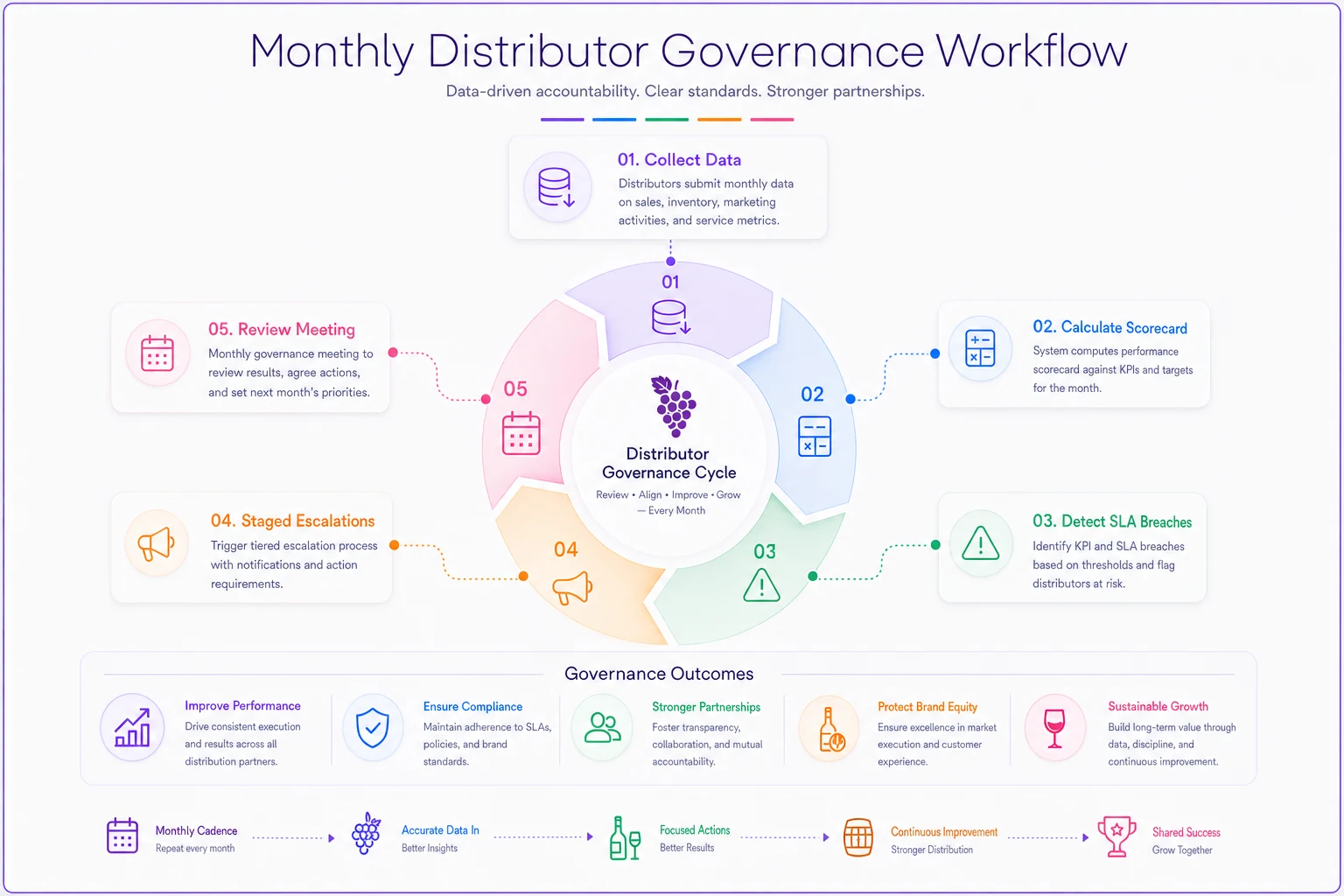
When breach tracking and forecast-versus-actual comparisons run in the background, the monthly review stops being a data-assembly chore and becomes what it's supposed to be: a fast, clear-eyed look at what's working and what needs attention.
The bigger point
Distributor governance is really about converting a relationship you can't see into a system you can steer. The scorecards, SLAs, escalation ladders, and joint forecasts aren't paperwork for its own sake — each one closes a gap where things quietly go wrong. Slow inventory, price erosion, depletion surprises, and recall chaos all trace back to the same root: expectations that were never made explicit and performance that was never measured on a fixed cadence.
Start small. One scorecard, a couple of SLAs, a simple escalation rule tied to allocation. Run it consistently for a quarter before you add anything. The wineries that manage their distributors well aren't the ones with the fanciest frameworks — they're the ones who actually look at the numbers every month and act on what they see.
Distributor governance is really about converting a relationship you can't see into a system you can steer. The scorecards, SLAs, escalation ladders, and joint forecasts aren't paperwork for its own sake — each one closes a gap where things quietly go wrong. Slow inventory, price erosion, depletion surprises, and recall chaos all trace back to the same root: expectations that were never made explicit and performance that was never measured on a fixed cadence.
Start small. One scorecard, a couple of SLAs, a simple escalation rule tied to allocation. Run it consistently for a quarter before you add anything. The wineries that manage their distributors well aren't the ones with the fanciest frameworks — they're the ones who actually look at the numbers every month and act on what they see.
Ready to elevate your winery management?
Join 500+ wineries using Corkyly to increase operational efficiency, boost customer loyalty, and grow sales.