

Most wineries treat contamination insurance like a fire extinguisher: something you grab in a panic, hope works, and never actually tested. Then a lot comes back TCA-positive, or a cleaning agent contaminates a tank, or a filtration failure introduces Brett across three blends — and suddenly you're trying to assemble six months of records into a coherent story while your cashflow quietly bleeds out.
The claim itself usually isn't the hard part. Contamination claims are evidence-heavy and time-sensitive, and most cellars don't produce the kind of documentation an adjuster can act on quickly. You know what happened. You just can't prove it in the format the insurer needs, fast enough to matter.
That's a systems problem, not a paperwork problem. A good contamination response touches your lab, your cellar logs, your inventory records, your finance team, and your broker — all at once. When those don't connect, claims drag for months and cash gets stuck exactly when you need it most. This playbook is less about policy language and more about the operational machinery that turns a bad lab result into a paid claim without wrecking your quarter.
Why contamination claims stall (and it's rarely the policy)
Walk through a denied or delayed claim and you'll almost always find the same gaps. The policy covered the event. The winery just couldn't clearly demonstrate three things:
-
When contamination started and was detected — the timeline
-
What was affected and what was ruled out — the scope
-
What the loss actually costs — the financial quantification
Adjusters aren't being difficult. They're trying to separate a genuine covered loss from normal production variance, and they can only work with what you hand them. When a winery sends a shoebox of lab PDFs, a spreadsheet of tank movements with no timestamps, and a verbal explanation of "we think it came from the hose," the adjuster has to reconstruct your operation before approving anything. That reconstruction is where weeks disappear.
In real operations, this usually happens because the people who know what happened — cellar crew, winemaker — aren't the people who file the claim — ownership, finance. The knowledge lives in someone's head or in a chat thread, and by the time finance needs it, nobody can pin down whether the affected tank was racked on the 11th or the 13th. That date matters, because it determines how much product was exposed.
What breaks at scale is coordination. A small winery with one tank line can sometimes muscle through on memory. Once you're running multiple blends, shared equipment, and bonded inventory across several lots, "we think it came from the hose" becomes a genuinely expensive uncertainty. The blast radius of a single contamination event grows with your SKU count and your equipment-sharing.
The three documents every claim actually runs on
Insurers don't want your entire records system. They want a narrow, well-structured set of evidence that answers their questions in their order. Build these three artifacts before you need them — as templates your team fills in during an incident — and you collapse the slowest part of the process.
Streamline your winery operations effortlessly.
Corkyly helps you track, manage, and optimize every step from vine to bottle.
- Vineyard & production tracking
- Customer relationship management
- Inventory & sales analytics
No credit card required
1. The insurer-ready evidence template
This is a single structured document (not a pile of attachments) that frames the loss the way an adjuster reads it. The goal: someone who has never set foot in your cellar should understand the event in ten minutes.
A workable structure:
| Section | What it contains | Why the adjuster needs it |
|---|---|---|
| Event summary | 3–4 sentences: what, when detected, suspected cause | Orients the reviewer fast |
| Affected inventory | Lot IDs, volumes, tank/barrel numbers, value at cost | Defines claim scope |
| Detection evidence | Lab results with dates, chain of custody | Proves contamination is real, not variance |
| Containment actions | What you isolated, quarantined, stopped | Shows you mitigated (policies require this) |
| Financial impact | Lost product + rework + disposal + opportunity | Quantifies the ask |
| Supporting exhibits | Logs, photos, invoices, lab certs — numbered | Backs every claim above |
The mistake most wineries make is leading with exhibits instead of the summary. Fifty pages of lab data with no narrative forces the adjuster to build the story themselves — and they'll build it conservatively.
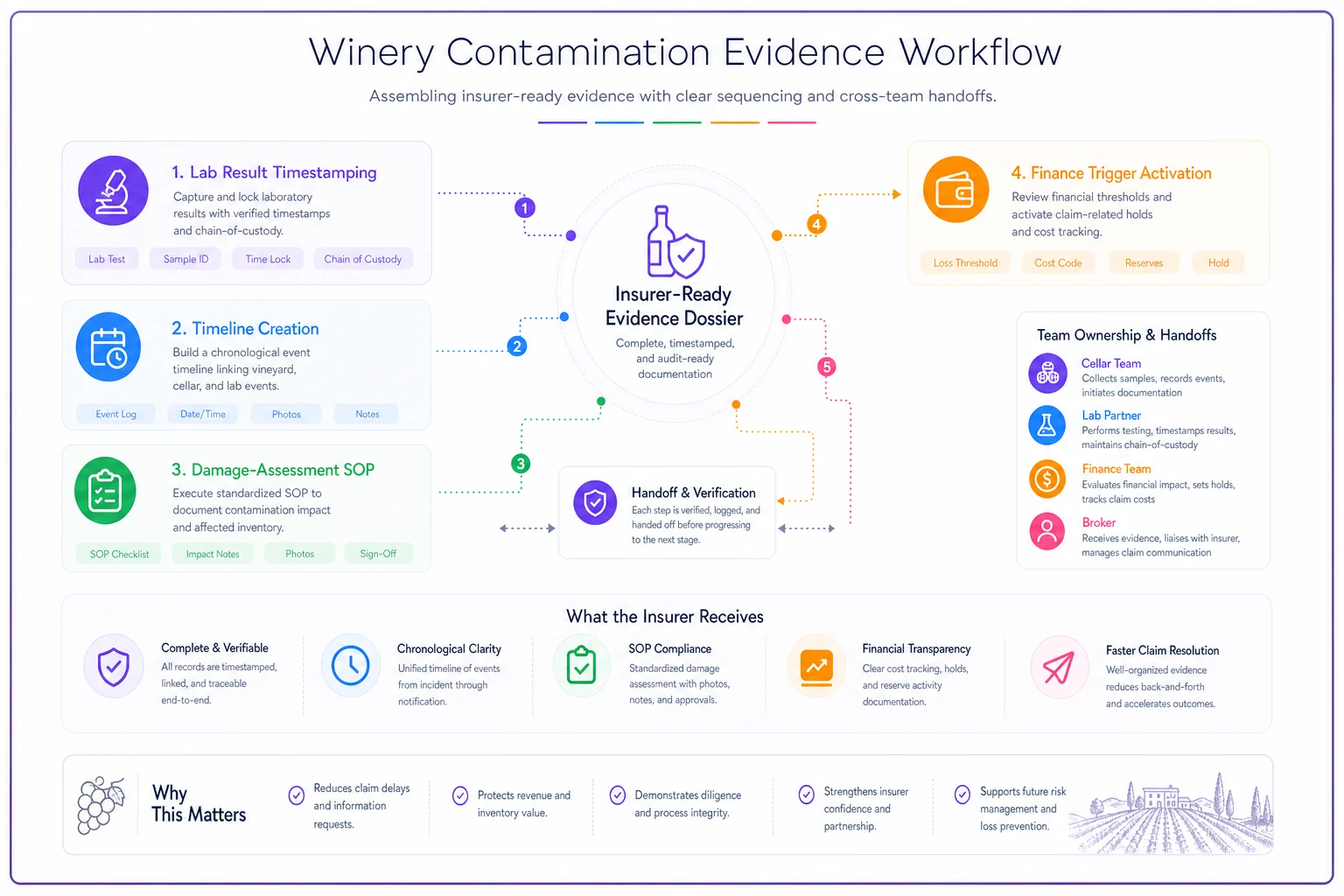
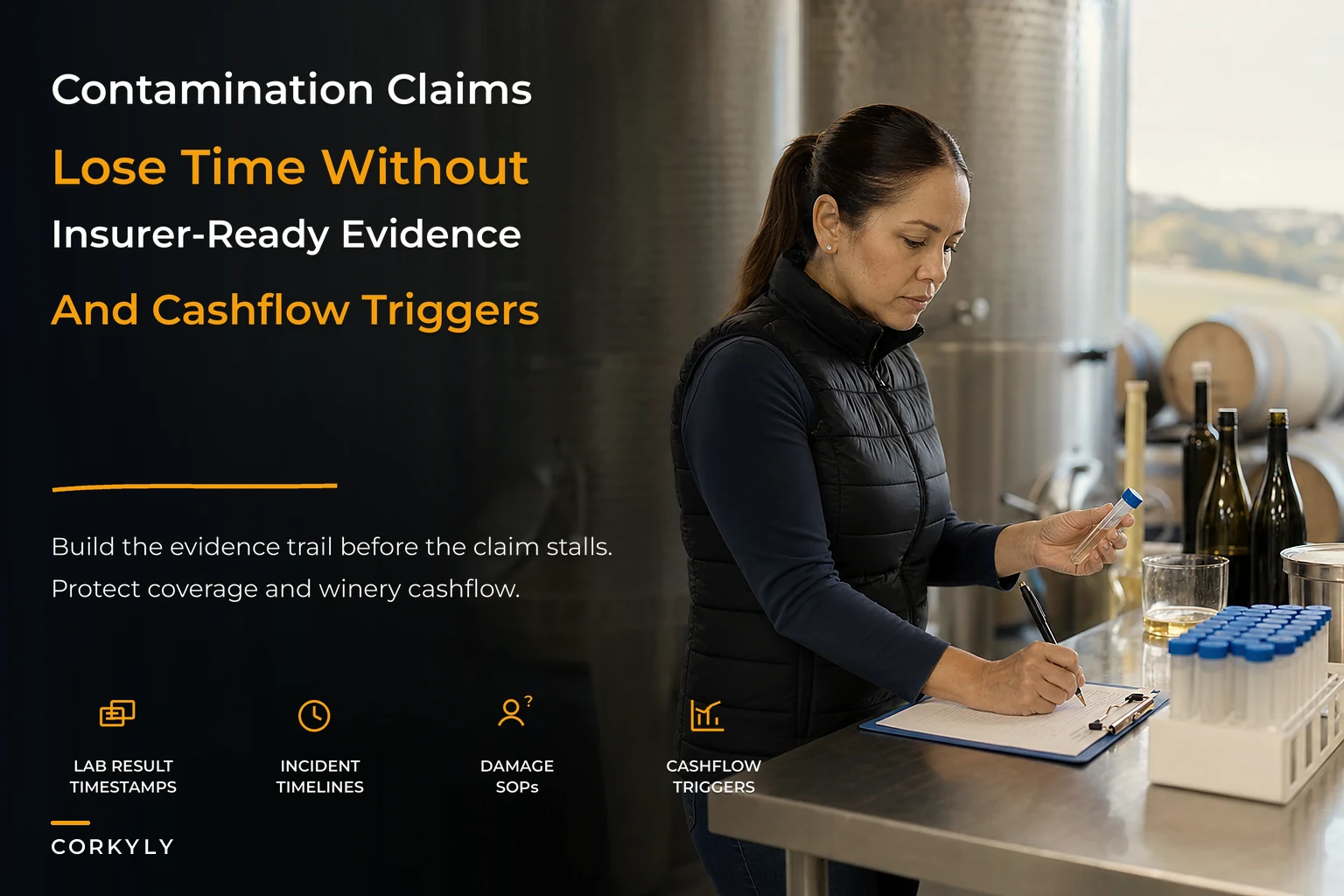
A quick visual of how the evidence pieces flow into a claim.
2. The incident timeline
This is the most underrated document in a contamination claim. A clean, timestamped sequence from first signal to containment does more to speed approval than almost anything else, because it lets the adjuster verify your scope without re-deriving it.
A worked example:
-
March 3, 08
40
— Cellar noted off-aroma during routine topping, Tank 14 (Lot CS-22-07, ~4,800 L) -
March 3, 11
00
— Sample pulled, sent to in-house lab -
March 4, 15
20
— Lab flags elevated TCA, 6.2 ng/L; external confirmation requested -
March 4, 16
00
— Tank 14 quarantined, downstream transfer to Tank 9 halted -
March 6 — External lab confirms 5.9 ng/L; trace to a replaced cellar hose batch
-
March 6 — Shared equipment (pump, two hoses) pulled and sampled to bound exposure
-
March 8 — Two adjacent lots cleared via negative results; scope locked to Lot CS-22-07
Notice what that timeline does: it shows prompt detection, fast containment, and — critically — the ruling out of adjacent lots. That last part prevents an adjuster from either over-paying (which triggers scrutiny) or under-paying because scope is fuzzy. Your block-to-bottle traceability system is what makes a timeline like this possible to assemble in hours instead of days. If you can't trace a lot, you can't bound a claim.
3. The damage-assessment SOP
The timeline tells the story. The damage-assessment SOP produces the defensible number. Without a standard method, two people assessing the same event will produce two different loss figures — and inconsistency reads as inflation to an insurer.
A tight damage-assessment SOP covers:
-
Direct product loss — affected volume × cost basis (not retail; insurers pay cost or a defined basis, so know which before you file)
-
Rework/remediation cost — fining trials, re-filtration, additional lab runs, labor hours
-
Disposal cost — if the lot is unrecoverable, hauling and destruction
-
Adjacent testing cost — the samples you ran to rule out spread
-
Downstream/opportunity loss — only if your policy covers it, and only with documentation
One pattern worth internalizing: remediation attempts are evidence, not just expense. A documented, failed fining trial proves the loss was genuine and unavoidable. Wineries that quietly try to fix a lot off the books and then file lose the ability to prove they couldn't save it.
The finance-trigger checklist that protects cashflow
This is the part most operational guides skip entirely. Even a perfectly documented claim can take 60–120 days to pay. If your winery's cash is tied up in the affected inventory and the rework, you can hit a crunch long before the insurer wires anything — which is exactly how a recoverable event turns into a liquidity event.
The fix is a set of pre-defined financial triggers that fire the moment contamination is confirmed, independent of the claim timeline. Protect cashflow in parallel with filing, not after.
A practical finance-trigger checklist:
-
[ ] Estimate exposed value within 24 hours — rough is fine; you need a magnitude, not a precise figure
-
[ ] Flag affected lots as non-sellable in inventory so they don't get allocated or promised to a distributor
-
[ ] Reforecast the quarter assuming zero recovery on the affected volume
-
[ ] Identify replacement supply or substitution if the lot was committed to a specific order or allocation
-
[ ] Notify the broker within the policy-required window (many policies have a hard notice clause — missing it is a real denial reason)
-
[ ] Open a dedicated cost code so every remediation hour and lab run is captured for the claim, not buried in general overhead
-
[ ] Set a cash buffer decision point — if payout timing exceeds X days, do you draw on your line of credit?
The dedicated cost code is the quiet hero here. When remediation costs get smeared across normal operating expenses, you can't itemize them for the claim and you can't see the true cost of the event. A single code, opened on day one, solves both.
Open the dedicated cost code as part of your incident checklist so it's never missed in the rush the first day.
When remediation costs are tracked from day one against a dedicated code, finance can roll-up accurate interim numbers for cash planning and provide clean backup for the adjuster.
A short real scenario
A mid-size producer running roughly 14,000 cases discovered a cleaning-agent carryover in a tank after a sanitation step was shortcut during a busy crush. Two blends sharing that tank line showed off-chemistry — around 7,000 L exposed, with a cost basis somewhere in the $45k–$55k range before rework.
Their first instinct was to spend two weeks trying to remediate quietly and figure out the claim later. The problem: they had no timeline, their cellar log had gaps around the sanitation step, and finance didn't know the lots were compromised — so one had already been allocated against a distributor order.
Once they rebuilt the process properly — timeline first, damage SOP second, finance triggers in parallel — the next time something similar happened (a minor filtration issue, much smaller scope), the difference was obvious. They had the evidence template populated within about two days, the affected ~1,200 L flagged as non-sellable immediately, and the broker notified inside the notice window. A claim that had previously taken close to four months of back-and-forth settled in a matter of weeks. More importantly, the inventory flag meant finance never promised product they couldn't ship.
The event cost roughly the same either way. The cashflow impact was completely different.
Where this connects to the rest of your operation
A contamination playbook isn't a standalone binder — it leans on systems you ideally already run. Detection speed depends on your QA cadence; the faster your sampling catches an off-result, the tighter your timeline and the smaller your scope. If you've built a continuous QA system with pass/fail gates and CAPA loops, you're already generating half the evidence a claim needs as a byproduct of normal work.
Same with risk prioritization. Contamination is one line in a broader operational resilience framework, and wineries that maintain a real risk register tend to have their insurance evidence process pre-mapped rather than improvised. The register tells you which contamination scenarios are worth pre-building templates for — shared-equipment cross-contamination and sanitation carryover usually top the list because they hit multiple lots at once.
The coordination challenge is where operational software earns its place. When your lab results, lot movements, inventory status, and cost codes live in connected records rather than separate spreadsheets, assembling an incident timeline stops being an archaeology project. A platform that timestamps lab entries, ties them to lot IDs, and lets you flag inventory states in one action means the evidence template nearly fills itself — and the finance triggers fire off the same data instead of waiting for someone to manually connect the dots. You're not buying automation for its own sake; you're removing the delay between "we found a problem" and "we can prove it."
When this level of rigor makes sense — and when it doesn't
Building full insurer-ready templates is worth the effort if you share equipment across lots, carry meaningful bonded inventory, commit product to distributors in advance, or run blends where one contaminated tank affects multiple SKUs. Those are the setups where a single event has a large, uncertain blast radius and where claim speed directly affects your cash position.
It's probably overkill if you're a very small producer with a single tank line, little shared equipment, and no advance commitments. Your exposure is bounded enough that memory and basic logs can carry a claim. A lightweight version — just the timeline template and the broker-notice trigger — covers most of the risk without the overhead.
The one group that should not skip this: anyone whose cashflow can't absorb a 90-day gap on tied-up inventory. If a stuck claim would force you to delay payroll, miss a bottling run, or draw hard on your credit line, the finance-trigger checklist isn't optional. It's the actual point of the exercise.
The bottom line on moving fast
The contamination insurance playbook that works isn't the thickest one — it's the one your team can execute under stress, with roles already assigned and templates already structured. The event will be chaotic regardless. What you control is whether that chaos produces a clean, fast, paid claim or a four-month scramble that strains your cash exactly when you can least afford it.
Build the evidence template, the timeline format, the damage-assessment SOP, and the finance triggers now, while nothing's on fire. Run one tabletop walkthrough with your winemaker, cellar lead, and whoever owns the books. The first real incident will tell you whether your system holds — and by then, it's a lot cheaper to find out you're ready than to find out you're not.
The contamination insurance playbook that works isn't the thickest one — it's the one your team can execute under stress, with roles already assigned and templates already structured. The event will be chaotic regardless. What you control is whether that chaos produces a clean, fast, paid claim or a four-month scramble that strains your cash exactly when you can least afford it.
Ready to elevate your winery management?
Join 500+ wineries using Corkyly to increase operational efficiency, boost customer loyalty, and grow sales.