

Most allocation problems don't show up as a single dramatic failure. They show up as a slow erosion of trust. The wholesale rep swears they were promised 40 cases of the reserve Cab. The club team already committed those bottles to the fall shipment. And the tasting room is quietly selling the same SKU off the shelf because nobody told them it was spoken for. By the time anyone notices, you've oversold a wine that only exists in 180 cases.
This isn't a forecasting problem. It's a governance problem. The forecast might have been fine. What failed is the set of rules that decide who gets what, when, and who wins when two channels want the same bottles. Wineries running three or four channels without an explicit governance layer are basically operating on verbal agreements and whoever happens to remember the last conversation.
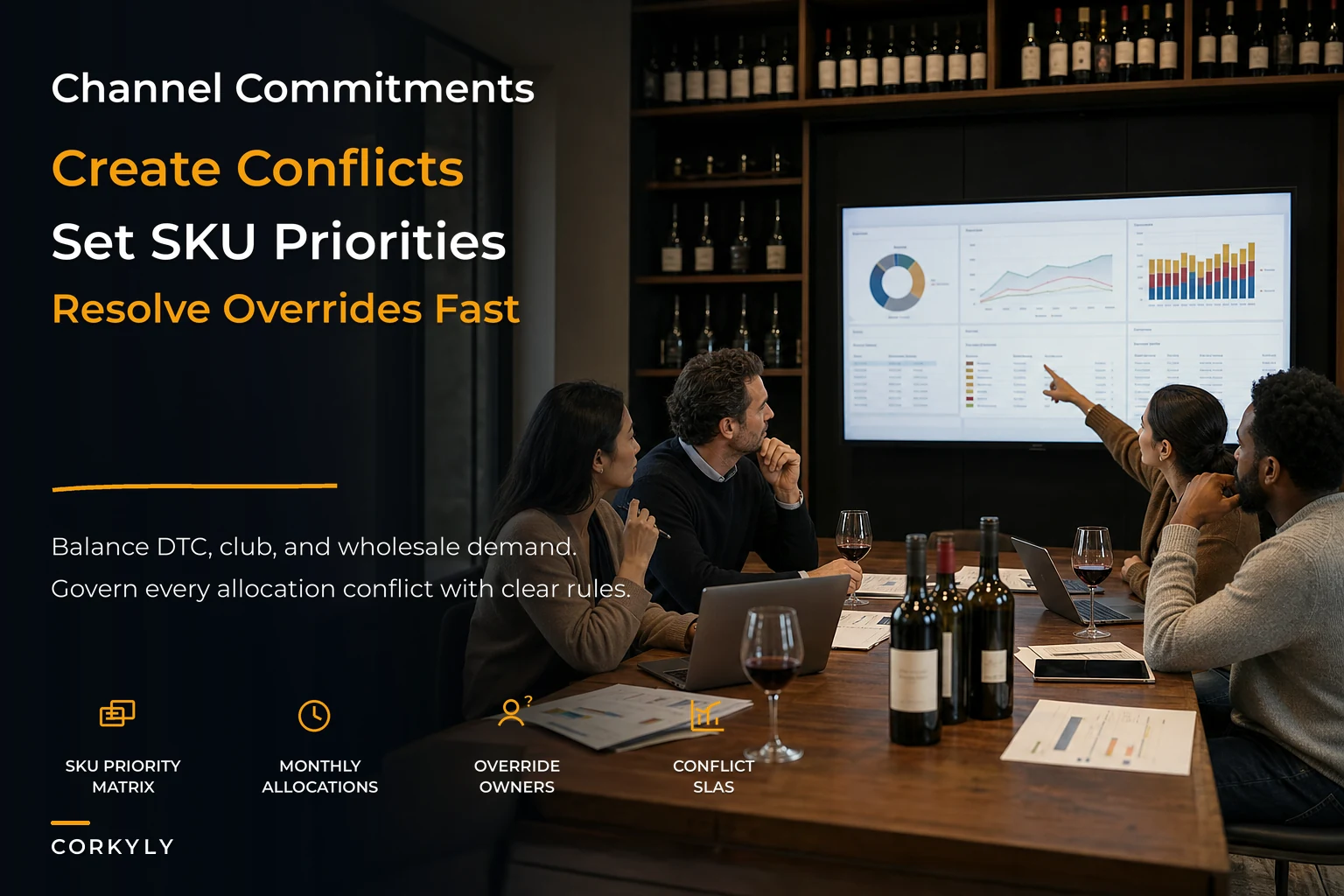
This article is about the actual system — the allocation priority matrix, the override rules, the monthly ritual that keeps everyone honest, and the conflict-resolution SLAs that settle disputes before they turn into relationship damage. Not tips. The operating structure itself.
Why channel allocation breaks (and it's almost never the forecast)
Allocation conflicts are structural, not accidental. They're baked into how most wineries grow.
You start DTC-heavy. The tasting room and club are your margin engine, so for years every decision defaults to protecting DTC. Then a distributor relationship opens up a new state, or a regional account wants a program, and suddenly you've got channels with completely different commitment logic competing for the same finite liquid.
-
DTC wants flexibility and the highest-margin SKUs available on demand.
-
Club needs certainty months in advance because shipments are scheduled and curated.
-
Wholesale and distributors operate on contract windows and volume commitments that, if missed, cost you placements and shelf space.
Each channel is internally reasonable. The conflict comes from the fact that nobody wrote down which one loses when supply gets tight. In practice, this usually happens when a small-batch SKU sells faster than expected and three channels all have a legitimate claim. Without a priority rule, the loudest voice or the most recent email wins — and that's a terrible way to run a business where allocations touch revenue, contracts, and relationships simultaneously.
If you've already worked through tying inventory states to channel policies — which we covered in the piece on winery inventory allocation governance — this article is the layer above it: the governance that decides disputes between channels, not just the policy inside each one.
The allocation priority matrix, tied to SKU strategy
The core artifact here is a priority matrix. Not a spreadsheet of inventory — a decision table that says, for a given SKU tier, which channel has first claim, which has second, and what the hard reserves look like.
Streamline your winery operations effortlessly.
Corkyly helps you track, manage, and optimize every step from vine to bottle.
- Vineyard & production tracking
- Customer relationship management
- Inventory & sales analytics
No credit card required
The mistake most people make is building one universal priority order — "DTC always wins" or "wholesale commitments always win." That breaks immediately, because your priority order should change depending on the role the SKU plays. A 240-case allocation-tier flagship behaves nothing like your everyday red.
A workable matrix looks something like this:
| SKU tier | Primary claim | Secondary | Hard reserve (locked) | Overflow goes to |
|---|---|---|---|---|
| Allocation-tier / library (≤300 cases) | Club allocation list | DTC waitlist | 15–20% held for comp/trade/press | Not released to wholesale |
| Reserve (300–1,000 cases) | Club + DTC split | Wholesale key accounts | ~10% tasting room pour + comps | DTC waitlist |
| Core production (>2,000 cases) | Wholesale contract windows | DTC/club | Minimal, demand-driven | Flexible across channels |
| Closeout / older vintage | Wholesale + distributor pushes | Tasting room promos | None | Flash DTC sale |
The logic is deliberate. Your scarcest, highest-margin wines protect the relationships that pay full price and renew predictably — usually club and loyal DTC. Your core-production wines protect contract commitments, because that's where a missed allocation damages shelf placement you spent years earning.
One pattern worth flagging: wineries consistently under-reserve on small-lot SKUs. They'll allocate 100% of a 240-case lot across channels and leave nothing for the winemaker dinner, the press sample, or the influential account that walks in a month later. Then they're clawing bottles back from a channel that was already promised them. A hard reserve of 15–20% on scarce SKUs isn't waste — it's the buffer that keeps you from breaking a commitment you already made.
Override rules: the part everyone skips
A priority matrix tells you the default. Override rules tell you when the default gets broken legitimately — and who's allowed to break it.
This matters because overrides happen constantly. A distributor offers an end-cap program that needs 60 cases this week. A club member who spends five figures a year wants a case of something technically sold out. A journalist needs samples from a lot that's fully committed. These aren't abuses — they're real business decisions. The failure is when overrides happen informally, a verbal yes from someone who didn't check what else was committed.
-
Who can authorize it? Define authority by dollar and case thresholds. A tasting room lead can comp 2 cases. Pulling 60 cases from a committed wholesale allocation needs the GM or owner. Write the thresholds down.
-
What gets logged? Every override records the SKU, quantity, the channel it was pulled from, the reason, and who approved it. If you can't see what you borrowed against, you can't reconcile later.
-
Does it get repaid or absorbed? Some overrides are permanent reallocations. Others are "borrow now, replace from next release." The rule should state which, so the channel that gave up bottles knows whether it's getting them back.
The single most useful override discipline: overrides always name the losing channel. You can't approve pulling 60 cases "from inventory." You approve pulling 60 cases from the wholesale Q3 allocation, which means someone in wholesale finds out immediately instead of discovering it at reconciliation. That one requirement eliminates most of the trust damage, because nobody gets surprised.
The monthly allocation ritual
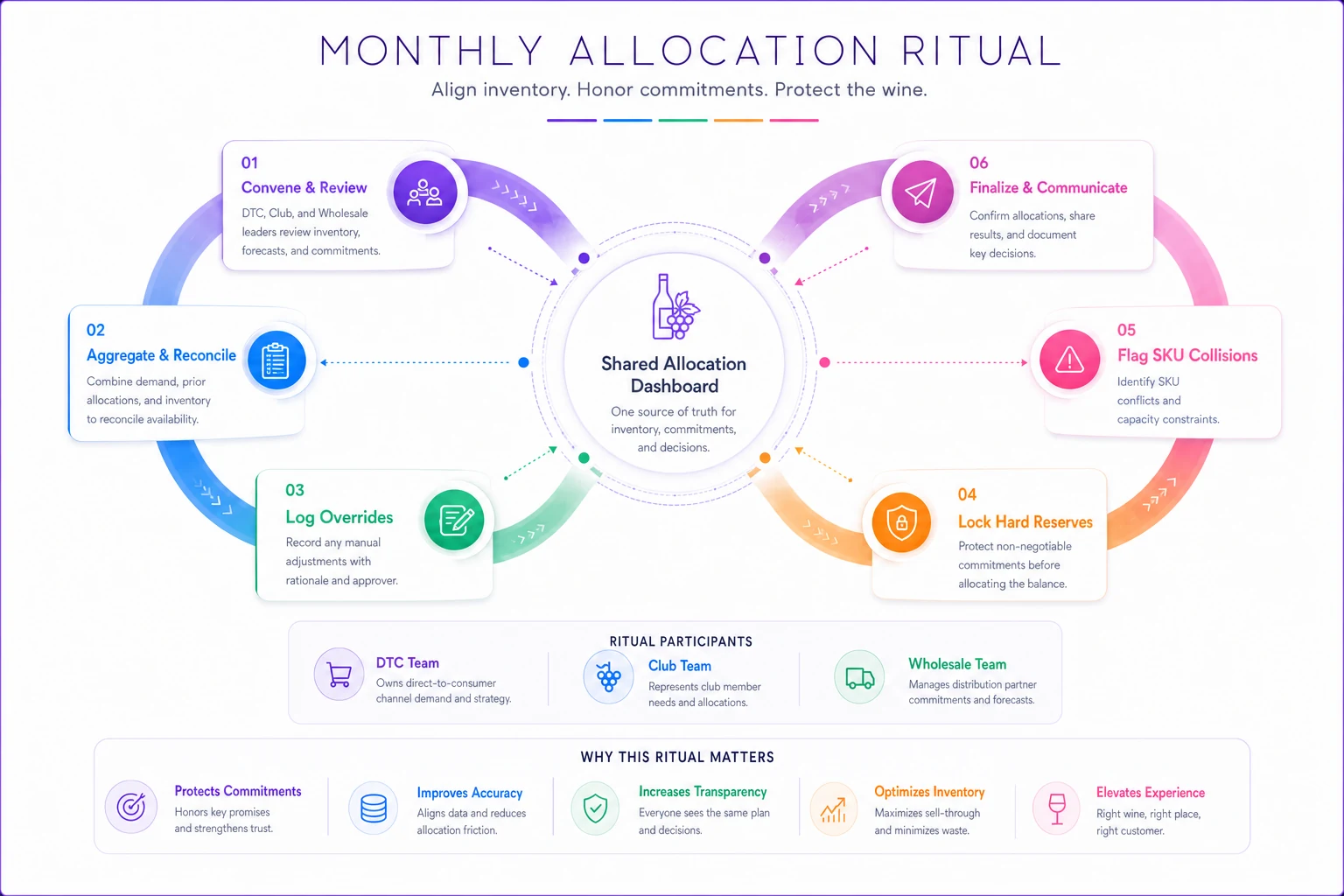
Governance that only lives in a document decays fast. The thing that keeps it alive is a recurring ritual — a standing monthly meeting where channels reconcile against the matrix and reset commitments for the period ahead.
This isn't a status update. It has a specific agenda and specific outputs.
-
Reconcile actuals vs. commitments. For each SKU tier, compare what each channel was allocated against what it actually moved. Chronic over- or under-pull is the early signal your matrix is wrong.
-
Clear the override log. Walk every override from the past month. Confirm the losing channel was notified. Mark which borrows get repaid from the next release.
-
Reforecast the tight SKUs. You don't need to re-plan everything. Focus on the 5–8 SKUs where demand is outrunning supply, because those are the only ones that generate real conflict.
-
Lock the next period's reserves. Before the meeting ends, hard reserves for the coming month are set and agreed in the room. No channel gets to quietly assume it owns inventory that hasn't been assigned.
-
Flag anything heading for a collision. If club has a shipment in six weeks that competes with a distributor window, surface it now while there's still room to negotiate instead of fight.
Who's in the room matters. You want one decision-maker from each channel — DTC/tasting room, club, wholesale — plus whoever owns inventory data. If the people with authority to commit aren't present, the ritual produces suggestions instead of decisions, and suggestions don't hold.
Below is a visualization of the monthly allocation ritual workflow.
The pattern to watch for: when the monthly meeting starts feeling like a formality where everyone nods and nothing changes, it usually means conflicts are being resolved outside the room. A healthy allocation meeting has real disagreement in it.
Conflict-resolution SLAs: deciding disputes on a clock
Even with a good matrix and a monthly cadence, mid-month conflicts happen. A distributor needs an answer in 48 hours. The club shipment locks Friday. These disputes can't wait for the next monthly meeting, and they can't be resolved by whoever emails most aggressively.
That's what conflict-resolution SLAs are for. An SLA here isn't about speed for its own sake — it's about giving every channel a predictable path so they stop hoarding and over-committing defensively.
-
Tier 1 — Channel managers resolve directly. Any conflict under a defined case/dollar threshold gets worked out between the two channel leads, documented in the override log, within one business day.
-
Tier 2 — Escalate to GM. If the two channels can't agree, or the amount crosses the threshold, it goes to the GM with a decision owed in 48 hours. Both channels submit their claim and the business reason in writing.
-
Tier 3 — Owner decision. Anything that affects a contractual wholesale commitment or a flagship allocation goes to the owner, with a hard 72-hour clock.
What makes SLAs work is the clock plus the written claim. When a channel knows it has to state its case in writing and will get a binding answer in two days, it stops playing games. When there's no clock, every dispute becomes a war of attrition — and attrition favors whoever has the most time to argue, which is never the person you want deciding your allocations.
This mirrors the discipline wineries already apply to distributor relationships. If you've built out the SLA logic in the distributor allocation playbook, extend the same escalation thinking across channels, not just within wholesale.
A real scenario: where the collision actually costs money
Consider a mid-size winery doing roughly 14,000 cases a year across DTC, a club of about 1,100 members, and distribution in four states. Their reserve Cabernet runs around 600 cases.
The club team scheduled it for the spring shipment — roughly 320 cases committed. Wholesale, working a separate planning cycle, promised around 200 cases to a key account building a by-the-glass placement. The tasting room, with no reserve carved out, kept pouring and selling it. By March they were committed to something like 640 cases of a 600-case wine.
The resolution wasn't pretty. They pulled bottles from the club shipment, which meant a last-minute substitution and a round of apology emails to members — a few of whom downgraded their tier. They shorted the wholesale account by 50 cases, which cost them part of the placement. Hard to put an exact number on it, but between the churned club members and the diminished account relationship, the damage landed somewhere in the low five figures, plus goodwill you can't easily rebuild.
What would have prevented it wasn't a better forecast. It was a 20% hard reserve on that SKU, an override log that flagged the tasting room sales, and a monthly ritual where club and wholesale would have seen the collision coming in January — with time to negotiate rather than scramble. The governance wasn't missing because anyone was careless. It was missing because they'd scaled past the point where informal coordination works, without building anything to replace it.
When a formal framework is worth it — and when it isn't
A full governance layer is overhead. Worth being honest about when it pays off.
When this makes sense:
-
You run three or more channels with genuinely different commitment logic.
-
You have scarce or allocation-tier SKUs where demand exceeds supply.
-
You've had at least one real oversell or channel dispute (most wineries have).
-
Different people own different channels, so coordination doesn't happen by default.
When it's overkill:
-
You're almost entirely DTC with a simple club — one decision-maker sees everything anyway.
-
Your production comfortably exceeds demand across every SKU, so there's nothing to fight over.
-
You're small enough that the owner personally touches every allocation decision.
The time to build governance is right before you need it — usually when you add your third channel or your first real wholesale commitment, because that's when informal coordination quietly stops scaling. A two-channel winery under a few thousand cases where the owner is in every conversation doesn't need a matrix and SLA structure. It adds process without solving a problem they actually have.
Keeping the whole thing coordinated as you grow
The hard part isn't designing the matrix. It's keeping real-time inventory, override logs, and channel commitments visible to everyone who makes allocation decisions. When those live in separate spreadsheets — one for club, one for wholesale, a POS for the tasting room — reconciliation becomes a monthly archaeology project, and overrides slip through because nobody can see the full picture at the moment of decision.
This is where AI-assisted operational platforms earn their place: not by making allocation decisions for you, but by centralizing inventory states, flagging when a commitment would push a SKU past its available-to-sell number, and surfacing collisions before they turn into disputes. When the system automatically warns that the tasting room is selling into a lot that's 95% committed, the override happens consciously instead of accidentally. The governance rules stay yours. The software just makes sure everyone's working off the same numbers in real time.
Centralize override logs and inventory states so decisions are made with full visibility and fewer surprise reallocations.
The broader point is that channel governance connects directly to how you measure the business. How you track allocation health, over-commitment rates, and channel fill rates should feed the operational metrics that actually move margin — the kind we broke down in the piece on winery operational KPIs. Allocations aren't a side process. They're where your margin strategy, your relationships, and your inventory reality all meet.
Balancing DTC, club, and wholesale isn't about picking a favorite channel. It's about building a system where every channel knows its priority, its reserve, and its path when things get tight — before the shortage hits, not after. A winery channel governance framework won't eliminate conflict. What it does is make conflict predictable and resolvable, so a scarce SKU becomes a planning conversation instead of a scramble that costs you members, placements, and trust you spent years earning.
Ready to elevate your winery management?
Join 500+ wineries using Corkyly to increase operational efficiency, boost customer loyalty, and grow sales.