
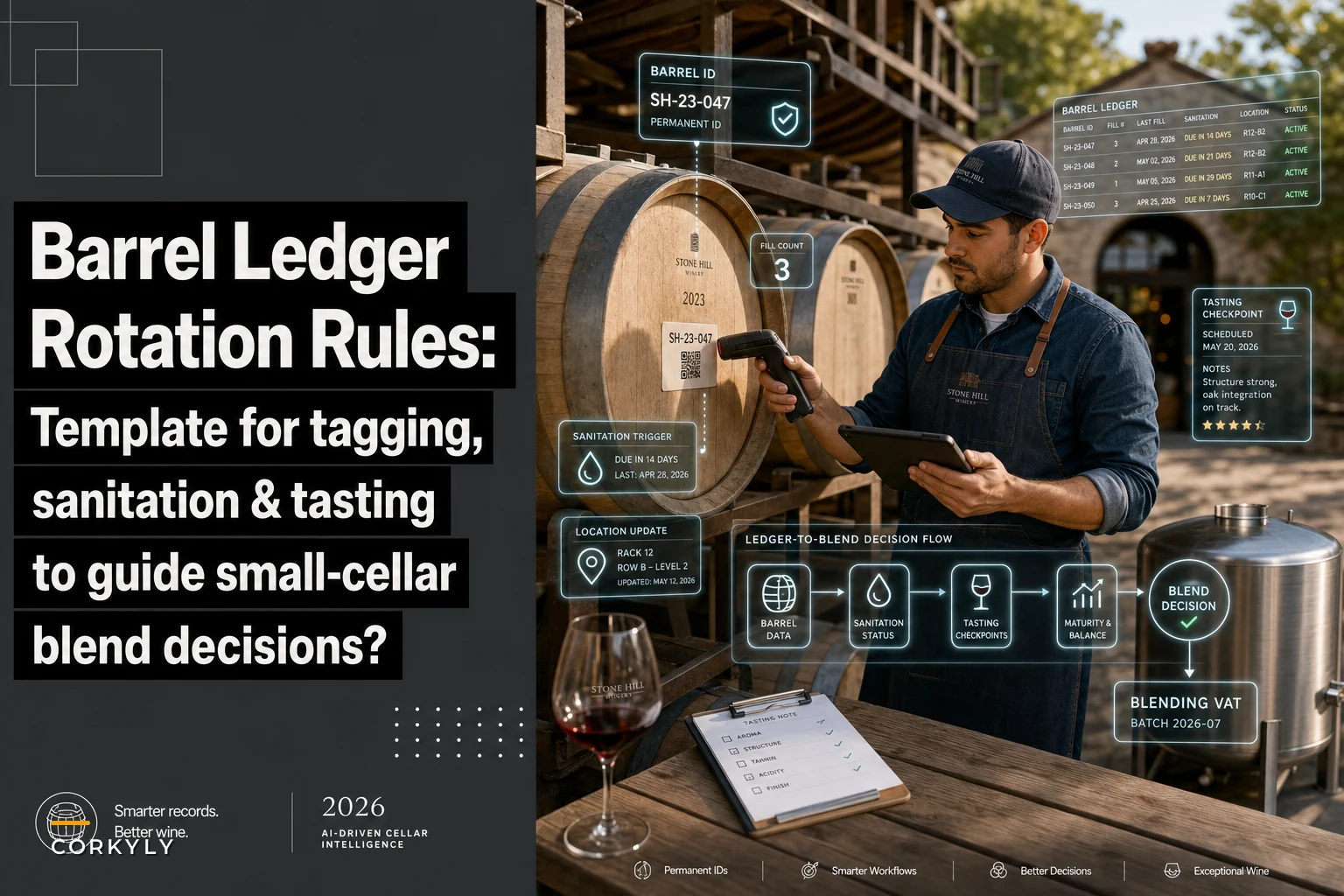

Most small cellars don't lose money on barrels because they bought the wrong cooperage. They lose it because nobody can say, with confidence, which barrel holds what, how many times it's been used, when it was last cleaned, and whether the lot inside is ready to pull for a blend trial. That information lives in three places: someone's memory, a chalk mark on the head, and a spreadsheet that was last updated in November.
This post is about fixing that specific gap. Not barrel theory, not French vs. American oak debates. Just the operational plumbing: a ledger you can actually maintain, the triggers that tell you when to sanitize, the rules for rotating fill order, and the tasting checkpoints that connect a barrel's age to a blend decision. If you run somewhere between 40 and 400 barrels, this is the range where a loose system quietly costs you quality and cash.
The core failure: barrels drift out of identity
Here's how it actually goes wrong. You fill 60 barrels at the end of harvest. About 20 are new, 25 are one-fill, and the rest are neutral. For the first month everyone knows the layout because it's fresh. Then topping starts, someone shuffles a few barrels to get to a leaking one in the back, a couple get emptied early for a rosé pull, and by February the chalk marks are smudged and the crew is topping "from memory."
By the time you're setting up blend trials in spring, you're guessing at oak exposure. A barrel you think is second-fill is actually a three-year neutral. The Cab that was supposed to get 30% new oak influence got closer to 15% because two new barrels got quietly swapped during a reorganization nobody logged.
The consequence isn't dramatic on any single day. It's the slow accumulation of small errors: a blend that doesn't match last year's, oak dollars spent on barrels that added nothing because they were older than recorded, and time burned re-tasting barrels just to figure out what you have. The cost shows up as rework, not disasters. A winemaker re-sampling 40 barrels because the records aren't trusted is losing a full day plus lab time, every trial cycle.
The ledger template that survives a real harvest
A barrel ledger only works if it's fast to update during topping and cleaning, not just at fill. If updating it takes more than 15 seconds per barrel, it won't get done in March. Keep the fields tight.
Streamline your winery operations effortlessly.
Corkyly helps you track, manage, and optimize every step from vine to bottle.
- Vineyard & production tracking
- Customer relationship management
- Inventory & sales analytics
No credit card required
| Field | Example value | Why it matters |
|---|---|---|
| Barrel ID | B-114 | Physical tag, not location. Location changes; ID doesn't. |
| Cooper / type | Sylvain, med+ toast | Ties to oak profile for blend math |
| Fill count | 2 (second-fill) | Drives oak contribution + rotation priority |
| Year commissioned | 2022 | Real age vs. assumed age |
| Current lot | 23-CAB-BlockNorth | Traceability link |
| Volume at last top | 224 L | Angel's share / leak flags |
| Last sanitation | 2024-01-08, steam | Triggers next cleaning |
| SO2 last checked | 2024-02-01, 32 ppm | Protection status |
| Blend status | Trial pulled / hold / cleared | Where it stands in decisions |
The Barrel ID is the whole game. Tag every barrel with a permanent number that never changes even when the barrel moves rows. Location is a separate field you update casually; identity is fixed. When you separate those two, the "which barrel is this really" problem disappears because you're never inferring identity from position.
Tag every barrel with a permanent number that never changes even when the barrel moves rows.
One pattern worth stealing: put fill count and year commissioned right next to each other. Fill count tells you oak usage; year tells you oak age. A barrel can be one-fill but three years old if it sat empty a season, and it will behave more like neutral than a fresh one-fill. Cellars that track only fill count consistently overestimate oak contribution on barrels that had a gap year.
Here's a simple workflow diagram for the ledger and checkpoints.
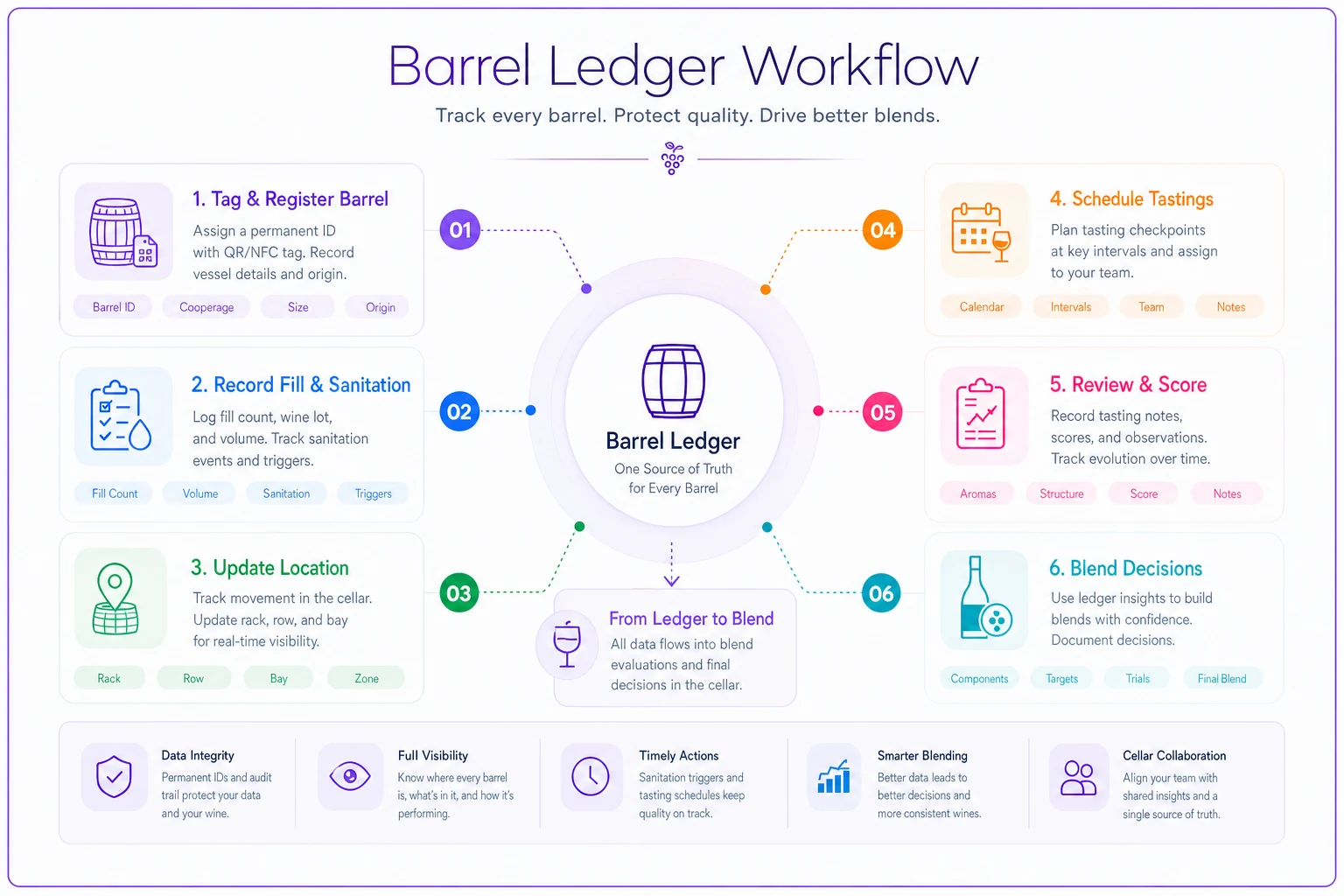
This ledger also feeds directly into your traceability work. If you've built out block-to-bottle traceability, the barrel ledger is the missing middle layer — it connects the lot that came out of the tank to the specific vessels it aged in, which is exactly what you need when a recall or an audit asks "where was this wine for 14 months?"
Sanitation triggers: stop cleaning on the calendar
The most common sanitation mistake in small cellars isn't cleaning too little. It's cleaning on a fixed schedule that ignores what the barrel is actually doing. Empty barrels held wet, barrels that held a spoiled lot, and barrels going back into service after a long empty stretch all need different treatment, and a monthly calendar treats them the same.
Use trigger-based rules instead. Each barrel gets cleaned when a condition is met, not when the month flips:
-
Emptied and going back into service within 72 hours → rinse + light SO2/citric hold, no full sanitation needed
-
Emptied and sitting empty >72 hours → burn a sulfur wick or gas, re-check every 2–3 weeks
-
Held a lot flagged for VA or Brett → hot water or steam, then hold; do not fast-turn into a clean lot
-
Coming back after >30 days empty → full sanitation + swell test for leaks before filling
-
Any barrel showing surface mold at bung → immediate exterior clean + inspect, log it
The trigger people skip most often is the "held a spoiled lot" one. A barrel that carried a Brett-positive wine and gets rinsed and refilled fast is how contamination walks across your cellar. It doesn't announce itself. Three months later two other barrels test positive and nobody connects it to the fast turnaround in January.
Log the sanitation method, not just the date. "Cleaned 1/8" tells you nothing next year. "Steam, 1/8" tells you whether the level of treatment matched what the previous lot required.
Rotation rules: fill order is a decision, not an accident
Rotation is where oak strategy lives. If you fill randomly, your oak contribution across a blend is random. The rule set doesn't need to be complex — it needs to be followed.
-
New barrels go to your reserve or top-tier lots first. New oak is your most expensive influence; spend it where it changes the wine's tier.
-
One-fill barrels handle the mid-tier and structural blend components. Still meaningful oak, far cheaper per unit of influence.
-
Neutral barrels are for volume, malolactic, and lots where you want texture without oak flavor.
-
Rotate barrels down a tier each vintage automatically. A new barrel this year is a one-fill next year — plan the whole barrel's life, not just this fill.
-
Cap consecutive fills of the same varietal in a barrel if you're chasing a specific profile. Some cellars keep barrels varietal-dedicated; decide on purpose, not by habit.
The rotation rule that saves the most money is planning a barrel's full lifespan up front. Cellars that buy new barrels every year without a downgrade plan end up top-heavy in new oak and short on neutral, then panic-buy neutral barrels or over-oak their entry wines. Map where each new barrel goes for its first four vintages the day you commission it.
Tasting checkpoints tied to blend decisions
Tasting barrels randomly whenever someone has time produces inconsistent notes and no decisions. Tie tastings to fixed checkpoints so each one has a purpose and feeds a specific decision.
Checkpoint 1 — 6 to 8 weeks post-fill. Purpose: catch problems early. You're looking for reduction, early VA, or a barrel that smells off. This isn't a quality tasting; it's a triage. Flag anything for corrective action while it's still fixable.
Checkpoint 2 — mid-aging (roughly 4–6 months). Purpose: assess oak integration and start sorting barrels into rough blend buckets. Which barrels are showing well? Which are lagging? This is where you start building a mental map of your future blend.
Checkpoint 3 — pre-blend trial (4–6 weeks before you plan to blend). Purpose: pull the actual barrels you'll trial. This checkpoint is where the ledger earns its keep — you're pulling based on recorded oak exposure and fill count, then confirming by taste. The record gets you to the right 15 barrels to taste instead of tasting all 60.
Checkpoint 4 — post-blend confirmation. Purpose: lock the decision and record which barrels went where, so next year you can reference what worked. Update blend status in the ledger to "cleared" so those barrels enter the rotation-down plan.
A pattern worth noting: cellars that don't tie tasting to checkpoints tend to over-taste early and under-taste at the decision point. They open barrels constantly in the first two months — oxygen exposure, topping labor — and then rush the pre-blend evaluation because they're out of time. Flip that. Light early, thorough at the decision.
A real scenario
A roughly 3,500-case producer running about 90 barrels had a recurring problem: their flagship Cab tasted noticeably different vintage to vintage even when the fruit source and picking decisions were stable. The winemaker blamed vintage variation. The actual cause was barrel drift — new-oak allocation was inconsistent because nobody tracked fill count reliably, and barrel reorganizations mid-aging weren't logged.
After tagging every barrel with a permanent ID and running a simple fill-count-driven rotation plan, the changes weren't glamorous. Pre-blend tasting dropped from tasting nearly the whole cellar to about 20 targeted barrels per trial, saving close to a full working day plus lab costs each cycle. More importantly, the new-oak percentage on the flagship became something they could set on purpose and hit within a few points, instead of discovering it after the fact. Two vintages later the wine was landing where they wanted it consistently — not because of better fruit, but because the oak decision was finally under control.
When a formal barrel ledger isn't worth it
If you run under about 25 barrels and one person handles every fill, top, and clean, a whiteboard and permanent tags might genuinely be enough. The overhead of a structured system pays off when information has to move between people — when the person topping isn't the person deciding blends, or when barrels physically move and someone loses track.
It's also a bad fit if you won't maintain it during harvest crunch. A ledger updated only at fill and blend is worse than no ledger, because people trust it and it's wrong. Better to keep it minimal and current than detailed and stale. Start with just Barrel ID, fill count, and last sanitation. Add fields only once those three are reliably maintained.
Where this connects to the rest of the cellar
Barrel records don't live alone. They feed directly into blending chemistry and into what eventually hits the bottling line. When your barrel ledger cleanly hands off "here are the exact vessels and volumes going into this blend," your downstream work gets smoother — the same discipline pays off when you're setting up bottling run batching and need to know precisely what's going where without last-minute reconciliation.
Some of this recordkeeping is where lightweight operational software helps — not because you need a complex platform, but because a barrel ledger that auto-flags sanitation triggers and surfaces which barrels are due for a checkpoint removes the "I forgot to update it" failure mode. The value isn't automation for its own sake; it's that the trigger fires whether or not someone remembered. But the system matters far less than the discipline. A cellar with permanent tags, a five-field ledger, trigger-based cleaning, and four honest tasting checkpoints will out-perform a cellar with expensive software and smudged chalk marks every single vintage.
Get the identity problem solved first — permanent IDs, separate location field — and most of the downstream chaos in a small barrel program quietly goes away.
Ready to elevate your winery management?
Join 500+ wineries using Corkyly to increase operational efficiency, boost customer loyalty, and grow sales.