
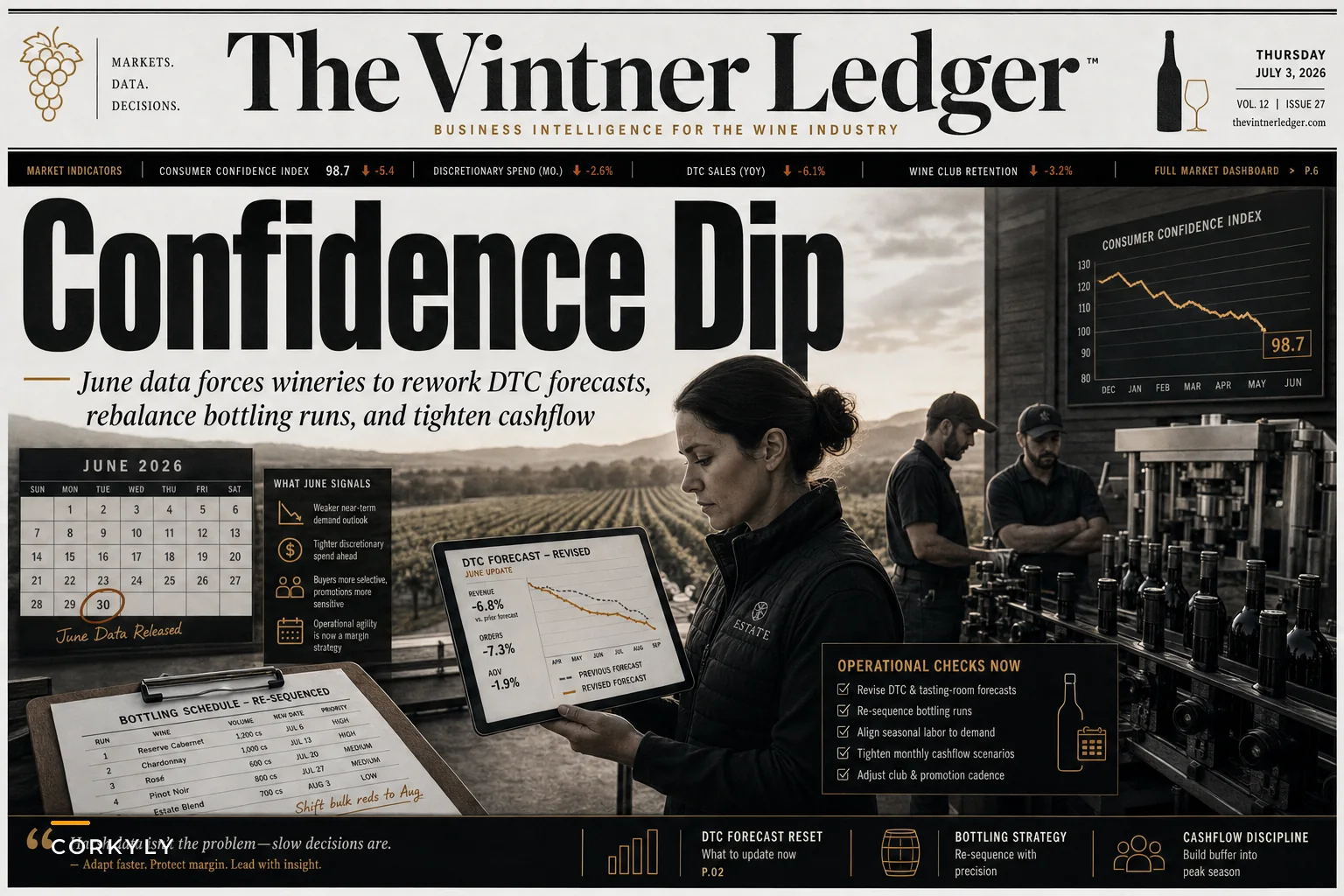

The Conference Board's latest consumer confidence report landed last week with a headline that probably didn't make your morning briefing: confidence ticked up slightly in June, but labor market perceptions got worse. If you're deep into veraison planning right now, you might've missed it entirely.
That matters for your operation because the consumer confidence impact wineries feel isn't immediate—it ripples through 60 to 90 days later, right when you're making critical decisions about tonnage contracts, bottling schedules, and how much Cabernet to hold back for reserve programs.
I learned this managing operations for a 12,000-case facility in Paso Robles. We ignored similar mixed signals in early summer 2019, kept production targets flat, and ended up sitting on 1,800 cases of excess inventory through the following spring. Roughly $140,000 in working capital frozen when we needed it for harvest labor and new French oak.
The pattern is consistent. When consumer confidence sends mixed signals in June and July, tasting room traffic stays relatively stable through August, but your September and October sales composition changes. Premium bottles slow down first. Library wines sit longer. Your $65 reserve Pinot that normally moves 40 cases a month drops to 25. Your $28 everyday red picks up slightly, but not enough to offset the margin hit.
Reading the tea leaves in tasting room patterns
Walk into any tasting room this weekend and watch what's happening at the sales counter. You'll see the early indicators playing out in real purchasing decisions.
When confidence edges up but job market concerns grow—exactly what Reuters reported in the June data—visitors don't stop coming. They change what they buy. The couple who normally joins at the reserve level drops to classic. The wine club member who usually adds a magnum to their shipment skips it. Groups still book private tastings but order fewer bottles for the table.
These micro-shifts compound into real operational headaches by October. A 15% drop in average transaction value changes your bottling math for upcoming lots. That 400-case run of small-lot Syrah you planned for September might need to become 250 cases, with the rest going into your red blend program.
The operational challenge isn't just adjusting production volumes—it's the cascade. Smaller bottling runs mean higher per-unit costs. Different blend ratios mean recalculating your barrel program. Changed allocation between DTC and wholesale means renegotiating distributor commitments that were set back in February.
The inventory trap nobody talks about
Most wineries run inventory planning on a simple formula: last year's sales plus expected growth equals this year's production target. When consumer confidence sends mixed signals mid-year, that formula breaks.
Streamline your winery operations effortlessly.
Corkyly helps you track, manage, and optimize every step from vine to bottle.
- Vineyard & production tracking
- Customer relationship management
- Inventory & sales analytics
No credit card required
Think through what happens at a typical 8,000-case winery when consumer patterns shift in June. You've already committed to fruit contracts based on spring projections. Your bottling schedule for August through October is locked in with your mobile line operator. Marketing has planned their fall campaign around specific SKUs and price points.
Now you're getting signals that premium price points might soften while your value tier could see upticks. Do you bottle everything as planned and risk sitting on expensive inventory? Adjust your bottling schedule and pay rush fees? Hold wine in tank until you have more clarity?
The hidden cost isn't just working capital tied up in slow-moving inventory. It's the opportunity cost of misallocated production capacity. Every tank holding wine that should've been bottled differently is a tank you can't use for incoming fruit. Every pallet of slow-moving reserves is warehouse space you're paying for monthly.
A Sonoma producer I worked with faced this in 2022. They held firm on their original plan, bottled 600 cases of their $85 Bordeaux blend in August, and sold 127 cases by December. The rest sat in climate-controlled storage at $1.20 per case per month while they scrambled to move it through flash sales and club allocations that ended up damaging their brand positioning.
Why your cashflow projection just became fiction
June's consumer confidence data essentially invalidates any cashflow projection you built before Memorial Day. Not because the sky is falling—the uptick in confidence suggests consumers aren't pulling back entirely—but because the composition of your revenue is about to shift in ways your spreadsheet doesn't capture.
Tasting rooms feel confidence shifts within 30 days. Wine clubs buffer you for one shipment cycle, maybe two. Wholesale reorders lag by a full quarter. Events split weirdly—corporate bookings evaporate while weddings stay solid.
The math gets ugly quickly. Say your monthly cashflow normally looks like:
-
Tasting room
$45,000
-
Wine club
$120,000
-
Wholesale
$35,000
-
Events
$15,000
When consumer confidence wobbles, tasting room drops to $38,000, but you won't see the wine club impact until September's shipment. Wholesale holds steady until Q4 when distributors suddenly cut orders by 20%. Events split—corporate goes to zero, private stays around $8,000.
By October, you're down roughly $30,000 per month from projection, exactly when you need cash for harvest labor, fruit payments, and bottle purchases for spring. The solution isn't panic—it's getting ahead of the adjustments.
Tactical adjustments for the next 90 days
The window for meaningful operational adjustments is narrow but not closed.
Bottling flexibility over commitment
Cancel any bottling runs scheduled for late August through September that aren't absolutely essential. Yes, you'll pay rebooking fees. They're nothing compared to sitting on unmarketable inventory. Hold wine in tank or barrel until demand patterns clarify. A Central Coast producer I advise saved around $67,000 in carrying costs by delaying two bottling runs by six weeks last year.
Delay non-essential bottling runs—rebooking fees often cost less than carrying high-end inventory.
Production pivots that preserve margin
Instead of bottling 500 cases of that $75 single-vineyard Cab, consider splitting the lot. Bottle 200 cases at the premium tier, blend 300 cases into a new $45 winemaker's selection. You preserve the premium positioning for loyal customers while creating a price point that actually moves in uncertain markets.
Rethink your club shipment
September and November club shipments are probably already set, but you can still adjust. Add a member's choice option where people can swap bottles within a tier. Offer early access to library wines at a discount. Create payment plan options for annual members. Small tweaks that reduce cancellations matter more than maximizing revenue per shipment right now.
Labor planning with built-in flexibility
Harvest labor needs are somewhat fixed, but cellar work through October isn't. Build scenarios where you can defer non-critical cellar tasks if cash gets tight. Barrel washing, racking schedules, and bottling prep can all flex by several weeks without compromising quality.
The blend decision matrix
Your blending decisions over the next 60 days lock in your market position for the next 18 months. When consumer confidence shows mixed signals, the traditional "make the best wine possible" approach needs a reality check.
Scenario 1: Premium demand recovers Keep your original blending plan. Single-vineyard stays single-vineyard. Reserve lots get the full treatment. You're betting on a return to normal by the holidays.
| Scenario | Action |
|---|---|
| Scenario 1: Premium demand recovers | Keep your original blending plan. Single-vineyard stays single-vineyard. Reserve lots get the full treatment. You're betting on a return to normal by the holidays. |
| Scenario 2: Middle tier takes over | Blend down one tier across the board. Your $90 reserve becomes a $65 special selection. Your $65 single-vineyard becomes a $45 estate bottling. You sacrifice some margin but maintain volume. |
| Scenario 3: Value rules everything | Aggressive blending to hit $25–35 price points. Almost everything except your absolute best lots goes into branded blends. You're prioritizing cashflow and inventory turns over margin. |
Scenario 2: Middle tier takes over Blend down one tier across the board. Your $90 reserve becomes a $65 special selection. Your $65 single-vineyard becomes a $45 estate bottling. You sacrifice some margin but maintain volume.
Scenario 3: Value rules everything Aggressive blending to hit $25–35 price points. Almost everything except your absolute best lots goes into branded blends. You're prioritizing cashflow and inventory turns over margin.
Most wineries should plan for Scenario 2 while keeping optionality for Scenario 1. Build your blends to work at multiple price points. That lot of Merlot could be a standalone $55 bottle or the backbone of a $35 red blend—keep both options open until the last possible moment.
Your seasonal operations need new triggers
The consumer confidence impact wineries experience is a good reason to rethink how you synchronize seasonal operations with market signals. Static annual plans don't work when demand shifts mid-season.
Build trigger points into your operational calendar. When tasting room traffic drops below 85% of the prior year for two consecutive weeks, that triggers a bottling schedule review. When average transaction value falls below $120, that triggers a pricing strategy session. When wine club cancellations exceed 8% monthly, that triggers a member benefit restructure.
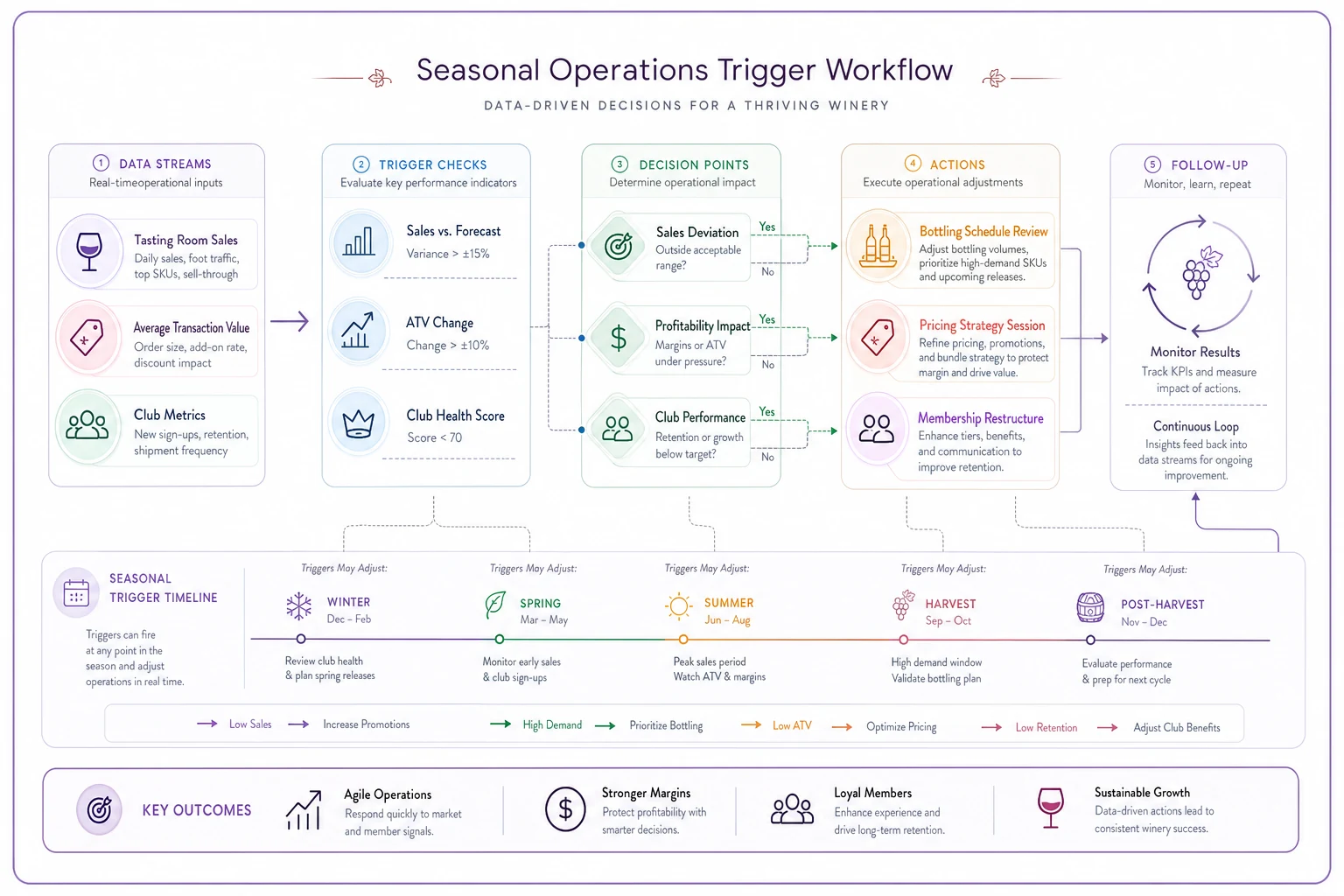
Here's a simple workflow to visualize those trigger points.
These aren't panic buttons—they're systematic responses to data that let you adjust before problems compound. A Napa facility started using this approach in 2021 and reduced excess inventory by around 40% while keeping margins within 2% of target.
Making peace with uncertainty
The hardest part about managing winery operations through consumer confidence shifts isn't the tactical adjustments—it's the psychological weight of constant uncertainty. You're making 18-month bets on 90-day information while managing perishable inventory and agricultural timelines that don't care about economic indicators.
Wineries that navigate these periods well tend to share a few traits.
They preserve optionality obsessively. Every operational decision gets evaluated for how much flexibility it keeps. They'll pay more for shorter-term contracts, smaller bottling runs, and modular staffing specifically to maintain maneuverability.
They communicate scenario planning to their team instead of pretending everything is fine. The cellar team knows what happens if you need to defer bottling. The tasting room understands the importance of maintaining traffic even if sales soften.
And they use operational systems that can handle rapid change. When you need to adjust bottling schedules, reforecast cashflow, and modify harvest plans simultaneously, spreadsheets and memory aren't enough. Modern operational platforms help track these moving pieces, flag conflicts before they become crises, and keep coordination intact when plans change week to week.
The next 12 weeks matter more than the next 12 months
Consumer confidence will shift again before harvest ends. It always does. The wineries that come out the other side aren't the ones with perfect predictions—they're the ones with operational systems flexible enough to adjust as reality unfolds.
Start with visibility. Know your daily tasting room numbers, weekly inventory positions, and monthly cashflow projections in real-time, not retrospectively. Build adjustment triggers based on actual operational data. Create feedback loops between sales patterns and production decisions that work in days, not quarters.
June's consumer confidence uptick, paired with labor market concerns, isn't a crisis. It's a yellow flag that demands operational attention. Your response over the next 90 days determines whether you enter 2027 with clean inventory, healthy margins, and preserved flexibility—or you're still trying to move excess 2026 vintage through desperate spring promotions.
That outcome gets decided in dozens of small operational choices between now and October.
Ready to elevate your winery management?
Join 500+ wineries using Corkyly to increase operational efficiency, boost customer loyalty, and grow sales.