

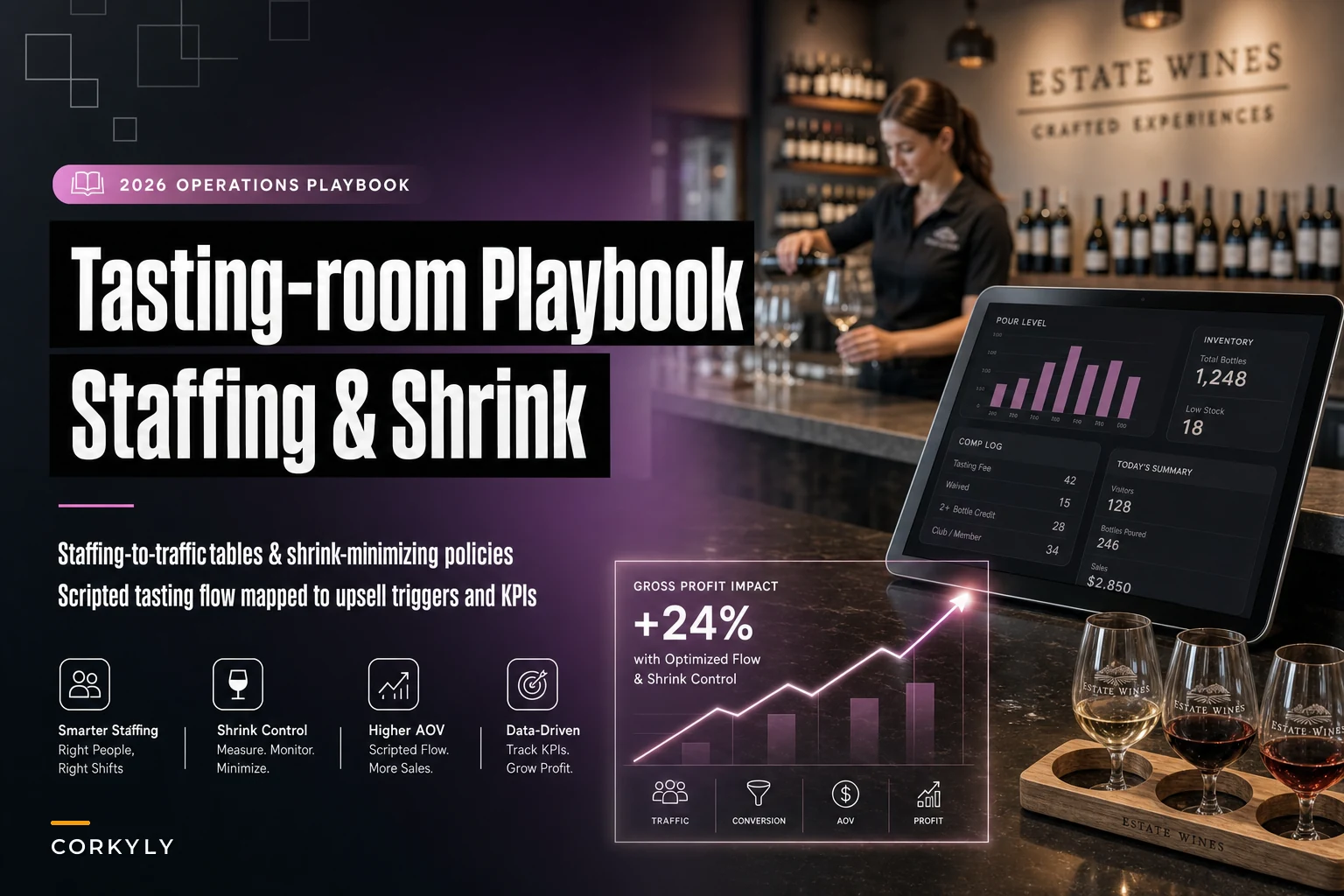

Most tasting rooms are run on gut feel. The manager looks at the reservation book, guesses how many pourers to schedule, and hopes the Saturday crowd doesn't blow past the two people behind the bar. When it works, nobody notices. When it doesn't, you get a room full of guests waiting, one overwhelmed staffer pouring blindly, and a whole lot of wine walking out the door in ways that are impossible to account for at the end of the night.
This is a walkthrough of three things that quietly decide whether your tasting room makes money: how you staff against actual traffic, how you stop shrink you can't see on a spreadsheet, and how you build a tasting flow that leads to a sale without anyone feeling sold to. These are connected problems. Fixing one without the others usually just moves the leak somewhere else.
The staffing guess that costs you both ways
Tasting-room staffing fails in two opposite directions, and most owners only notice one of them.
Overstaffing is easy to spot. Four pourers on a Tuesday afternoon, three of them refolding brochures, payroll bleeding. Owners catch this because it's visible and shows up directly on the P&L.
Understaffing is the one that actually costs more, and it's nearly invisible. When one pourer is trying to run six guests through a five-wine flight while three more parties wait to be greeted, a few things happen simultaneously. The waiting group gets bored and leaves without buying. The pourer, rushing, over-pours to look generous and speed things along. Nobody gets the club pitch because there's no time. The room feels chaotic, so the guests who do stay grab one bottle instead of the case they might've taken home in a calmer setting.
That's the pattern: understaffing doesn't show up as a line item. It shows up as a conversion rate that's mysteriously low and a shrink number nobody can explain. You paid for those guests to walk in — through events, ads, wine-country foot traffic — and then couldn't convert them because the room was too thin to sell.
Build a staffing-to-traffic table, not a schedule
The fix isn't "schedule more people." It's building a repeatable table that maps expected traffic to a specific number of pourers and support roles. Here's a practical version tuned for a mid-size tasting room. Adjust the ratios to your pour complexity and average party size.
| Expected guests / hour | Pourers | Host/greeter | Support (runner, POS) | Notes |
|---|---|---|---|---|
| 0–8 | 1 | shared | shared | Pourer handles greeting + POS |
| 9–18 | 2 | 1 | shared | Greeter controls the door flow |
| 19–30 | 3 | 1 | 1 | Runner keeps bottles + water stocked |
| 31–45 | 4 | 1 | 1–2 | Split the room into stations |
| 46+ | 5+ | 1–2 | 2 | Consider timed seatings / reservations only |
The number that matters most here is the greeter/host role — and it's the first one small rooms cut. A dedicated greeter at 19+ guests per hour isn't a luxury. That person controls the pace of the entire room. They hold parties at the door for 90 seconds instead of letting them crowd a busy pourer, they set expectations, and they're the reason pourers can actually finish a scripted tasting instead of rushing through it.
To use the table, you need traffic estimates that are better than a guess. Pull the last two seasons of daily sales counts by hour. Layer in your reservation data. Most rooms find their traffic is far more predictable than they assumed — the same three-hour Saturday window drives the majority of the week's covers, and that's exactly the block people chronically understaff because labor cost anxiety kicks in.
Shrink you can't see on a spreadsheet
Tasting-room shrink is different from cellar or warehouse loss because most of it looks completely legitimate. It's not theft in the dramatic sense. It's dozens of tiny, defensible-in-the-moment pours that quietly add up.
Streamline your winery operations effortlessly.
Corkyly helps you track, manage, and optimize every step from vine to bottle.
- Vineyard & production tracking
- Customer relationship management
- Inventory & sales analytics
No credit card required
-
Over-pouring. A "generous" pour is 1.5 oz instead of 1 oz. Do that across a five-wine flight, fifty times a day, and you're pouring an extra bottle-plus per staffer per shift with no sale attached.
-
Comps with no record. The pourer knows the visitor, waives the fee, pours extra, and nothing gets logged. Individually fine. In aggregate, a black hole.
-
Open-bottle waste. Bottles opened for a flight, half-finished, and dumped at close because nobody tracked what was already open.
-
Buyback and staff tasting. Legit and necessary, but only if it's counted. Untracked staff education tasting is one of the most common quiet leaks.
-
The "just one more taste" pour. The guest is on the fence about the reserve, so the pourer offers another taste to close the sale. Sometimes that's smart selling. Often it's just giving product away to someone who was never going to buy.
The reason this shrink hides is that your inventory count and your sales count live in two different systems and nobody reconciles them at the pour level. You know how many bottles left the cellar for the tasting room. You know how many you sold. The gap gets waved off as "tasting samples" every month, and the number quietly grows.
A shrink-minimizing policy set that doesn't kill hospitality
-
Standardize the pour with a measured line or a jigger. Not for every pour — that feels clinical — but train to a line on the glass. A visible standard means "generous" stops meaning "double."
-
Log every comp, even zero-dollar ones. The point isn't to stop comps. It's visibility. A comp with a reason code costs nothing and closes the biggest untracked hole.
-
Track open bottles on a running board. A simple opened-bottles log per shift, reconciled at close. What was opened, what's left, what got dumped and why.
-
Set a daily staff-tasting allowance and record it. Give pourers a legitimate amount to taste for education, and count it. Removing the guilt removes the sneaking.
-
Reconcile pour-level at least weekly, not monthly. Bottles issued to the room minus bottles sold minus logged comps/waste/staff tasting = your true unexplained shrink. Watch that last number.
Standardize the pour with a measured line or a jigger.
That final reconciliation is where the real signal lives. A monthly reconciliation lets a small leak run for weeks before anyone notices. A weekly one catches a bad pattern — a specific shift, a specific pourer, a specific wine that keeps going missing — while you can still do something about it.
This connects directly to your broader numbers. If you're serious about which metrics actually move margin, it's worth reading how managers get winery KPIs wrong and the formulas that actually move margins — because tasting-room shrink and conversion are two of the most commonly mis-measured numbers in the whole operation.
The scripted flow that sells without selling
Now the part that ties staffing and shrink to actual revenue: the tasting flow itself.
Most tasting-room conversations are improvised. A good pourer improvises well; an average one wanders, forgets the club pitch, and never gets to the upsell. A loose framework — not a word-for-word script — fixes the floor without capping the ceiling. It makes sure the moments that drive purchases actually happen every time, regardless of who's behind the bar that day.
Mapping the flow to upsell triggers
-
Greeting + framing (0–2 min). The greeter or pourer sets the arc: "We'll taste five today, building from lighter to bigger, and I'll point out a couple that are club or library exclusives." This plants the club and the upsell before a single sip. It costs nothing and primes everything after.
-
Pour 1 — the easy yes. An approachable white or rosé. No pitch. Build rapport, read the party. Trigger: figure out who the decision-maker and the enthusiast are. They're rarely the same person.
-
Pour 2 — the story wine. Something with a real story — old vines, a tough vintage, a small lot. Stories create the emotional attachment that makes bottles leave the room. Trigger: if the enthusiast lights up, mention limited availability here, not later.
-
Pour 3 — the reaction read. Watch faces. The wine someone reacts to is the wine to circle back on at checkout. Trigger: "That one surprises a lot of people — it's one of our club members' favorites." Club seed, dropped naturally.
-
Pour 4 — the reserve / upsell wine. Your higher-margin pour. By now they trust the pourer. Trigger: the direct-but-soft club math — "If you're already grabbing two bottles, the club gets you this one at basically the tasting-room discount, plus you skip the line next time."
-
Pour 5 — the close. End on a crowd-pleaser or the flagship. Trigger: assume the sale. "Which of these do you want to take home?" beats "Would you like to buy anything?" every single time.
The difference between a room that converts at 20% and one converting at 45% usually isn't the wine. It's whether these moments happen reliably, or whether they depend entirely on which pourer got scheduled that day.
Tying the script to KPIs you actually watch
-
Conversion rate (parties that buy ÷ parties tasted)
-
Average order value per converting party
-
Club sign-ups per 100 tastings
-
Reserve/upsell attach rate (how often the higher-margin wine gets added)
-
Revenue per available pour hour — the tasting-room version of RevPASH from restaurants, and honestly the single best number for judging whether staffing and flow are actually aligned
Track these by shift and by pourer. Your best pourer isn't always the one with the highest AOV — sometimes it's the one with the highest conversion rate, because they're closing parties a flashier pourer lets walk.
A real scenario
A family-run tasting room in a moderate-traffic region — around 30,000 visitors a year spread across a busy season and a slow one — was running the classic setup: two pourers most days, three on Saturdays, no dedicated greeter, no pour standard, monthly inventory reconciliation.
Unexplained shrink was running somewhere around 6–7% of tasting-room product, waved off as samples. Conversion sat in the low 20s. Nobody could explain why some Saturdays crushed it and others didn't.
They changed three things over one season. They built a staffing-to-traffic table and added a dedicated greeter on any shift projected above roughly 18 guests per hour. They introduced measured pours, a comp log, and weekly pour-level reconciliation. And they rolled out the mapped tasting script with club triggers at pours 3 and 4.
By the end of the season, unexplained shrink dropped to roughly 2–3% — not zero, because staff tasting and honest waste are real, but the mysterious gap mostly closed. Conversion climbed into the mid-30s. The greeter role they'd resisted paying for turned out to more than cover its own cost by keeping the room's pace calm enough for pourers to actually finish the script. Club sign-ups roughly doubled off the same traffic volume.
No single change did it. The staffing fix created the time to run the script, and the shrink policies made sure extra pours were going toward sales instead of vanishing.
When this actually makes sense — and when it doesn't
The full system is worth building if your tasting room does meaningful volume with variable traffic — big weekend swings, event days, seasonal peaks. That's exactly where guessing hurts most and where a table plus a script pays off.
If you're a very small room pouring for a handful of appointment-only guests a day, don't over-engineer it. A staffing table for one pourer is pointless. Focus on the pour standard and a simple comp log — the two highest-leverage shrink controls — and skip the rest until volume justifies it.
One thing worth being clear about: don't hand pourers a rigid word-for-word script and enforce it. That kills the hospitality that makes wine tasting actually work. The framework guarantees the moments happen; the pourer's personality fills them. Get that backwards and you'll train the warmth right out of your room.
Keeping it running
The hard part isn't setting this up — it's keeping the numbers honest week after week. Pour-level reconciliation, per-shift conversion tracking, and comp logging all fall apart the moment they depend on someone manually stitching together the POS, the inventory count, and a paper log at 9pm after a long shift. That's usually when reconciliation quietly slides back to monthly and the leak reopens.
Here's a simple workflow for tying your tasting-room POS to inventory, comp logs, and weekly reconciliation.
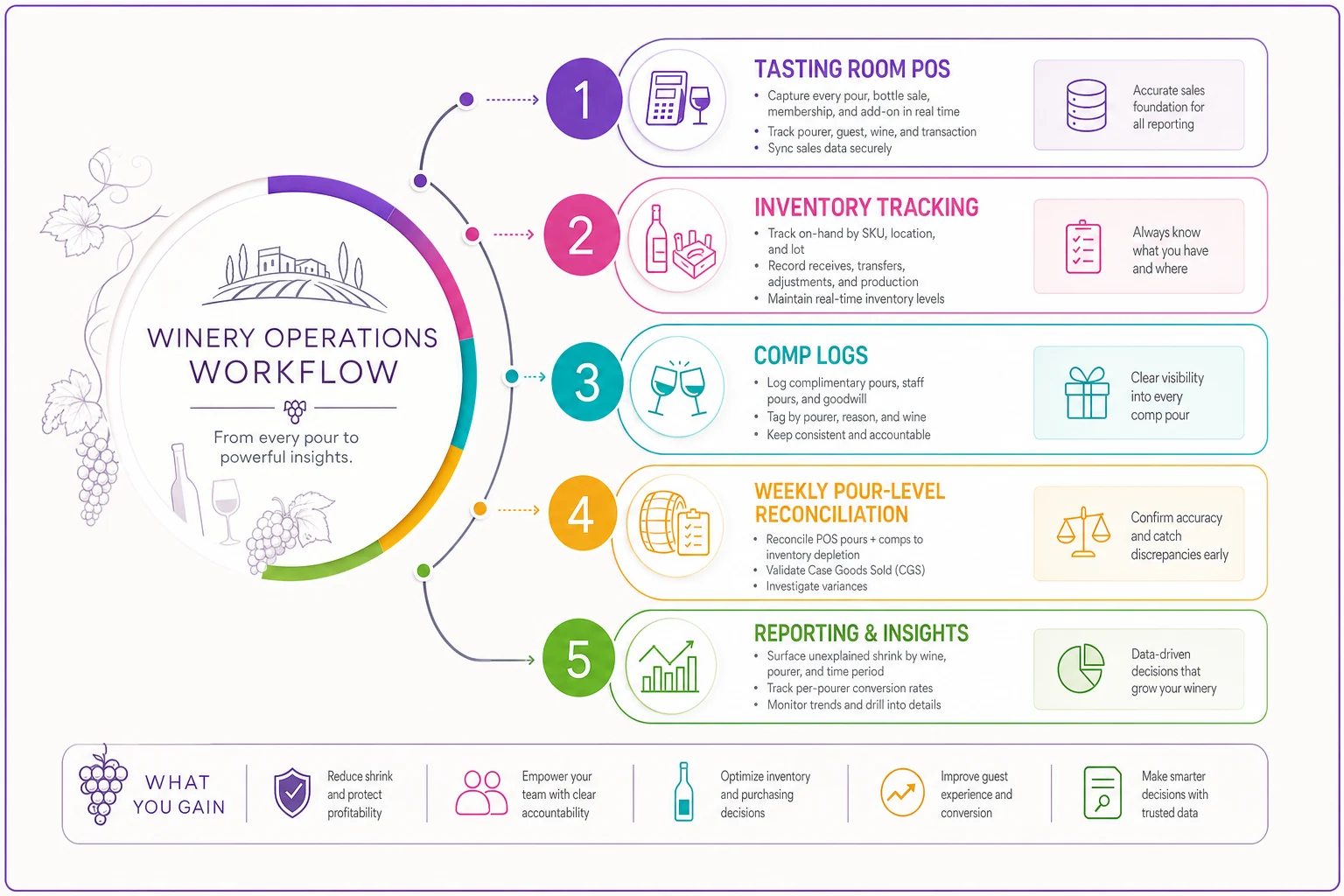
A workflow platform that ties your tasting-room POS to inventory and surfaces shrink and conversion numbers automatically earns its keep — not because it sells anything for you, but because it removes the manual reconciliation step that people always skip. When the weekly unexplained-shrink number and the per-pourer conversion rate just appear without anyone building a spreadsheet, the policies actually stick.
The tools are secondary, though. The real work is deciding that staffing, shrink, and the tasting flow are one connected system — not three separate problems to address in isolation. Fix them together, measure them honestly, and the tasting room stops being the fuzzy, gut-feel corner of the winery and starts behaving like what it actually is: usually your highest-margin sales channel.
Ready to elevate your winery management?
Join 500+ wineries using Corkyly to increase operational efficiency, boost customer loyalty, and grow sales.