

The hardest week of harvest isn't peak pick. It's the week before, when you're trying to turn forty strangers into a crew that can sort fruit, run a destemmer, and not hurt themselves around a forklift — all while the sugar numbers are climbing and you've got maybe three days before the first block comes in.
Most wineries treat seasonal labor like a staffing problem. Fill the headcount, get bodies on the line, sort it out later. But "sort it out later" usually means the first ten days of harvest are a slow-motion mess: sluggish sorting, inconsistent intake, safety near-misses, and a couple of good pickers quietly deciding they'd rather work the orchard down the road.
A real seasonal labor system isn't about hiring faster. It's about compressing the time between "this person showed up" and "this person is productive and safe" — and doing that with actual structure instead of hoping your cellar lead has time to shadow everyone.
Why the first 72 hours decide your whole harvest labor cost
A pattern that shows up again and again: a winery hires its seasonal crew in a rush, onboards everyone in one chaotic morning meeting, and then spends the next two weeks absorbing the cost of that shortcut.
-
A sorting line running at maybe 70% of its real throughput because half the crew isn't sure what to pull
-
The cellar lead pulled off their actual job to re-explain the same thing nine times
-
One or two intake mistakes that contaminate a lot or throw off a weigh-in
-
Turnover in week one, which means you're re-hiring and re-training during the busiest stretch of the year
The wineries with the smoothest harvests aren't the ones that hire the best people. They're the ones who decided, before the season, exactly what a new hire needs to know by hour 4, by hour 24, and by day 30 — and built the onboarding around that instead of around whoever happened to be free that morning.
The insight most people miss: seasonal labor is a throughput problem disguised as a hiring problem. If your onboarding takes a week, you've lost a week of your season's capacity. If it takes 48 hours, you've bought that week back.
Hiring scorecards: stop interviewing on vibes
Before anyone gets onboarded, you have to pick them. And this is where a lot of wineries lose before they've started, because the "interview" is a two-minute conversation at the gate or a referral from someone's cousin.
Streamline your winery operations effortlessly.
Corkyly helps you track, manage, and optimize every step from vine to bottle.
- Vineyard & production tracking
- Customer relationship management
- Inventory & sales analytics
No credit card required
A hiring scorecard doesn't need to be corporate. It needs to force you to rate the two or three things that actually predict performance for that specific role, on a consistent scale, so you're not comparing a gut feeling about one person against a gut feeling about another.
For harvest roles, the things worth scoring are usually:
-
Physical reliability — can they stand, lift, and repeat for a full shift without quality dropping off hour by hour?
-
Prior relevant experience — not "have you worked a harvest" but "have you run this kind of task"
-
Availability through the window — the person available for the full 6 weeks is worth more than a stronger worker who disappears in week three
-
Safety awareness — do they already think about where their hands are, or do you have to teach the whole concept?
Here's a simple scorecard structure you can adapt per role:
| Criteria | Weight | 1 (weak) | 3 (okay) | 5 (strong) |
|---|---|---|---|---|
| Relevant task experience | 3x | Never done it | Some adjacent work | Ran the exact task before |
| Availability through window | 3x | Partial, gaps | Most of window | Full window committed |
| Physical consistency | 2x | Fades fast | Steady with breaks | Strong all shift |
| Safety awareness | 2x | Needs full training | Basic instincts | Already safety-minded |
| Attitude / coachability | 1x | Resistant | Neutral | Eager, asks questions |
Have the same two people score candidates during a hiring window so ratings stay consistent across the pool.
The weighting matters more than the scores. A picker who commits to the full window and brings steady hands will almost always out-value a stronger worker who's gone in two weeks. The scorecard forces that trade-off into the open instead of letting you get dazzled by one strong answer during the interview.
One mistake to avoid: don't use the same scorecard for every role. The criteria that make a great sorter — consistency, attention to detail — are different from what makes a good forklift or pump operator, where certification, calm under pressure, and spatial awareness matter a lot more. Build two or three scorecards, not one.
Role-based rapid onboarding bundles (24–72h)
This is the core of the system. Instead of one generic orientation, you build a small bundle per role — the exact set of things a person needs before they're safe and productive. Each bundle is designed to be completed in a tight window: 24 hours for simpler roles, up to 72 for anything involving equipment or chemical exposure.
-
Safety SOPs they must know before touching anything — the non-negotiables
-
The core task, broken into its first-day version — not the master class, just what they'll actually do day one
-
A named person they report to — so questions have a destination, not a shrug
-
A short sign-off — a quick check that they can actually do the thing, not just that they watched someone else do it
Here's what the bundles look like across common harvest roles:
Sorting line crew — 24h bundle
-
Safety first (hour 1) line pinch points, emergency stop location, glove and cut protocol, what to do if someone goes down
-
Core task what to pull vs. keep for this varietal and this quality tier — with physical examples in front of them, not a photo on a wall
-
Report to sorting line lead
-
Sign-off supervisor watches them sort one bin and confirms the reject rate looks right
Cellar intake / weigh-in — 48h bundle
-
Safety forklift traffic awareness, slip/trip zones from standing water, chemical contact from sanitizers
-
Core task receiving a load, logging weight and block, sampling for the lab, tagging the lot correctly
-
Report to cellar lead
-
Sign-off complete two supervised intakes with correct paperwork and tagging
Equipment operators (forklift, pumps, destemmer) — 72h bundle
-
Safety this is the whole first block — certification check, lockout/tagout, confined-space awareness if relevant
-
Core task operating the specific machine, startup/shutdown, what "wrong" sounds like
-
Report to cellar master or equipment lead
-
Sign-off operate under supervision until the lead clears them to go solo
The reason this works: a person can finish a 24-hour sorting bundle and be genuinely productive while you're still working through the 72-hour forklift bundle for someone else. You're not waiting on the whole crew to be "trained" — you're releasing people into productivity as fast as each role safely allows.
The wineries that stall at onboarding usually fail because the bundle isn't written down. It lives in the cellar lead's head, so it only happens when that one person has time, and it's slightly different every time. Writing the bundle out — even on one laminated page per role — is what makes it fast and repeatable.
A simple diagram of the onboarding flow helps clarify who gets released when.
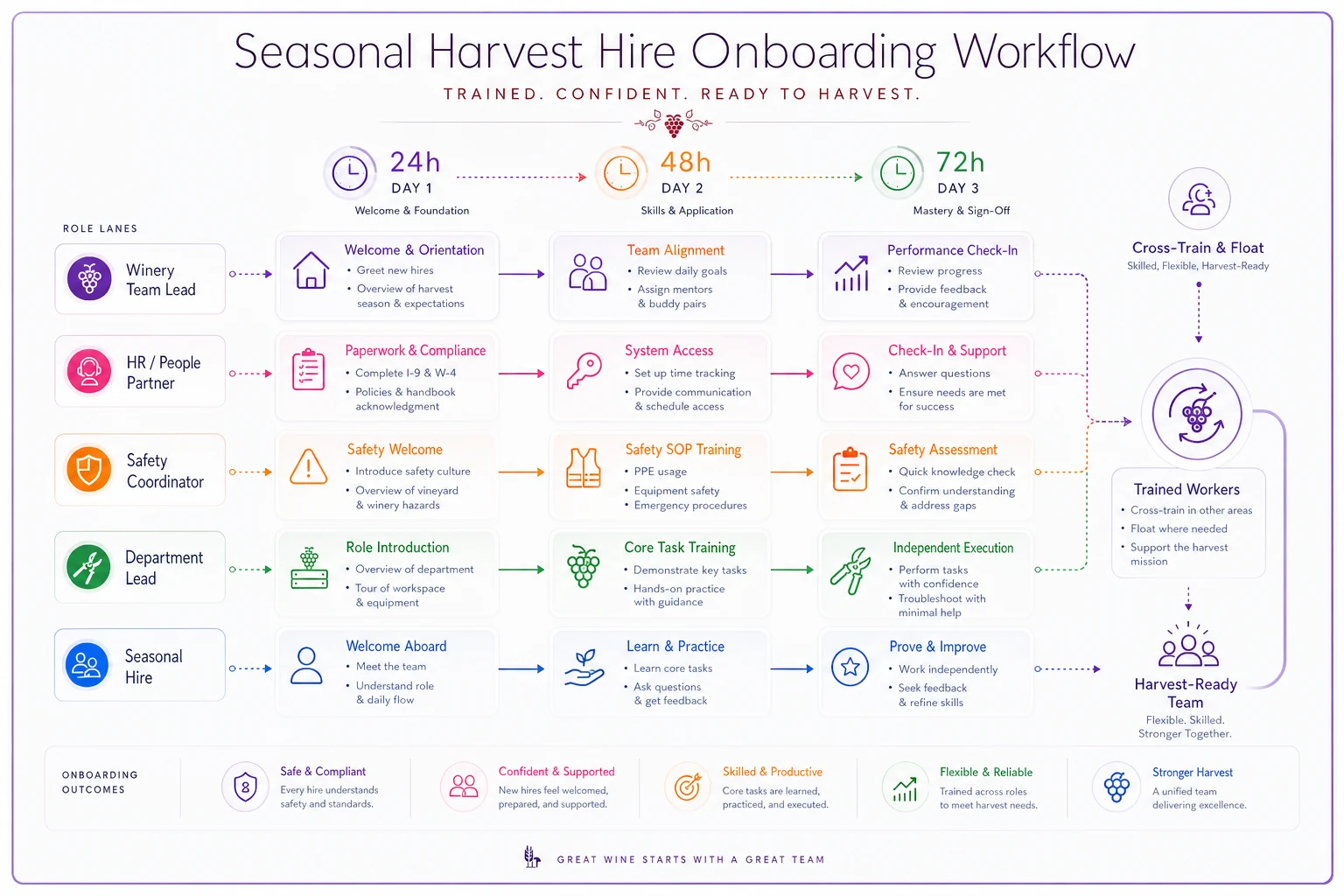
The reason this works: a person can finish a 24-hour sorting bundle and be genuinely productive while you're still working through the 72-hour forklift bundle for someone else. You're not waiting on the whole crew to be "trained" — you're releasing people into productivity as fast as each role safely allows.
The 30-day competency checklist tied to real tasks
Getting someone productive in 48 hours is the start. The second half of the system is making sure they actually develop over the first month instead of plateauing at "barely functional" and staying there.
A 30-day competency checklist ties each milestone to a real harvest task and a real safety SOP — not to abstract training modules. It answers: by day 7, by day 14, by day 30, what should this person be able to do unsupervised?
-
Day 1–3 Can receive a load with supervision, correct paperwork and tagging. Knows forklift traffic rules cold.
-
Day 7 Runs intake solo for standard loads. Flags anything unusual to the lead instead of guessing.
-
Day 14 Handles multiple loads during a busy intake window without the paperwork falling behind. Comfortable with lab sampling.
-
Day 30 Can walk a new hire through basic intake. Catches tagging or block-assignment errors before they propagate.
That last milestone is the one people skip, and it's the most valuable. When a seasonal hire hits "can train the next person" by day 30, your onboarding system becomes self-sustaining late in the season — which is exactly when you're most likely to be adding bodies and your leads are most burned out.
Tie each checkbox to a specific SOP document so there's no ambiguity about what "competent" means. "Knows safety" is useless. "Can state the three forklift traffic rules and demonstrate the E-stop on the sorting line" is something you can actually verify.
Shift-optimization templates: matching crew to the fruit
Onboarding gets people ready. Scheduling decides whether that readiness turns into throughput or gets wasted standing around.
The common failure here is scheduling by headcount instead of by workflow. You bring in twenty people because that's who's available, then discover the bottleneck is actually the two people on the press and the other eighteen are waiting on them. Or the reverse — you've got a huge sorting crew and one weigh-in station backing up every truck.
A shift-optimization template works backward from the constraint. Before the day starts, you answer:
-
What's coming in and when — which blocks, estimated tonnage, rough arrival windows
-
Where the bottleneck will be — intake, sorting, crush, or press
-
How many people each station needs to keep pace with the slowest step — not to keep everyone "busy"
-
Who's cross-trained so you can shift people when the bottleneck moves during the day
This connects directly to how you stage the whole intake operation. If you're running fruit from several blocks or microclimates on the same day, the sequencing of trucks, crews, and cellar capacity is its own puzzle — we go deep on that in harvest logistics for multiple microclimates, and the labor template should slot into that logistics plan rather than being treated as a separate thing.
Here's a rough shift template structure for a day with two blocks arriving:
| Station | AM (Block A intake) | PM (Block B + crush) | Notes |
|---|---|---|---|
| Weigh-in / intake | 2 | 2 | Bottleneck AM — keep staffed |
| Sorting line | 6 | 4 | Shift 2 to crush PM |
| Crush / destem | 2 | 4 | Ramps up as fruit backs up |
| Press / cellar | 2 | 3 | Pull from sorting as needed |
| Float / cross-trained | 2 | 1 | Covers breaks and surges |
The float row is the quiet lever most schedules don't have. Two cross-trained people who can slide to wherever the backup is will do more for your throughput than two extra bodies locked to one station. This is also where your 30-day competency checklist pays off — the people who've hit "can run intake solo" by day 14 are exactly the ones worth keeping as floats.
When this level of system actually makes sense (and when it doesn't)
Not every operation needs the full build. If you bring in four returning workers every year who already know your cellar, formal scorecards and 72-hour bundles are overhead you don't need. Keep a one-page refresher and move on.
The system earns its keep when:
-
You're hiring 15+ seasonal workers, especially first-timers
-
You have high turnover or rely on a labor pool that changes year to year
-
You run equipment that creates real safety and liability exposure with untrained operators
-
Your harvest window is tight and you can't afford a slow first two weeks
Where it becomes a problem: over-engineering it. Some wineries build a 40-page onboarding binder nobody reads. That's worse than nothing, because it creates the illusion of a system while the actual training still happens by whoever's free. The bundles should be short enough to live on a laminated page. If a new hire can't get through the day-one version in a single sitting, it's too long.
A real scenario
A mid-sized winery running roughly 300–350 tons brought in around 25 seasonal workers, most of them new, every harvest. Their old approach was a single Saturday orientation and then "learn on the line." The first two weeks were reliably rough — sorting throughput lagged, the cellar lead spent most of his time re-training instead of running the cellar, and they usually lost three or four people in the first ten days.
They rebuilt it into role-based bundles: a 24-hour sorting bundle, a 48-hour intake bundle, and a 72-hour equipment bundle, each with a written sign-off. They added two simple scorecards for hiring and a 30-day checklist tied to their existing safety SOPs.
The difference showed up fastest in two places. The sorting line was running close to full speed by around day three instead of day ten. And the cellar lead got his actual job back, because questions now routed to named leads and the bundles answered most of the basics. Turnover in the first two weeks dropped to one person that season. Nothing dramatic — there was no magic moment — they just stopped paying the invisible tax of chaotic onboarding, and that tax had been eating most of their first two weeks every year.
Where tools fit, lightly
Most of this runs fine on paper and whiteboards, and plenty of good wineries never go further than that. Where operational software earns a place is in the coordination layer — keeping each role's checklist, sign-offs, and daily shift template in one spot so the cellar lead isn't rebuilding it from memory each morning, and so a worker's day-14 competency status is actually visible when you're deciding who can float.
AI-assisted scheduling can also take arrival estimates and tonnage and suggest a staffing split per station, which saves the lead from doing that math by hand at 6am. But the system comes first. Software just keeps a good system from degrading back into tribal knowledge halfway through a long season.
Bringing it together
Seasonal labor doesn't have to be the part of harvest you dread. The wineries that handle it well aren't lucky with their hiring — they've decided in advance exactly what each role needs to know, compressed the path to productivity into 24–72 hours, and built a 30-day arc that turns raw hires into people who can eventually bring the next wave up to speed.
Start smaller than you think. Write one bundle for your biggest role. Build one scorecard. Run one shift template against your real intake plan. Get those working this season, and the rest of the system will tell you where it needs to grow next year.
Start smaller than you think. Write one bundle for your biggest role. Build one scorecard. Run one shift template against your real intake plan. Get those working this season, and the rest of the system will tell you where it needs to grow next year.
Ready to elevate your winery management?
Join 500+ wineries using Corkyly to increase operational efficiency, boost customer loyalty, and grow sales.