


The Interior Department's August 21, 2026 finalization of the 2027–2028 operating guidelines put a hard number on something a lot of Lower Basin growers have been quietly dreading: roughly 1.25 million acre-feet per year coming out of deliveries to Arizona, California, and Nevada. Reuters covered the deep cuts to the three Lower Basin states, and the official DOI release laid out the two-year cut alongside a longer 10-year framework meant to guide operations through the next drought cycle.
That's the news. But if you own vineyard acreage in the Coachella Valley, along the Lower Colorado in Arizona, or you're pulling from a district that sources any part of its supply from the river, the news isn't the story. The story is what happens to your block plan, your harvest window, and your cash position when you suddenly have less water to work with — and it costs more per acre-foot than it did last season.
This isn't a "conserve where you can" situation. The Colorado River water cuts force a decision most operations have been avoiding: which vines actually earn their water, and which ones you've been irrigating out of habit.
Start with the uncomfortable question nobody wants to answer first
Most water-planning conversations start at the wrong end. Managers open the irrigation controller, look at run times, and start trimming minutes. That's backwards.
The first question isn't "how do I use less water per vine." It's "which blocks am I willing to sacrifice quality on, and which ones am I protecting no matter what."
That sounds harsh. But when your allocation drops and you can't fully water everything, you're going to make that call one way or another. The only real choice is whether you make it deliberately in December or accidentally in July when the district calls and says your delivery is getting shorted mid-season.
A pattern worth noticing: operations that get caught flat-footed spread the cuts evenly across all blocks. Everybody gets 15% less. It feels fair. It's also the worst possible allocation strategy, because it drags down your premium fruit to the same degree as your bulk-contract fruit. You end up with a whole vineyard of slightly-compromised wine instead of a protected core of high-value blocks and a few clearly-deprioritized ones.
The operations that handle scarcity well tend to think in tiers. And the tiering has to happen before the season, not during it.
Tiering blocks by water priority — an actual framework
The ranking below is the kind of thing that actually works when growers commit to it. It's not about vineyard prestige. It's about the dollars-per-acre-foot each block returns and how fragile that return is under stress.
Streamline your winery operations effortlessly.
Corkyly helps you track, manage, and optimize every step from vine to bottle.
- Vineyard & production tracking
- Customer relationship management
- Inventory & sales analytics
No credit card required
| Priority Tier | What goes here | Water strategy under cuts | Acceptable quality risk |
|---|---|---|---|
| Tier 1 – Protect | Estate/reserve blocks, long-term premium contracts, old-vine parcels you can't replace | Full deficit-managed irrigation, first claim on stored/alt supply | Near zero |
| Tier 2 – Manage | Solid mid-tier fruit, reliable but replaceable contracts | Regulated deficit irrigation, tighten but don't starve | Moderate, monitored closely |
| Tier 3 – Stress | Bulk-contract blocks, high-vigor sites that tolerate stress | Aggressive deficit, longer intervals, accept smaller berries | High — and that may be fine |
| Tier 4 – Sacrifice/Fallow | Marginal economics, aging blocks near replant, disease-pressure parcels | Minimal survival water or intentional fallow | N/A — you've decided |
Identify at least one Tier 4 candidate early — that's often where the biggest reallocation gains are.
The Tier 4 conversation is the one people skip, and it's often where the biggest water savings actually live. If you have a 6-acre block that's been limping along on marginal economics and is due for replant in two years anyway, fallowing it in 2027 might free up enough water to keep two Tier 1 blocks fully protected. That's a better outcome than watering everything a little worse.
-
Block A (Tier 1 Cabernet) ~2.1 acre-feet/acre historically, delivering fruit at roughly $3,800–$4,200/ton. Protect it.
-
Block C (Tier 3 bulk red) ~2.4 acre-feet/acre, fruit selling closer to $900–$1,100/ton. This is where deficit irrigation earns its keep.
-
Block F (Tier 4, aging) currently drinking ~2.0 acre-feet/acre for fruit that barely clears cost. Fallow candidate.
Once the tiers exist on paper, the run-time adjustments become obvious instead of agonizing. This is the same block-ranking logic covered in detail in the guide to irrigation scheduling under constrained water — the framework holds up, the cuts just make it non-optional.
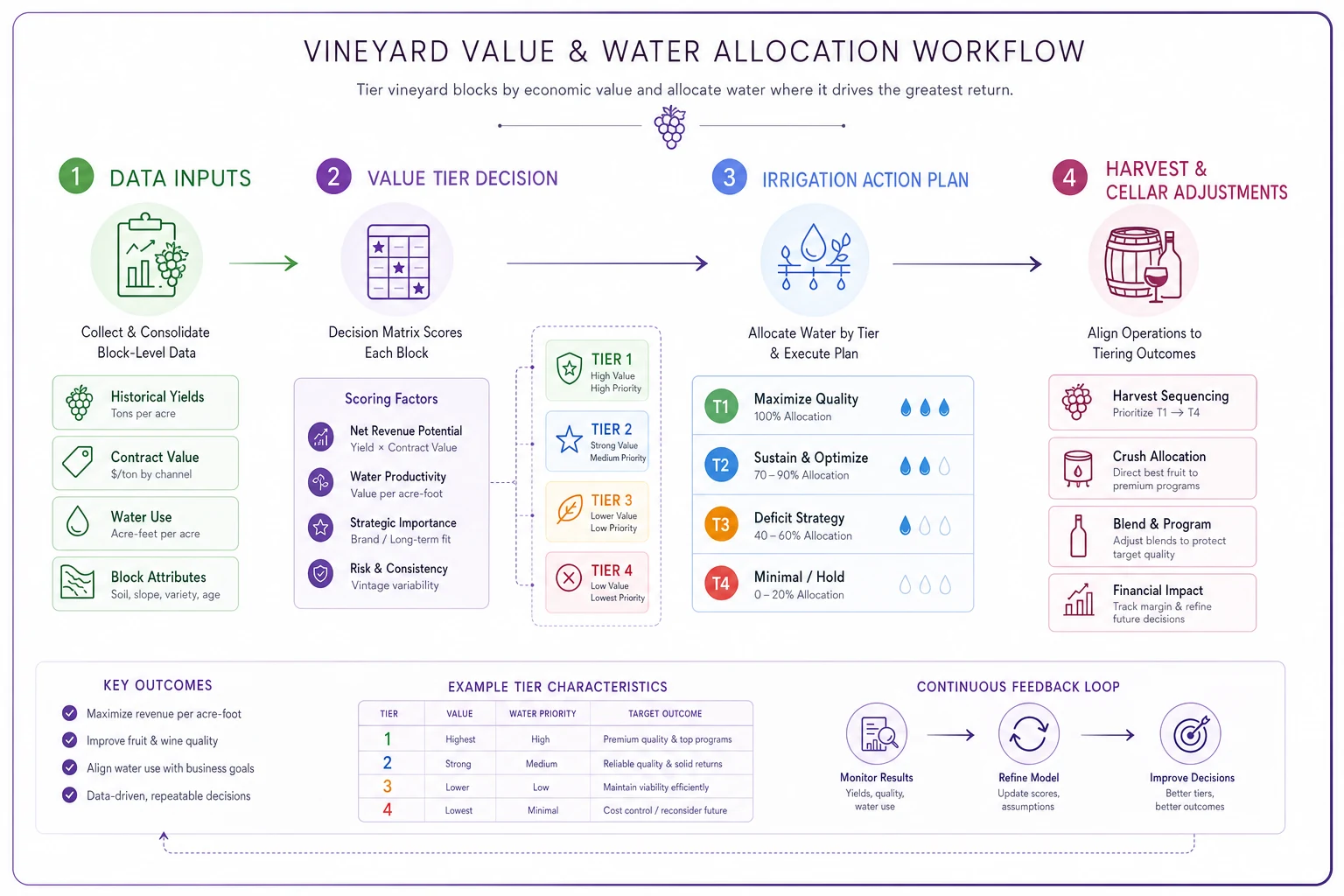
This diagram shows a simple workflow from data to irrigation plan to harvest adjustments, so teams can act quickly when allocations change.
Deficit irrigation is a tool, not a punishment
There's a reflex to treat reduced water purely as loss. But regulated deficit irrigation (RDI), applied to the right blocks at the right phenological stage, can actually improve red wine quality — smaller berries, better skin-to-juice ratio, more concentration. The trick is stage timing.
The window that matters most is post-fruit-set through veraison. Controlled stress here reduces berry size and shoot vigor without wrecking yield potential. Stress the vine too early, during fruit set, and you lose berries you wanted. Stress it too hard after veraison and you stall ripening right when the canopy needs to finish the job.
-
Set a stem water potential (SWP) target per tier. Tier 1 might hold at -10 to -12 bars midday. Tier 3 you let drift to -14 to -16 bars during the deficit window.
-
Measure, don't guess. Pressure-bomb readings twice a week during the stress window on a fixed set of sentinel vines per block. Same vines, same time of day, same reader where possible.
-
Irrigate to the target, not to the calendar. You're chasing a plant-stress number, not running the controller because it's Tuesday.
-
Back off the deficit as harvest approaches on any block where you see ripening stall or excessive canopy collapse.
-
Log every reading against the block record so next season you're not starting from scratch on what each block tolerated.
Operations that struggle with RDI aren't usually failing at agronomy. They're failing at consistency of measurement. Someone takes readings for three weeks, gets busy during a heat spike, stops, then guesses for the rest of the season. That gap is exactly where you either over-stress a premium block or waste water you didn't have.
The part everyone underestimates: harvest and cellar knock-on effects
Less water doesn't just change the vineyard. It reshapes harvest timing, tonnage, and cellar intake — and if you don't plan for the downstream effects, you'll have crews and tank space allocated for a crop that doesn't show up in the volume you expected.
Deficit-stressed blocks ripen differently. Sugars can spike faster while phenolics lag, which compresses or shifts your pick windows. If three blocks that normally came in a week apart all hit target Brix within 48 hours because they were stressed similarly, crew scheduling and press capacity get slammed at once.
-
Lower tonnage on stressed blocks means your contracts need a hard look. If you're selling by the ton and yields drop 15–25% on Tier 3 blocks, that revenue hit needs to be in the 2027 forecast, not a July surprise.
-
Tighter, overlapping pick windows strain crew and truck logistics harder than a normal year.
-
Cellar capacity shifts — smaller lots from some blocks may let you consolidate tanks, but compressed timing can create intake jams even with less total fruit.
-
Higher solids and lower juice yield per ton on heavily stressed fruit change your press schedules and expected finished-wine volume.
The honest planning move is to reforecast finished-case volume by tier and let that flow into your allocation and cashflow model. Fewer cases of Tier 1 wine at premium pricing may hold your margin even as total volume drops — but only if you actually modeled it.
Where the real operational failure hides
The problem the cuts expose isn't really water. It's that most vineyard operations don't have their water use, block economics, and irrigation records connected in one place they can act on quickly.
In practice it looks like this: water bills and allocation data live with the bookkeeper, pressure-bomb readings live in a field notebook or a foreman's phone, block yield and contract values live in a spreadsheet the owner maintains, and the irrigation controller has its own log nobody exports. When the district announces a mid-season delivery cut, pulling those four things together to make a fast, defensible decision takes days — and by then you've already lost the window to respond.
This is where a solid operational platform earns its place — not as some futuristic add-on, but as the thing that keeps block-level water use, sentinel-vine readings, tonnage, and per-block economics in one view so a delivery cut becomes a quick reallocation decision instead of a fire drill. Platforms with AI-assisted alerting can flag when a sentinel block drifts past its SWP threshold or when projected water use for the month is running ahead of your revised allocation, so you catch the drift early instead of discovering it in the July bill. The value isn't the automation for its own sake — it's that the decision-ready information is already assembled when you need it.
But the tool is secondary. The discipline of tracking water use by block against the revenue that block produces is what actually protects you. Most operations have never run that math even once.
A real scenario
A mid-sized operation in the Lower Colorado corridor — around 140 planted acres, roughly a third of its water sourced from a district tied to river allocations — was looking at a projected cut of about 18% for the 2027 season.
Their first instinct was the even-cut approach: trim everybody proportionally. When they sat down and tiered the blocks instead, they found something worth knowing. About 22 acres were marginal Tier 4 fruit — aging blocks feeding a low-margin bulk contract that barely covered farming cost. By fallowing roughly 14 of those acres and moving the rest to survival water, they freed up enough allocation to keep their ~40 acres of Tier 1 estate fruit fully protected under deficit-managed irrigation.
The result wasn't painless. Total tonnage dropped noticeably. But the fruit that mattered — the estate program driving most of their margin — came in on spec. Revenue on the premium tier held roughly flat despite the water cut, and they avoided the scenario where the whole vineyard produces slightly diminished wine across the board. Total water use came down enough to stay inside the reduced allocation with a small buffer.
The number that stuck with the owner wasn't the water saved. It was realizing they'd been spending real money watering 22 acres that were quietly losing money — cut or no cut. The allocation reduction just forced them to finally look at it.
When this approach makes sense — and when it doesn't
Tier-and-deficit works well when:
-
You have a genuine spread of block economics — premium and bulk mixed.
-
Your varieties and rootstocks can tolerate controlled stress. Most reds in warm regions can.
-
You have, or can commit to, consistent plant-stress measurement.
Be cautious when:
-
You're farming thin-skinned whites or aromatic varieties where stress hurts more than it helps.
-
Your soils are very shallow or sandy with little buffering — stress can go from managed to catastrophic fast.
-
You genuinely can't commit to twice-weekly measurement during the stress window. Half-executed deficit irrigation is worse than none.
This is a bad idea if you treat it as a one-time seasonal patch. The Colorado River water cuts come with a 10-year framework attached. The operations that fare best will treat 2027 as the start of a permanent shift in how they budget water against block value — not a rough year to grit through until things return to normal.
Where to put your energy before the water year starts
If you do nothing else before 2027, work through this:
-
Pull three seasons of water use by block and set it next to per-block revenue. If you can't do it by block, do it by zone.
-
Assign every block a tier. Force yourself to name at least one Tier 4 fallow or sacrifice candidate.
-
Confirm your revised allocation with your district in writing and model your total available acre-feet against tiered demand.
-
Identify stored or alternative supply — recovered pond water, recycled sources, groundwater where permitted — and know what it actually costs per acre-foot.
-
Set SWP targets per tier and buy the pressure bombs and sentinel-vine plan now, not in May.
-
Reforecast finished-case volume and cashflow off the new tonnage assumptions, especially for by-the-ton contracts.
-
Build one place where water use, readings, tonnage, and block economics actually live together.
The cuts are real and they're not the last ones. But the operations that come through this in good shape won't be the ones with the most water. They'll be the ones who knew, block by block, exactly which vines were worth the water they were getting — and had the numbers ready when the allocation call came.
The cuts are real and they're not the last ones. But the operations that come through this in good shape won't be the ones with the most water. They'll be the ones who knew, block by block, exactly which vines were worth the water they were getting — and had the numbers ready when the allocation call came.
Ready to elevate your winery management?
Join 500+ wineries using Corkyly to increase operational efficiency, boost customer loyalty, and grow sales.