

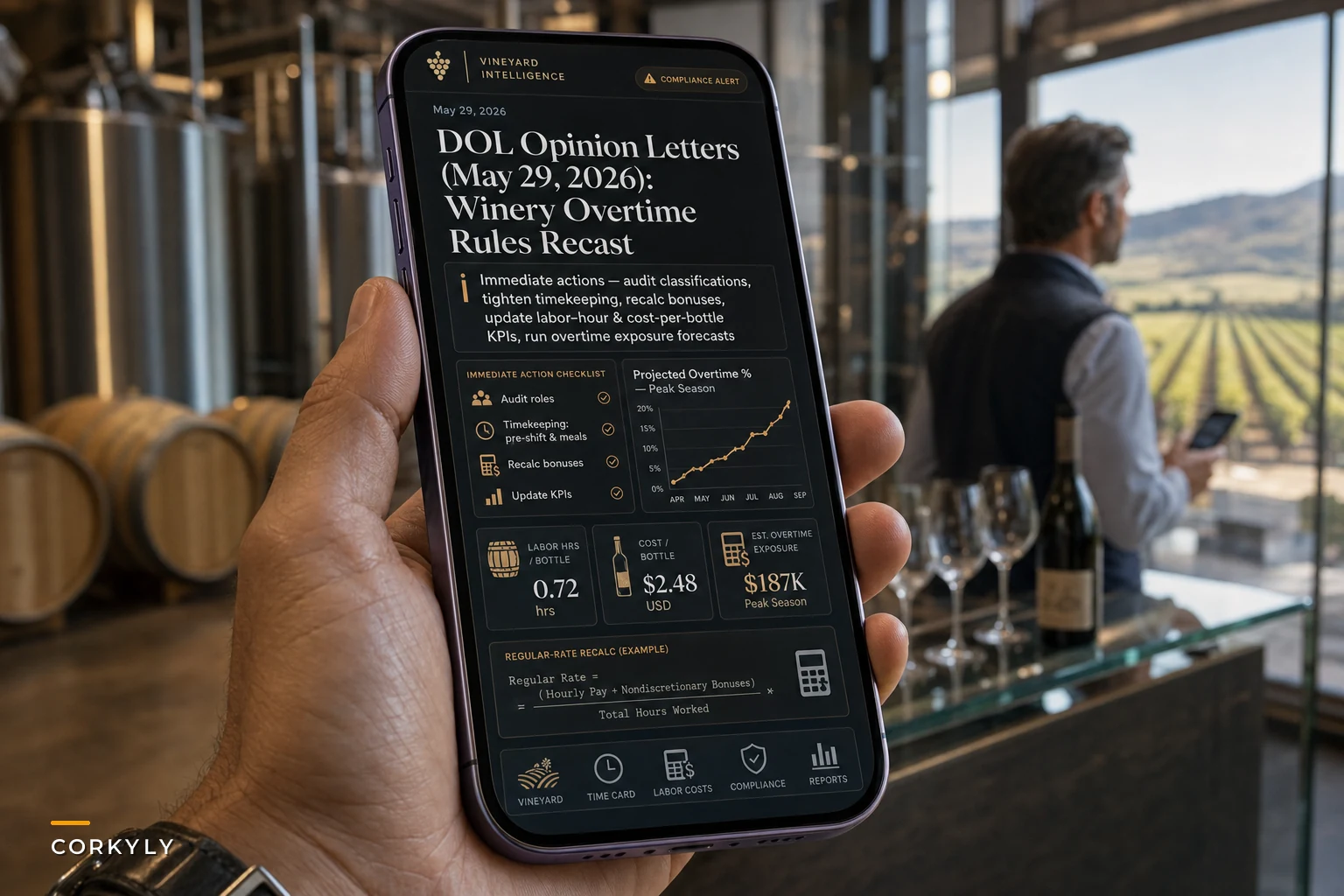

Last week's DOL opinion letters dropped right as most wineries are finalizing their harvest labor plans. Four new interpretations on overtime exemptions, bonus calculations, and compensable time—and suddenly that vineyard supervisor you've been treating as exempt might need to start clocking in.
The timing couldn't be worse. Or maybe it couldn't be better, depending on how prepared you are.
I got three panic calls from different Napa operations within 48 hours, all asking variations of the same question: "Do we need to reclassify our cellar leads before harvest?"
The short answer? Probably.
The long answer involves understanding why wineries have been walking a tightrope with labor classifications for years, and why these new interpretations just made that rope a lot thinner.
Why wineries get labor classification wrong (and why it costs more than overtime)
Most wineries classify workers based on title and salary, not actual duties. After auditing dozens of operations, the "production manager" who spends 70% of their time operating the crusher-destemmer isn't a manager under FLSA—that's an hourly worker with a fancy title.
The new DOL letters specifically address secondary-role hourly work. If your exempt employee performs non-exempt work more than occasionally, you might have a problem. In wineries, where everyone wears multiple hats during harvest, "occasionally" becomes impossible to define.
A winery hires a "Vineyard Operations Manager" at $65,000 salary. Sounds exempt, right? But during harvest, they're driving tractors, operating equipment, and doing the same physical work as the crew. Under the new interpretations, that could trigger reclassification.
The real kicker isn't just the overtime liability—it's the cascade effect on your entire labor structure.
When you reclassify one position, you expose inconsistencies across your operation. That cellar supervisor who also reclassifies? Now your assistant winemaker looks suspiciously similar in duties. Before you know it, you're restructuring your entire org chart two months before harvest.
The bonus calculation trap that's about to get expensive
Every winery I know runs some form of harvest completion bonus. Usually structured as a flat amount—$500 for seasonal workers who make it through harvest, maybe $2,000 for year-round staff. Simple, clean, motivating.
Streamline your winery operations effortlessly.
Corkyly helps you track, manage, and optimize every step from vine to bottle.
- Vineyard & production tracking
- Customer relationship management
- Inventory & sales analytics
No credit card required
Not anymore.
The new opinion letters clarify that non-discretionary bonuses must be included in regular rate calculations for overtime. This isn't new law, but the DOL's interpretation makes it crystal clear: that harvest bonus changes every overtime calculation for the period it covers.
Real numbers from a Central Coast operation I worked with last year:
-
Old calculation
-
Regular pay
40 hours × $18 = $720
-
Overtime
15 hours × $27 = $405
-
Weekly total
$1,125
-
8-week total
$9,000
-
Plus bonus
$9,800
New calculation with bonus in regular rate:
-
Bonus per hour
$800 ÷ (55 hours × 8 weeks) = $1.82
-
New regular rate
$18 + $1.82 = $19.82
-
New overtime rate
$29.73
-
Regular pay
40 hours × $19.82 = $792.80
-
Overtime
15 hours × $29.73 = $445.95
-
Weekly total
$1,238.75
-
8-week total
$9,910
| Scenario | Weekly total | 8-week total | Plus bonus/Notes |
|---|---|---|---|
| Old calculation | $1,125 | $9,000 | $9,800 |
| New calculation with bonus included in regular rate | $1,238.75 | $9,910 | $9,910 |
That's $110 more per worker. Multiply by 40 seasonal workers, and you just added $4,400 to your harvest labor cost. Not catastrophic, but definitely not budgeted.
Meal breaks and pre-shift meetings: the hidden compensable time
This gets messy for wineries fast. The opinion letters address pre-shift activities and meal break interruptions as potentially compensable time.
Walk through a typical harvest morning:
-
5
45 AM: Workers arrive, grab safety gear
-
5
50 AM: Quick meeting about today's picks
-
6
00 AM: Official clock-in
-
6
05 AM: Drive to vineyard blocks
Under the new interpretations, that 15-minute pre-shift period? Probably compensable. The meeting is work-related, mandatory, and primarily benefits the employer.
One Sonoma operation tracked this for a week and found they were missing 1.25 hours of compensable time per worker. Across 30 workers for a 10-week harvest, that's 375 hours of straight time, plus potential overtime implications.
The operational nightmare: How do you track this accurately?
Most wineries use basic timekeeping—punch clock at the winery building, maybe a mobile app. But if workers need to be paid from the moment they start donning required safety equipment, you need to capture that time. If a supervisor calls someone during their meal break to ask about tank temperatures, that break might need to be paid.
Recalibrating your labor KPIs for compliance
These regulatory changes expose a fundamental problem with how wineries measure labor efficiency. Most operations track basic metrics like labor-hours-per-ton or cost-per-case calculations, but these assume your labor classifications and time tracking are accurate.
They rarely are.
The KPIs you should actually be tracking in light of these changes:
Exempt vs. Non-Exempt Ratio by Department Track the percentage of truly exempt employees in each area. If your cellar operation is 80% non-exempt but your vineyard is 40%, you have inconsistent classification standards.
Actual vs. Scheduled Hours Variance Not just for overtime planning, but to identify untracked compensable time. If workers consistently clock in 5-10 minutes after arrival, you're probably missing pre-shift work.
Bonus Impact on Overtime Rate Calculate this before announcing any incentive program. That generous harvest bonus might increase your OT costs by 10-15%.
Secondary Duty Hours for Exempt Employees If your vineyard manager spends more than 20% of their time on non-exempt tasks, you have a classification problem brewing.
Run a short time-study during peak harvest weeks to quantify pre-shift and meeting time before you change classifications.
These metrics reveal patterns that traditional winery KPIs miss completely. They also provide the documentation you need if your classifications get challenged during an audit.
Building a compliance framework that actually works in wine production
After working through these issues with dozens of operations, certain patterns emerge. The wineries that adapt successfully don't just update their handbooks—they restructure their operational workflows.
Start with role audits, but do them during different production phases. That exempt classification might work in January but fall apart in September. Document actual duties, not job descriptions. I've seen operations where the written job description hadn't been updated since 2015, while the actual role evolved completely.
Your timekeeping system needs granularity that most wineries lack. It's not enough to track clock-in and clock-out. You need to capture:
-
Pre-shift preparation time
-
Meeting attendance
-
Equipment preparation
-
Travel between work locations
-
Any meal break interruptions
Manual tracking of these elements is virtually impossible at scale. You need systems that can differentiate between compensable and non-compensable activities automatically, integrate with your payroll processing, and flag potential compliance issues before they become violations.
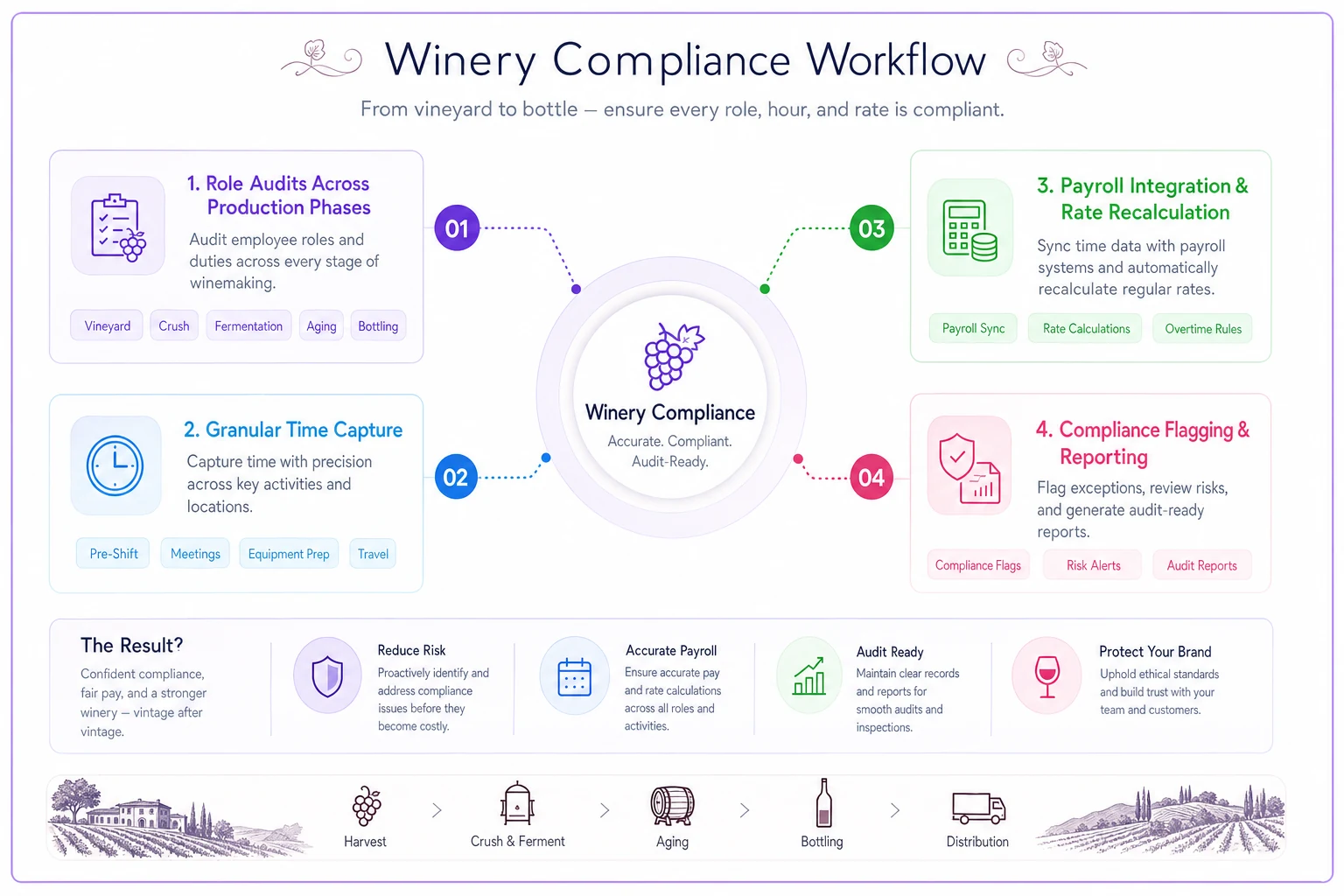
A simple workflow like this helps teams see where data needs to flow to avoid surprises at payroll.
Without that integration, you'll keep finding hidden hours after payroll closes, and that's how violations happen.
The retrofit reality: what this means for 2026 harvest planning
Most wineries can't completely restructure before this harvest. So the practical retrofit approach:
Immediate actions (before July):
-
Audit your exempt classifications against the new DOL interpretations
-
Focus on roles that blend administrative and physical duties
-
Recalculate all planned incentive payments with regular-rate implications
-
Review your biggest risks in production supervision and vineyard management roles
Medium-term adjustments (by August):
-
Implement time capture for pre-shift activities
-
Start documenting when workers begin work-related activities
-
Update your scheduling systems to account for true compensable hours
-
Schedule workers for 8.25 hours if they need 15 minutes of prep time, not 8
Harvest-period management:
-
Daily audits of exempt employees performing non-exempt work
-
Keep a simple log—date, hours, specific tasks
-
Clear communication about meal breaks and when they can be interrupted
-
Document when a meal break question turns into compensable time
Most violations happen because supervisors don't understand these boundaries, not because of deliberate non-compliance.
Why most wineries will get this wrong (and pay for it later)
The fundamental problem isn't the regulations—it's that winery operations resist standardization. Every vintage is different, every day during harvest brings new challenges, and flexibility is built into the culture.
But labor law doesn't care about your unique terroir or your artisanal approach. It cares about consistent, documented, compliant practices.
The wineries that will struggle are those that treat this as purely a compliance exercise. Update the handbook, send a memo, hope for the best. That's not enough when your entire operational model depends on flexible roles and seasonal intensity.
The successful operations will use this as an opportunity to modernize their workforce management. They'll implement systems that capture real work patterns, not theoretical job descriptions. They'll design incentive structures that motivate without creating compliance landmines.
Most importantly, they'll build operational flexibility within a compliant framework.
Moving forward: compliance as operational intelligence
These DOL opinion letters aren't just regulatory guidance—they're a mirror reflecting how outdated most winery labor practices have become. The industry has operated on handshake agreements and informal understandings for generations. That era is ending.
The wineries that thrive will be those that see compliance as operational intelligence. Every hour tracked accurately is data about your true production costs. Every properly classified employee is a clear understanding of your management structure. Every correctly calculated bonus is predictable labor spending.
This isn't about adding bureaucracy to an agricultural art form. It's about understanding the true mechanics of your operation. When you know exactly how many hours go into each ton crushed, each barrel filled, each case produced—including all the previously hidden compensable time—you can make better decisions about everything from pricing to production planning.
The DOL letters are a wake-up call, but they're also an opportunity. The question isn't whether you'll need to change your labor practices. It's whether you'll use this moment to build better operational systems or just paper over the cracks until the next compliance crisis.
For most wineries, harvest 2026 will be more expensive than planned. But for those who get their labor operations right, it might also be the most efficiently run harvest they've ever had. The difference comes down to whether you're tracking time or truly managing labor.
Ready to elevate your winery management?
Join 500+ wineries using Corkyly to increase operational efficiency, boost customer loyalty, and grow sales.