


A container of Cabernet doesn't get rejected at customs because the wine is bad. It gets rejected because the label height is 2mm off the mandated position, the alcohol tolerance printed on the back reads "13.5%" when the certificate of analysis says 14.1%, or the lot code on the shipping documents doesn't match the lot code etched on the bottle. Tiny things. Paperwork things. And they cost you thousands.
Every one of those rejections was preventable. The information existed somewhere in your winery. It just didn't make it onto the right form, in the right format, for the right country, before the truck left.
That's a workflow problem, not a knowledge problem. So this is about the actual mechanics: per-destination checklists that catch country-specific rules, who owns which piece of the packet, and a last-minute audit you run before anything ships.
Why the same wine passes in one country and fails in another
"Export documentation" isn't one thing. It's a different animal for every destination, and the differences are specific enough that a single master checklist actively hurts you — it gives your team false confidence. A few examples of how the requirements actually diverge:
-
Canada (across provinces) wants standardized container sizes and bilingual labeling, and the liquor boards each have their own submission portals with their own SKU registration timelines.
-
The EU requires allergen declarations (sulfites above 10 mg/L must be stated), specific nominal volume markings, and the "e" mark rules that trip up first-time exporters.
-
China requires a Chinese back label that must be registered and approved before import, plus a certificate of origin that has to be legalized, not just notarized.
-
Japan is strict on additive disclosure and will hold shipments over a mismatch between the ingredient documentation and what's on the label.
A pattern that shows up with a lot of small producers: they treat the first successful shipment to a country as a template forever. Then a regulation shifts, or the importer changes, or a new vintage has a different sulfite level, and the old template quietly becomes wrong. Nobody notices until the container is sitting in a bonded warehouse racking up demurrage.
It's almost always the same underlying issue — the person who knew the destination-specific rule wasn't the person filling out the paperwork that shipment.
The real cost of a single rejection
People underestimate this because they think about the wine value. The wine is usually the smallest part of the loss.
Streamline your winery operations effortlessly.
Corkyly helps you track, manage, and optimize every step from vine to bottle.
- Vineyard & production tracking
- Customer relationship management
- Inventory & sales analytics
No credit card required
| Cost component | Rough range | Notes |
|---|---|---|
| Demurrage / storage | $800–$2,500 | Accrues daily while the container sits |
| Return freight or re-export | $1,500–$4,000 | Often more than the original freight |
| Relabeling / rework | $1,200–$3,000 | Especially if bottles must be pulled and re-cased |
| Importer relationship damage | Hard to quantify | This is the one that actually hurts |
For a small winery shipping maybe 8–15 international containers a year, one rejection can wipe out the margin on two or three good shipments. And the relationship cost is real — an importer who gets burned once tends to shift volume to a producer who ships clean. You don't get a warning. You just get smaller reorders.
The producers who ship clean consistently aren't smarter. They just don't rely on memory. Everything lives in a checklist tied to the destination, and someone specific signs off on each line.
Build the checklist per destination, not per shipment
The unit that matters is the destination profile. You build it once, carefully, then reuse and update it. Each profile carries three things: the label requirements, the document requirements, and the timing requirements — because some approvals have to happen weeks before shipment, and that lead time is where things actually fall apart.
Label requirements
-
Nominal volume in mL, correct format, "e" mark if applicable
-
Alcohol by volume matching the current vintage's COA (within legal tolerance)
-
Sulfite / allergen declaration present and correctly worded
-
Importer name and address block present
-
Lot / batch code legible and matching production records
-
Mandatory pictograms (pregnancy warning where required)
Document requirements
-
Certificate of Analysis matching the exact lot
-
Certificate of Origin (legalized where required)
-
Commercial invoice with correct HS codes
-
Packing list with lot codes matching the COA
-
VI-1 or equivalent analytical document where required
-
Any pre-registration confirmation numbers
Timing requirements
-
Label pre-approval submitted (lead time
varies, often 2–6 weeks)
-
SKU / product registration confirmed
-
Legalization of documents booked with enough runway
Keep timing requirements front-and-center — build profiles backwards from the longest lead-time item.
Most people miss the timing section — and that's where shipments actually die. The label and documents are fixable in a day. A pre-approval that takes four weeks and got started three days before shipment is not fixable at all. Build your destination profiles backwards from the longest lead-time item.
Assign ownership so nothing falls between people
A checklist without named owners is just a wish list. In small wineries, one person often wears the cellar hat and the export coordinator hat, and that's exactly when things slip — because when everyone's responsible, no one is.
-
Production / cellar lead — owns the COA accuracy and confirms the lot code on the physical bottles matches the paperwork. They're the only ones who actually know what's in the tank.
-
Compliance / office manager — owns document generation
invoices, certificates of origin, HS codes, and tracking pre-approval status per destination.
-
Shipping coordinator — owns the physical match
does the pallet content equal the packing list, are case counts right, is the container sealed and photographed.
-
Final approver (owner or GM) — runs the last-minute audit and is the single signature that releases the shipment.
The chain matters. The cellar lead can't approve documents, and the office manager can't verify what's physically on the pallet. Each role checks something only they can actually see. That separation is what catches the mismatches — the alcohol percentage discrepancy, the wrong lot on the invoice — before they leave the building.
Keeping destination profiles, lot data, and sign-offs in one connected system rather than scattered across spreadsheets and email threads is where most of the manual chasing disappears. When the COA, the lot record, and the packing list all pull from the same source of truth, the "does this match that" question mostly answers itself. This ties directly into block-to-bottle traceability — if your lot data is already clean and connected, half your export documentation is effectively pre-filled and pre-verified.
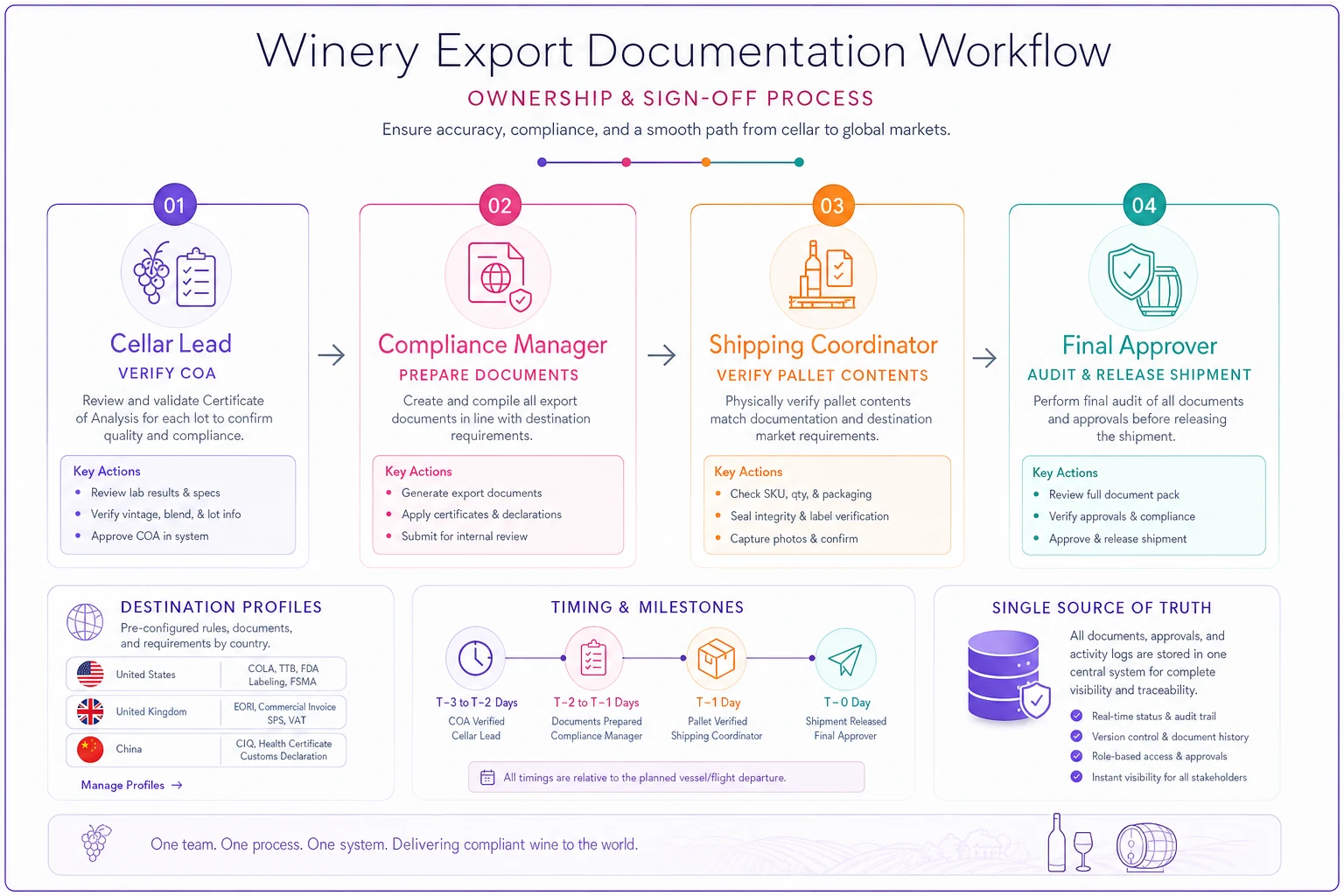
Quick visual of the ownership and sign-off workflow.
The sample documentation packet
Every international shipment should carry a consistent packet. Here's a workable baseline — adjust per destination profile:
-
Commercial invoice (with HS codes and correct Incoterms)
-
Packing list (lot codes matching COA)
-
Certificate of Analysis for the exact lot
-
Certificate of Origin (legalized/notarized per destination)
-
Bill of lading / airway bill
-
VI-1 or equivalent analytical certificate (EU)
-
Label approval confirmation (China, Canada provinces, etc.)
-
Insurance certificate
-
Any importer-specific forms
The trick is versioning. Keep the packet template attached to the destination profile, so when the shipping coordinator opens "Container to Rotterdam," they get the EU packet — not a generic one. A surprising number of rejections come from someone grabbing last quarter's Canada packet for an EU shipment because it was the file open on their desktop.
The last-minute audit (run this before the truck leaves)
This is the final gate. It takes 15–20 minutes and it's non-negotiable. The final approver runs it against the physical shipment — not from memory, not from "I'm pretty sure."
Last-minute audit checklist:
-
[ ] Alcohol % on label = alcohol % on COA = alcohol % on invoice
-
[ ] Lot code on bottle = lot code on packing list = lot code on COA
-
[ ] Case count physically matches packing list
-
[ ] Importer name/address on label matches current importer (not last year's)
-
[ ] Destination pre-approvals confirmed and reference numbers included
-
[ ] Sulfite/allergen declaration present and correct language for destination
-
[ ] Certificate of Origin signed, legalized, and dated correctly
-
[ ] HS codes correct on invoice
-
[ ] Nominal volume format correct for destination
-
[ ] All documents reference the same total quantity
The single highest-yield check on this list is the first one: alcohol percentage across all three documents. It's the most common mismatch and one of the most common rejection triggers, because the label gets printed off one vintage's data and the COA reflects the actual bottled lot. When those drift apart, customs notices.
A real scenario
A boutique producer in Paso Robles — around 6,000 cases a year, exporting to Canada, the UK, and testing China — had two shipments held in eighteen months. The first was a Canadian provincial rejection over a SKU registration that hadn't cleared before the container shipped. The second was a China hold because the Chinese back label revision hadn't been re-approved after a vintage change.
Combined direct cost of those two events landed somewhere around $9k–$11k, plus a UK importer who cut their next order roughly in half after hearing the producer was "having compliance issues."
They rebuilt around destination profiles and a named-owner sign-off chain, with a hard last-minute audit before release. Over the following year they shipped 13 international containers with zero holds. Nothing exotic — they just stopped relying on the one person who "knew the China rules" and put those rules into a checklist that couldn't be skipped.
When this level of process makes sense — and when it's overkill
If you're shipping one or two international containers a year to a single, stable market with a patient importer, a full destination-profile system might be more overhead than it's worth. A single well-maintained checklist could carry you.
Where it becomes essential:
-
You export to three or more countries with different rules
-
You ship multiple vintages where COA data changes shipment to shipment
-
You've had even one hold already (the second one is usually more expensive)
-
Different people touch the paperwork on different shipments
The producers who get burned repeatedly are usually mid-growth — enough export volume that memory can't hold every rule, but not enough yet to have a dedicated compliance person. That's the exact gap where structured checklists and clear role ownership pay for themselves fastest.
The takeaway
Cross-border rejections aren't a knowledge gap. Most wineries already have the information needed to ship clean — it's just sitting in someone's head, or in an outdated template, or in an email nobody re-read. The fix is making that information travel with the shipment: a destination-specific profile, an owner for each piece, a documentation packet that matches the market, and a short audit that someone actually runs before the doors close on the container.
Build the profiles once. Assign the roles clearly. Run the audit every single time. The wineries that do this stop treating export documentation as a recurring fire drill and start treating it as what it should be — a routine, boring, repeatable step that never surprises them at the border.
Cross-border rejections aren't a knowledge gap. Most wineries already have the information needed to ship clean — it's just sitting in someone's head, or in an outdated template, or in an email nobody re-read. The fix is making that information travel with the shipment: a destination-specific profile, an owner for each piece, a documentation packet that matches the market, and a short audit that someone actually runs before the doors close on the container.
Build the profiles once. Assign the roles clearly. Run the audit every single time. The wineries that do this stop treating export documentation as a recurring fire drill and start treating it as what it should be — a routine, boring, repeatable step that never surprises them at the border.
Ready to elevate your winery management?
Join 500+ wineries using Corkyly to increase operational efficiency, boost customer loyalty, and grow sales.