

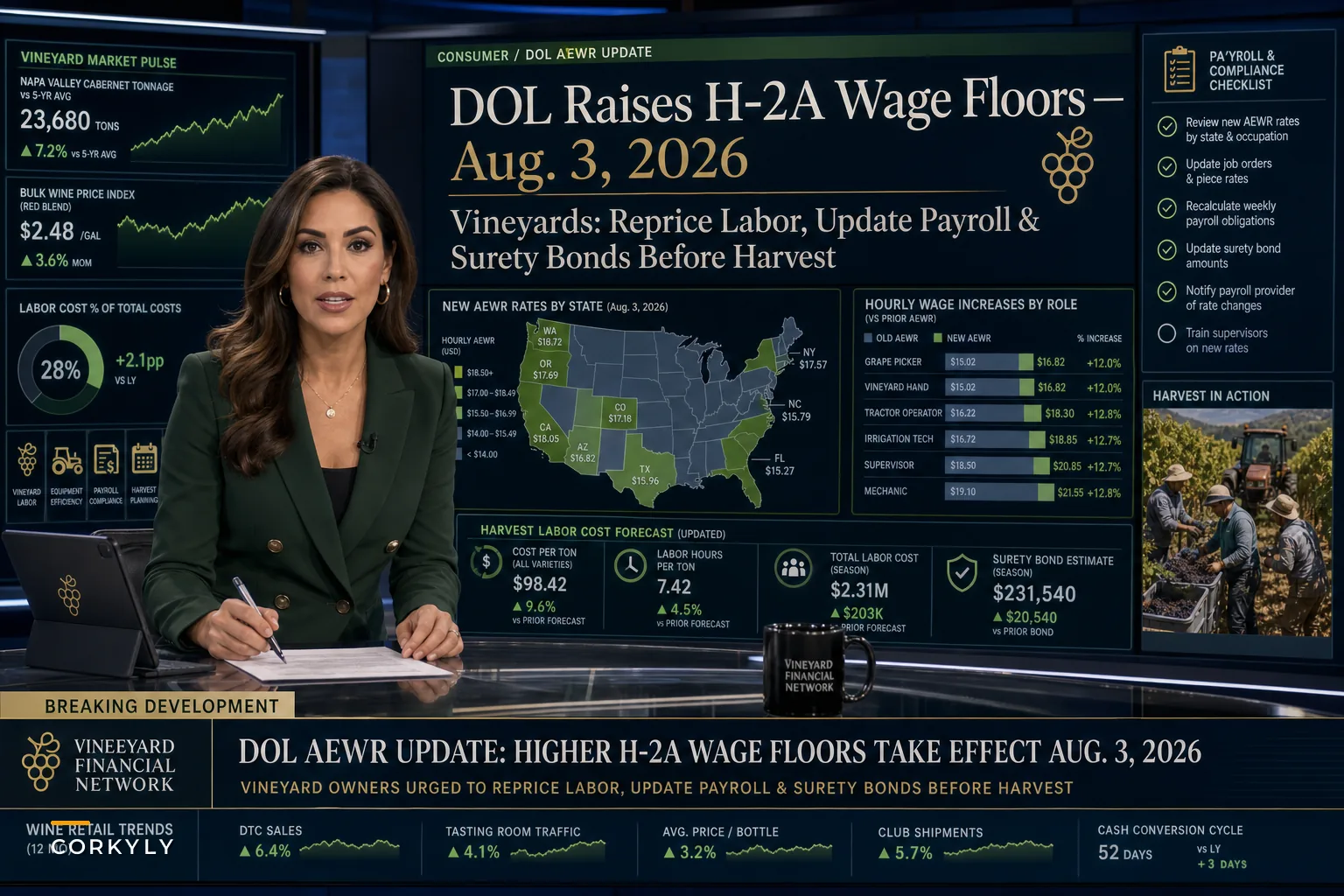

The timing on this one is rough. The Department of Labor posted updated H-2A Adverse Effect Wage Rates on August 3, 2026, and for most states the new rates were effective immediately. States covered by the 2024 court order got a delayed effective date of August 17. Either way, the notice dropped right as crews are showing up for late-summer picks across a lot of regions.
The bigger change isn't just the numbers—it's the method. DOL moved to a skill- and occupation-based AEWR structure, which means the flat statewide hourly floor you budgeted against last season may not be the floor that applies to your specific job order this season. Fisher Phillips put out a solid practical breakdown for agricultural employers that's worth reading for the legal framing. The rest of this is about what happens on your side of the fence when that notice hits your payroll clerk's desk.
What breaks when the wage floor moves
Most vineyards don't have a single "H-2A wage." They have a job order that describes duties, and those duties now map to different occupational classifications with different wage floors. That's the part that catches people off guard. If your job order bundles general vineyard labor, equipment operation, and skilled pruning under one loose description, the new methodology can force a reclassification—and a higher applicable rate than the one you priced into your cost-per-ton model back in the spring.
-
Your posted job order and recruitment ads no longer match the required wage, which is a compliance problem before it's a budget problem.
-
Payroll runs at the old rate for a pay period or two before anyone catches it, creating a back-pay liability.
-
Your surety bond calculation—tied to the wage obligation—may now be undersized.
-
Cost-per-ton climbs, and if you're selling fruit under contract, your margin on that contract just got thinner without anyone touching a vine.
The nastiest part is item two. The payroll shortfall usually happens not because someone ignored the rule, but because the rate change and the first affected pay run overlap by a few days. Nobody flagged it, checks went out, and now you've got a back-pay problem plus a documentation gap during the exact weeks you have zero spare attention.
The underlying problem this exposes
Wage rate updates aren't new. What the August change makes obvious is that most vineyards treat labor compliance as a spring project and harvest as an operations project—two separate mental buckets. They're not separate. Your job order classifications, your timekeeping, and your block-level task assignments are the same system viewed from different angles.
Streamline your winery operations effortlessly.
Corkyly helps you track, manage, and optimize every step from vine to bottle.
- Vineyard & production tracking
- Customer relationship management
- Inventory & sales analytics
No credit card required
Think about how a crew actually works during crush. A worker might pick in the morning, run the gondola tractor for a couple of hours, then help with cellar intake. Under a flat AEWR, that blend didn't matter much for wage classification. Under an occupation-based structure, it can. If your records show a general-labor classification but someone spent a third of the day operating equipment, you've got a mismatch between what you're paying, what you filed, and what actually happened in the vineyard.
That gap has always existed. The old flat rate just hid it. The wage methodology change didn't create a new problem—it removed the cover from an old one. Vineyards that already track tasks at a granular level are barely inconvenienced. Vineyards logging "8 hours, general vineyard work" for a crew of 22 are exposed on multiple fronts at once.
Recalculating your labor budget without guessing
You need three numbers refreshed before your next pay run, not before next season:
-
The applicable AEWR for each occupational classification your job order actually covers
-
Your realistic hours-by-task split per crew, based on how work genuinely gets distributed during harvest
-
The updated cost-per-ton and cost-per-bottle that fall out of the first two
Most owners try to do this with a single blended rate and a gut estimate of hours. That's how you end up off by enough to matter. A more honest approach is breaking the crew's week into task buckets and applying the correct floor to each.
Here's a simplified version of what that looks like for a mid-sized operation running one H-2A crew:
| Task bucket | Est. weekly hours (crew) | Old flat rate | New applicable floor | Weekly cost delta |
|---|---|---|---|---|
| General picking / canopy | 640 | $17.20 | $17.55 | +$224 |
| Tractor / gondola operation | 120 | $17.20 | $19.40 | +$264 |
| Cellar intake support | 90 | $17.20 | $18.10 | +$81 |
| Skilled pruning / suckering | 60 | $17.20 | $19.90 | +$162 |
The figures above are illustrative—your state's actual floors and your crew's real hour split are what matter. But notice the pattern: the general-labor bucket barely moves, while equipment and skilled buckets jump. If you budgeted everything at the general rate, your miss concentrates exactly in the tasks you probably under-counted. Across a full harvest run, a delta like this can add up to somewhere in the low-to-mid four figures per week per crew. That's real money against a fruit contract you signed months ago.
Quick workflow visual:
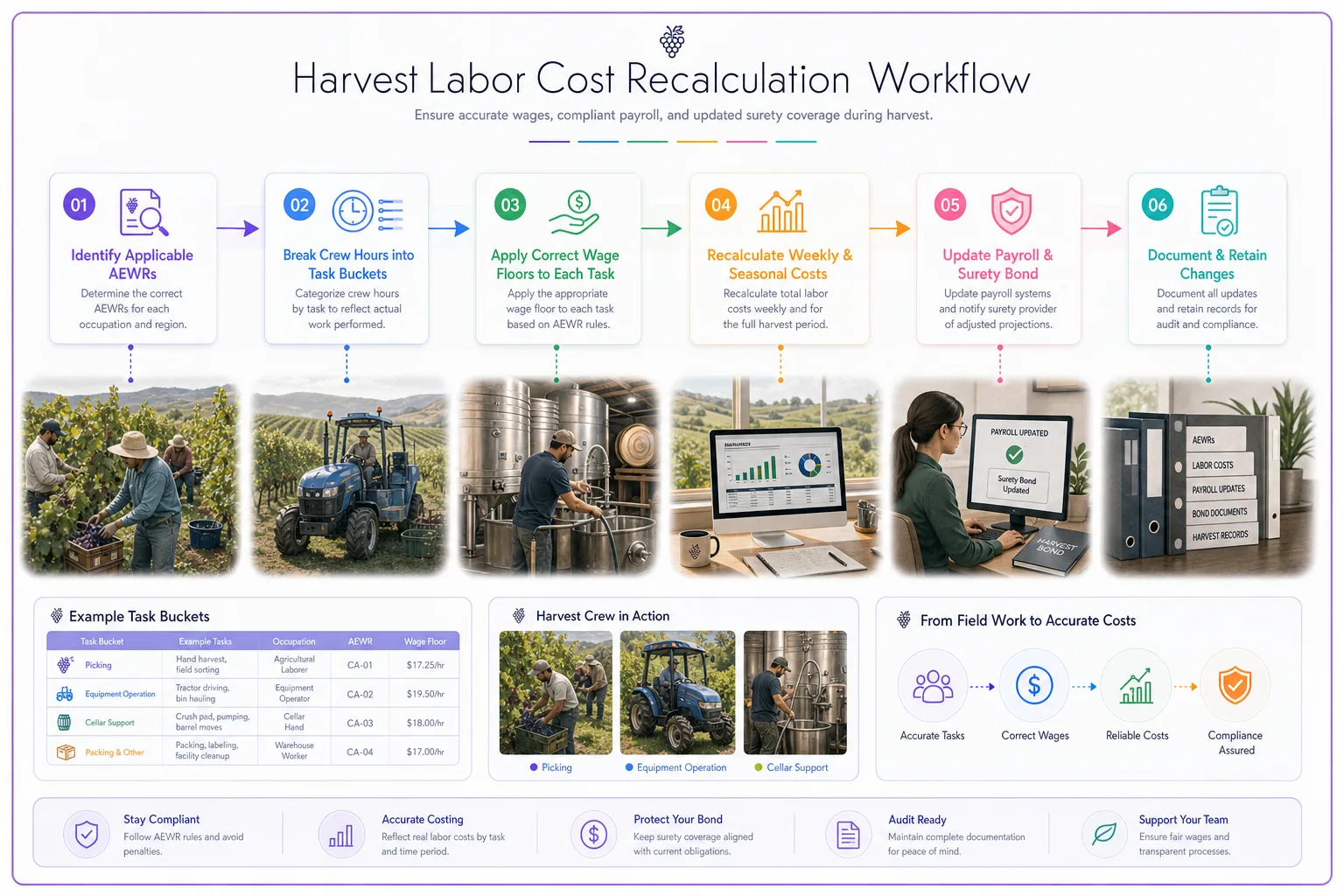
This shows the step-by-step recalculation process.
A pre-harvest compliance pass you can run this week
Before the next pay period closes, walk this checklist. It's ordered by how much damage each item does if you skip it.
-
- [ ] Pull your active H-2A job order and re-read the duties against the new occupational classifications. Flag anything that blends skilled and general work.
-
- [ ] Confirm the effective date that applies to your state—immediate for most, August 17 for the court-order states.
-
- [ ] Update payroll system rates before the next run, and check whether any hours since the effective date were paid at the old rate.
-
- [ ] Recalculate your surety bond obligation against the new wage figures.
-
- [ ] Refresh recruitment ads and any posted materials so they reflect the current required wage.
-
- [ ] Rebuild your cost-per-ton and cost-per-bottle with the corrected blended rate.
-
- [ ] Document the change—date, source, old rate, new rate—so an auditor sees a clean paper trail instead of a scramble.
Document changes immediately in a dedicated compliance log so an auditor can follow the timeline.
That last item gets skipped constantly and it's the cheapest insurance in the list. Fruit Growers News ran a useful compliance reminder for H-2A employers that reinforces the same point—the operations that stay out of trouble aren't the ones that never make a mistake, they're the ones who can show what they did and when.
You can always verify the current rates and the actual notice straight from DOL's Foreign Labor Certification page rather than relying on secondhand summaries.
A real scenario: where the number actually bites
Take a roughly 90-acre estate operation in an inland region, running one H-2A crew of about 20 during crush. They'd built their fruit contracts and internal cost model around a blended labor rate of about $17.20. Their job order described the crew as general vineyard workers, but in practice four of them ran equipment daily and two handled skilled canopy work.
When the reclassification shook out, their real applicable cost landed closer to $17.90 blended once the equipment and skilled hours got mapped correctly. Not a dramatic jump per hour. But across a six-to-eight week harvest for a 20-person crew working long days, it added up to somewhere around $9k–$12k in additional labor cost they hadn't priced. On a couple of their fixed-price fruit contracts, that quietly ate most of the margin.
The fix wasn't complicated. They split their timekeeping into task buckets, re-ran the cost model per block, and adjusted remaining spot-market fruit pricing to absorb the difference. The operations that get hurt aren't the ones dealing with higher wages—they're the ones finding out about the higher wages three weeks into harvest.
Where task-level tracking earns its keep
This is the practical takeaway that outlasts any single wage notice. The vineyards that absorbed this update with minimal pain already had systems logging work by task and block instead of by lump-sum hours. When your daily records show who did what, applying occupation-based wage floors becomes arithmetic instead of forensics. When they don't, every rate change turns into a reconstruction project during your busiest month.
Operational platforms that tie crew hours to specific blocks and task types—rather than a single daily timesheet—make this kind of reclassification almost routine. Instead of guessing how much of the week was equipment operation, you already have it. AI-assisted scheduling and timekeeping tools in modern vineyard management software can flag when a worker's logged tasks cross wage classifications, so payroll catches the mismatch before the check goes out rather than after an audit surfaces it. That's not about replacing your judgment—it's about not being blindsided by a rate change that lands during harvest.
If you want to see how task-level tracking connects to the rest of your season—cellar capacity, block work, and the monthly cashflow all of this feeds into—the seasonal operations playbook walks through how those pieces fit together. Labor cost is one input into that picture, and it's a lot easier to manage when it's not living in a spreadsheet separate from everything else.
When to adjust crew strategy—and when not to
A wage floor increase always tempts people to reach for mechanization or trim crew size. Sometimes that's the right call. Often it's a reaction that costs more than the wage bump itself.
Cutting crew size makes sense when your bottleneck is genuinely labor cost and your fruit quality tolerates a slightly compressed pick window. It's the wrong move when your blocks have tight ripeness windows or multiple microclimates—shorting your crew there risks fruit quality losses that dwarf the wage delta. And accelerating a mechanization plan mid-season in response to a single notice is almost always premature. That's a capital decision that deserves its own analysis, not a panic response to an August wage letter.
For most operations, the right move this year is narrower: get the classifications right, get payroll accurate, reprice the fruit you haven't committed yet, and document everything. Save the structural crew decisions for the off-season when you can model them properly.
Closing thought
The wage change itself is manageable. The exposure comes from treating labor compliance and harvest operations as two different worlds when they're really one. Get your job order classifications matched to how work actually happens, fix payroll before the next run, and keep a clean record of what you changed and why. Do that, and this update is a Tuesday afternoon task. Skip it, and it becomes a back-pay problem plus a margin problem plus an audit problem, all landing at once during the six weeks you can least afford them.
Ready to elevate your winery management?
Join 500+ wineries using Corkyly to increase operational efficiency, boost customer loyalty, and grow sales.