

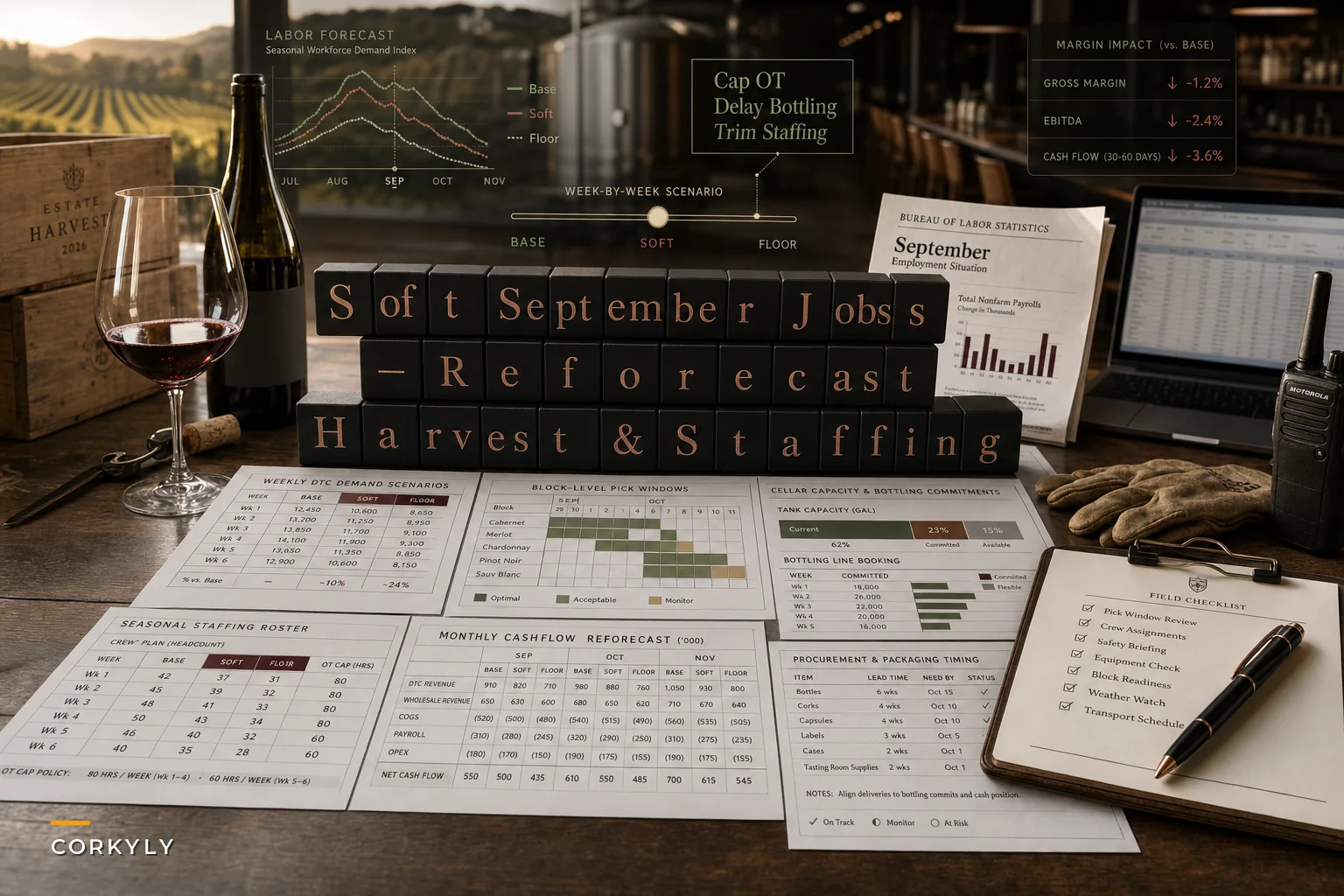

The timing couldn't be much worse. Payrolls grew by only 29,000 in September and unemployment ticked up to 4.2%, according to the Bureau of Labor Statistics release. Reuters called it job growth slowing sharply, and for most industries that's just another macro headline. For wineries, it lands right in the middle of the two weeks of the year when every decision carries a real price tag.
A softer labor market doesn't hit wineries through some complicated chain reaction. It hits two places fast: the discretionary dollar that buys a $45 tasting flight or a club shipment, and the consumer confidence to spend it. Q4 is when DTC margins carry the whole operation. If demand softens even a little while your harvest labor and bottling commitments are already locked in, you end up carrying cost against revenue that didn't materialize.
This isn't a "read the news and feel worried" piece. It's about what you actually change in the next two to three weeks while fruit is still coming in.
Why one soft jobs print matters more to wineries than most businesses
Most retailers can throttle inventory monthly. You can't throttle a harvest. Once fruit hits ripeness, you pick, you process, you pay the crew, and you commit tank space and packaging dollars months before you know whether Q4 DTC will hold. That timing mismatch is the real vulnerability, and a weakening labor market just widens it.
The pattern worth watching: when consumer sentiment softens, winery DTC doesn't fall off a cliff — it erodes at the edges. Club cancellations tick up a point or two. Average tasting-room ticket drops because people skip the reserve flight or buy two bottles instead of four. Walk-in traffic holds but converts worse. None of these are dramatic individually. Added together across October through December, a 6–10% DTC softening is enough to turn a comfortable quarter into a tight one.
And the softening rarely shows up in your own numbers until November, by which point your harvest overtime is already spent and your bottling run is already scheduled. The signal is early (now). The pain is late (Q4). That's the trap.
The underlying problem: harvest and sales forecasts live in separate heads
The deeper issue a report like this exposes has nothing to do with the economy. It's that in most wineries, the harvest plan and the sales forecast are made by different people, on different timelines, in different spreadsheets, and they almost never get reconciled until the fiscal year closes.
Streamline your winery operations effortlessly.
Corkyly helps you track, manage, and optimize every step from vine to bottle.
- Vineyard & production tracking
- Customer relationship management
- Inventory & sales analytics
No credit card required
The vineyard side is thinking tons, blocks, crew hours, tank capacity. The DTC side is thinking club runs, tasting-room shifts, holiday email calendars. When something macro shifts — a weaker demand outlook, say — there's no single place where someone asks: "If Q4 DTC comes in 8% light, does our current harvest staffing and bottling schedule still make sense?"
That question is answerable. It just requires both sides of the business to be looking at the same picture. This is exactly the synchronization problem covered in the seasonal operations playbook on aligning block-level tasks, cellar capacity and monthly cashflow, and a soft jobs report is the moment that synchronization stops being theoretical.
Run three harvest-staffing scenarios before next pick
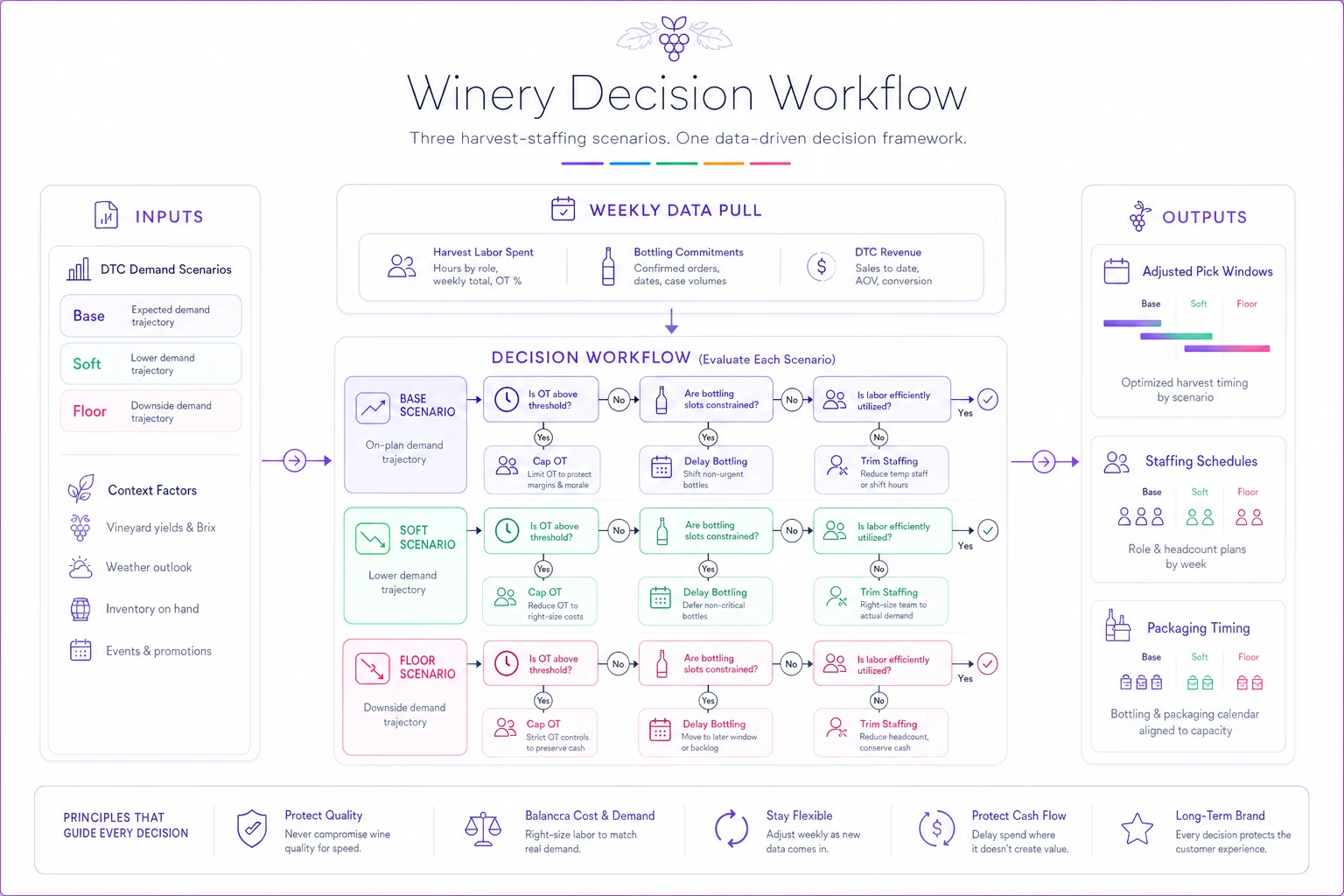
The highest-value move this week is to stop planning around one demand number and start planning around three. You don't need fancy modeling. You need a base case, a soft case, and a floor case — and you need to know what each one changes operationally.
A quick workflow to run the three scenarios each week.
| Scenario | Q4 DTC vs. plan | Harvest overtime posture | Bottling timing | Tasting-room staffing |
|---|---|---|---|---|
| Base | On plan | Standard crew, limited OT | As scheduled | Full weekend coverage |
| Soft | Down 6–10% | Cap OT, extend pick window | Delay one run to defer packaging spend | Trim midweek shifts |
| Floor | Down 12–15% | Hard OT freeze, prioritize contract fruit | Split run / reduce initial bottle count | Weekend-only + on-call |
The point of that table isn't precision. It's that each column forces a pre-decision. If you've already decided what you'll do when DTC comes in soft, you react in a day instead of a committee meeting in mid-November when it's too late to adjust the bottling run.
Rank blocks by flexibility before harvest so capping OT becomes a planned choice rather than a panic move.
The overtime line deserves the most attention. Harvest overtime is where margin quietly disappears. A crew running heavy OT across a compressed pick can add thousands per week, and in a soft case that money comes straight out of a quarter that's already underperforming. Capping OT doesn't mean picking worse — it means widening the pick window where varietal timing allows and being more disciplined about which blocks genuinely need to come in on the same day.
Where the overtime math actually breaks
A mid-size estate plans harvest around a two-week compressed window, budgeting the crew at standard hours with a modest OT buffer. Fruit comes in a few days tight, three blocks ripen together, and suddenly the crew is running 12-hour days for a week straight. OT alone runs somewhere in the $8k–$12k over-budget range.
In a normal year, Q4 DTC absorbs it and nobody flinches. In a year where demand is softening, that same overrun is the difference between hitting the quarter and missing it. The fix isn't to pick less carefully — it's to have already ranked your blocks by "must pick on exact date" versus "has a 2–4 day flex window" before the season starts. The flex blocks are your pressure valve. Most wineries know this intuitively but never write it down before harvest, so the decision gets made in panic instead of on paper.
Reforecast DTC and tasting-room staffing against traffic, not habit
Tasting-room staffing is usually set by routine — this is how many people we had on last October. In a softening demand environment, that habit costs you. If both conversion and average ticket slip, you're paying the same labor against lower revenue per visitor.
-
Pull last year's weekday vs. weekend traffic and revenue-per-visitor, and flag the shifts that were already thin on revenue
-
Identify which midweek shifts exist out of habit rather than demonstrated traffic
-
Set a conversion trigger
if average ticket drops below a defined threshold for two consecutive weekends, trim the next midweek shift
-
Move at least one scheduled staff member to on-call status for the lowest-traffic days
-
Pre-write the club email sequence for a soft Q4 — a value-forward angle, not just a discount reflex
That last point matters more than people usually expect. The instinct in a soft quarter is to discount. But discounting your club in a weak demand year trains your best customers to wait for the next markdown, and it compresses the margin you need most. Leaning on exclusivity and member-only access holds average order value instead of eroding it.
The reconciliation ritual that keeps the two sides honest
None of these scenarios help if nobody checks them against reality as the quarter unfolds. The teams that handle a demand shift well all do some version of the same thing: a short weekly check where harvest/cellar spend-to-date and DTC actuals get looked at on the same page.
The workflow is simple. Each week someone pulls three numbers — harvest labor spent against budget, bottling and packaging committed, DTC revenue versus the three scenarios. Then one question gets asked: which scenario are we actually tracking toward? If the answer drifts from base to soft, the pre-decided adjustments from the table kick in. No debate, no delay.
The reason this breaks down in practice is almost never analytical — it's that the numbers live in four different systems and pulling them takes half a day nobody has during crush. When vineyard tasks, cellar costs, labor hours, and DTC sales feed into one operational view, this weekly check takes twenty minutes instead of a morning. That's the practical case for keeping seasonal operations data centralized rather than scattered across spreadsheets and disconnected tools — not because it's modern, but because it's the only way the reconciliation actually happens week after week when everyone is running on fumes.
When to actually act on this — and when to sit tight
When reforecasting makes sense: Your Q4 depends heavily on DTC and club revenue, your harvest OT budget has little slack, and you have real flexibility in bottling timing or tasting-room scheduling. In that case, running the scenarios now is pure upside — you lose nothing by being ready.
When it's a bad idea to overreact: If you're heavily contract-fruit based and your Q4 is mostly locked distributor volume, a soft consumer print barely touches you this quarter. Slashing staffing or delaying bottling on one month's data could leave you short-handed if demand holds. One jobs report is a signal, not a trend.
Who should mostly ignore this: Very small estates already running lean with minimal OT exposure and no bottling flexibility. There's little to reforecast when there's no slack to adjust. Your energy is better spent on the pick itself.
The real scenario
A roughly 9,000-case family estate, heavy on DTC and club, going into harvest with a standard OT buffer and full weekend-plus-midweek tasting-room coverage.
The problem: the previous year they'd run about $10k over on harvest OT and didn't notice until December, and their club had quietly shed a handful of members through Q4 while staffing stayed flat. Margin on the quarter came in noticeably softer than planned, but nobody connected the two until year-end.
Going into this harvest, they built the three-scenario table, ranked their blocks by pick-date flexibility, moved two habitual midweek tasting shifts to on-call, and started a twenty-minute Friday reconciliation during crush. When club numbers came in a touch soft in early November, they'd already trimmed the midweek shifts and held one flexible bottling run an extra three weeks to defer packaging spend.
The outcome wasn't a dramatic turnaround — it was a tight quarter handled calmly instead of a scramble. Harvest OT stayed close to budget, and the deferred packaging spend kept cash available through the slow stretch. The difference wasn't better forecasting. It was having decided in October what they'd do if the soft case showed up.
Bottom line for the next two weeks
A single weak jobs report shouldn't send anyone into panic mode. But it's a useful nudge to do something most wineries skip: reconcile the harvest plan and the sales forecast before the money is spent instead of after.
Build your three scenarios, rank your blocks by flexibility, pre-decide your overtime and staffing triggers, and set up a weekly check that takes twenty minutes instead of half a day. The wineries that come through a soft quarter in good shape aren't the ones who predicted it. They're the ones who'd already written down what they'd do, so that when the demand signal finally showed up in their own numbers, the decision was already made.
The wineries that come through a soft quarter in good shape aren't the ones who predicted it. They're the ones who'd already written down what they'd do, so that when the demand signal finally showed up in their own numbers, the decision was already made.
Ready to elevate your winery management?
Join 500+ wineries using Corkyly to increase operational efficiency, boost customer loyalty, and grow sales.