
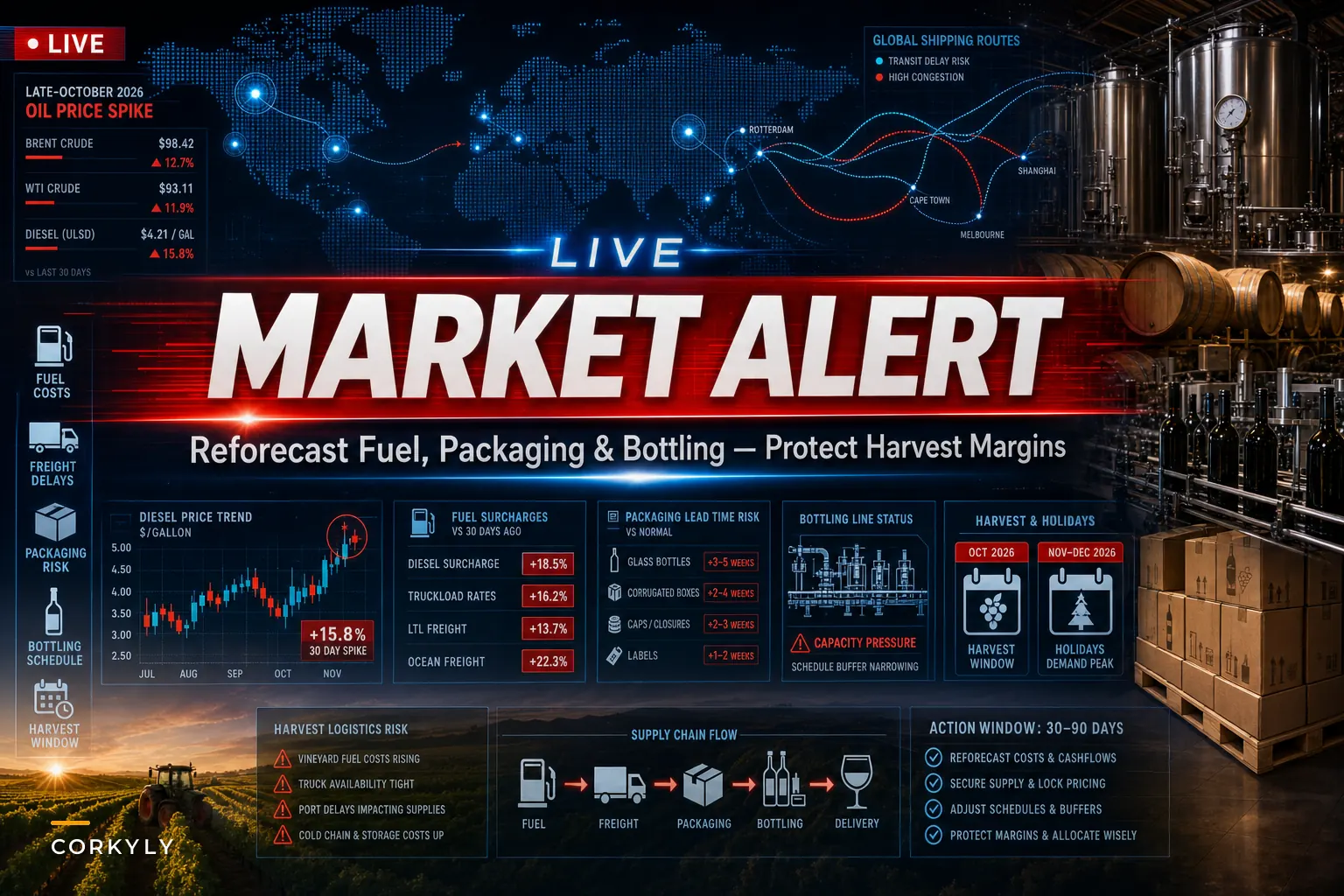

When Brent and WTI jumped to multi-month highs in late October after renewed supply fears tied to Middle East attacks, most wineries shrugged. Diesel's up again. We've seen that movie. But the timing here is bad in a specific way — it landed right in the middle of crush for a lot of regions and right before the holiday shipping ramp. Reuters reported the move was driven by supply concerns rather than demand, which matters because supply-side spikes tend to flow into diesel and freight faster than they fade.
So the real question isn't whether fuel is expensive right now. It's which decisions in the next six weeks you're quietly getting wrong because you budgeted them at September freight rates. That's a different kind of problem, and it's the one worth your time.
The costs that move first (and the ones that lag)
Not every line item reacts to an oil spike at the same speed. If you treat them all as one blob called "costs went up," you'll either overreact on things that barely moved or miss the ones about to hit you hard.
| Cost area | Speed of impact | Typical exposure for a mid-size winery |
|---|---|---|
| Outbound DTC shipping (carrier fuel surcharges) | Days to 2 weeks | High — surcharges reprice almost immediately |
| Harvest trucking / fruit haul | Immediate for spot loads | Medium-high during active crush |
| Inbound freight on packaging | 2–6 weeks | High if you reorder during the window |
| Glass and closures (energy-intensive manufacturing) | 4–12 weeks | Medium, shows up as the next PO, not this one |
| Field diesel (pumps, crew transport) | Immediate at the pump | Low-medium, depends on remaining irrigation |
The pattern that trips people up: the stuff that hits your bank account first (carrier surcharges) is usually the smallest dollar exposure, while the stuff that feels far away — glass, inbound freight on your spring bottling order — is where the real money is. People react to the fuel surcharge on a DTC box because they see it instantly, then get blindsided by a glass quote that comes in 9% higher in January.
Start with the decisions that are still open
A cost shock only matters where you still have a choice. Fuel you already burned hauling fruit last week is sunk. So the first move isn't a spreadsheet of everything — it's a list of open decisions in the next 45 days.
Streamline your winery operations effortlessly.
Corkyly helps you track, manage, and optimize every step from vine to bottle.
- Vineyard & production tracking
- Customer relationship management
- Inventory & sales analytics
No credit card required
-
Remaining fruit hauls still to be scheduled
-
Any packaging PO not yet locked (especially glass and closures)
-
Bottling run timing for lots that are flexible
-
DTC shipping promotions planned for November/December
-
Distributor delivery consolidation for the quarter
Everything else is noise for now. The discipline is to not reforecast your whole annual budget in a panic. Reforecast the open decisions, then revisit the rest after the price action settles.
The harvest trucking squeeze nobody budgets for
Spot-market fruit hauling is where a diesel spike quietly eats margin during crush, and it's almost never treated as a variable in anyone's harvest budget.
A realistic version: a winery pulling fruit from three growing areas, hauling maybe 40–50 tons across a two-week push, running a mix of contracted and spot trucks. When diesel jumps and carriers add fuel adjustments, the spot loads reprice first. What was a $4.50-ish per-mile lane creeps toward $5.20–$5.40 on short notice. Across a dozen loads over distance, that's a few thousand unplanned dollars — not catastrophic, but it showed up during the most cash-intensive three weeks of the year.
The mistake isn't paying the higher rate. Sometimes you have to — the fruit's ripe and the cellar's waiting. The mistake is making haul decisions truck-by-truck without seeing the pattern until the invoices land in November. A winery tracking pick dates, haul distances, and committed vs. spot capacity in one place can make a smarter call: consolidate two smaller picks into one load, shift a flexible block's pick by a day to share a truck, lean harder on the contracted carrier whose rate is locked.
When harvest logistics live across text threads, a whiteboard, and three people's heads, you can't do that math in real time. The coordination problem is really a visibility problem — which is the same issue underneath most harvest bottlenecks regardless of what diesel costs.
Packaging is where the spike actually bites
This is the one to take seriously. Glass and closures are energy-intensive to manufacture and freight-heavy to move, so an oil spike hits them twice. As CNBC noted in its coverage, the pressure was flowing straight into diesel and freight expectations across US supply chains — and packaging is about as freight-exposed as a winery input gets.
The timing problem: if your spring bottling PO lands in the next few weeks, you may be quoting glass at exactly the moment manufacturers are pricing in higher energy and freight. Wait it out and you risk lead-time slippage. Lock it now and you might overpay if crude settles back. There's no clean answer, but there's a structured way to decide.
A quick decision process for an open packaging PO during a price spike:
-
Pull your current on-hand glass and closure counts and your committed bottling schedule through Q2.
-
Calculate weeks of coverage at planned run rates — not average, planned.
-
If coverage is under your supplier's stated lead time plus a safety buffer, you're ordering regardless of price; protect the runs.
-
If coverage is comfortable, split the order
lock the near-term portion, hold the back half 2–3 weeks to see if freight settles.
-
Ask suppliers directly whether their quote includes a fuel/freight surcharge and whether it's fixed for the quote window. Many surcharges are renegotiable or time-boxed, and nobody asks.
That last point gets skipped constantly. Surcharges feel like weather — just a thing that happens to you. They're line items, and line items can be questioned.
When splitting a packaging PO, document the locked vs. held quantities and the decision date so suppliers and procurement are aligned if pricing moves.
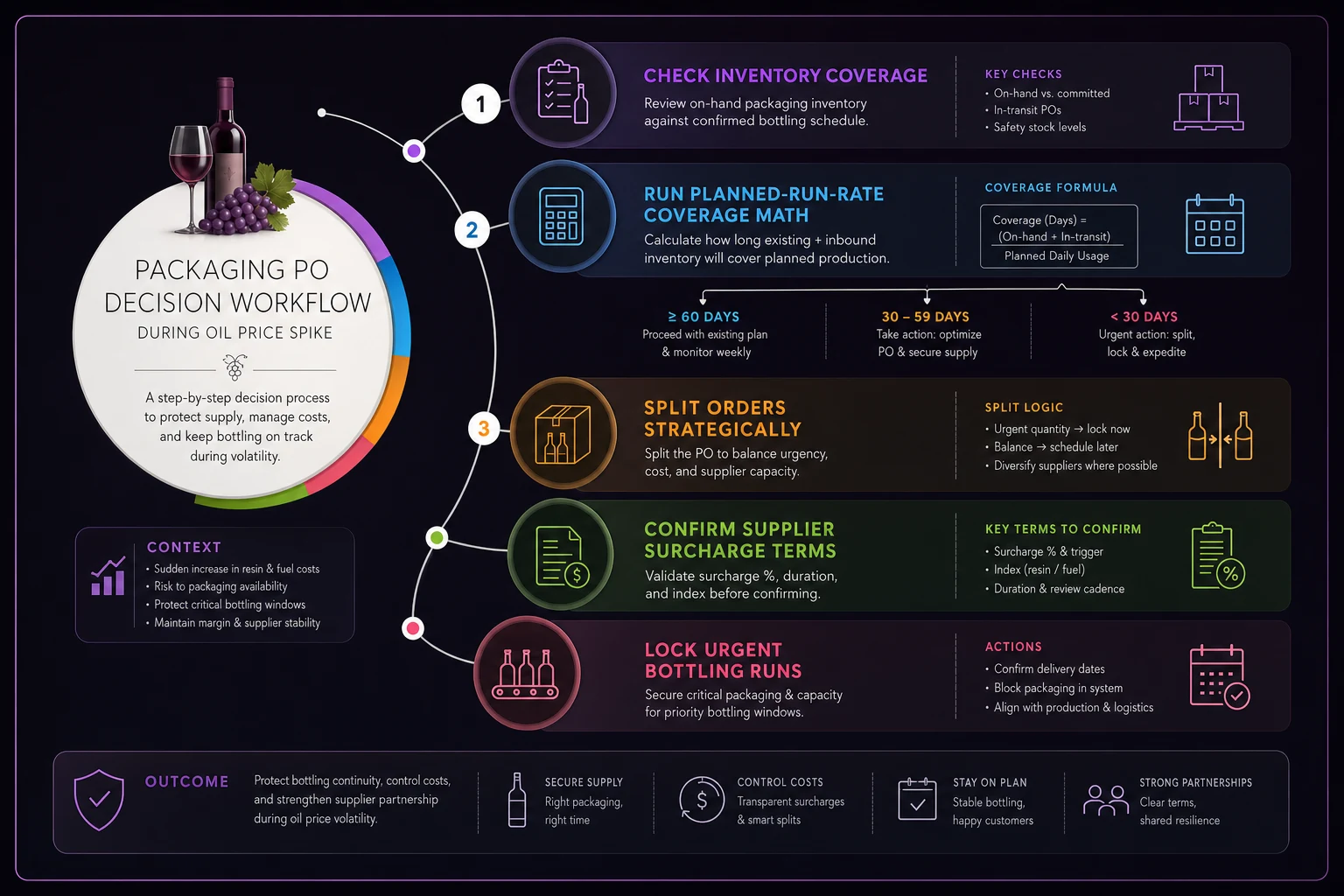
A simple visual of the steps above can make it easier to get procurement, cellar, and finance on the same page quickly.
DTC shipping and the price-sensitivity trap
Carrier fuel surcharges reprice fast, and heading into holiday that's a margin issue on every box. The reflex is to absorb it quietly or pass it through with a shipping bump. Both can be wrong depending on your customer.
What tends to show up across DTC programs: a shipping cost increase at checkout hurts conversion more than an equivalent increase buried in product price, especially on single-bottle and entry-tier orders. The club member buying a case barely notices $4 more in freight. The first-time buyer grabbing two bottles abandons the cart.
So the move isn't one blanket decision. It's segmenting:
-
Club and high-AOV orders small shipping adjustments are usually fine; these buyers are relationship-driven.
-
First-time and low-AOV orders protect the checkout. Consider a free-shipping threshold that nudges order size up instead of raising visible shipping costs.
-
Holiday promotions model the surcharge into the promo margin before you launch it, not after. A free-shipping holiday offer designed at September freight rates can quietly go underwater.
When absorbing the cost makes sense
If the surcharge is a dollar or two per box and you're inside a conversion-sensitive window, eating it to protect order volume is often the right call — the lifetime value of a converted first-time buyer dwarfs the freight hit.
When it doesn't
If you're shipping heavy case volume to a region at a steep surcharge, absorbing it across the board bleeds real money. A threshold or regional adjustment beats a blanket policy there.
A real scenario
A roughly 9,000-case producer running a healthy DTC program plus distributor volume hit the October spike mid-crush. Their initial instinct was to pass the carrier surcharge straight through on all web orders. Before doing it, they pulled their numbers and found two things.
First, their holiday free-shipping promo — already built and scheduled — was modeled at early-fall freight. At the new surcharge, that promo's per-order margin dropped by a few dollars, enough to push the whole campaign from modestly profitable to roughly breakeven. Second, their spring glass PO was two weeks from being placed, and their coverage math showed enough on-hand inventory to wait on the back half.
What they actually did: left the DTC checkout alone for first-time buyers to protect conversion, adjusted the holiday promo to a threshold-based offer instead of flat free shipping, locked only the urgent half of the glass order, and held the rest. The net effect wasn't dramatic — it was avoiding roughly $5k–$7k of unplanned margin erosion across the quarter by not making three reflexive decisions. That's the whole game with a cost shock: most of the value is in the mistakes you don't make.
The underlying problem the spike exposes
What the oil jump really reveals is this: most wineries can't answer basic questions fast enough to react well. How many weeks of glass coverage do I have at planned run rates? What's my committed vs. spot haul capacity for the next two weeks? Which open POs are exposed to this surcharge? What's my real per-order DTC margin after shipping?
When that information is spread across a packaging spreadsheet, a harvest text thread, the bookkeeper's QuickBooks, and someone's memory, you can't reforecast in the window that matters. By the time you've assembled the picture, the glass is ordered and the promo's live.
This is why the wineries that handle shocks calmly aren't necessarily the biggest or best-capitalized. They're the ones whose harvest schedule, inventory coverage, open POs, and channel margins live somewhere they can actually look at them together. Whether that's a well-disciplined set of linked spreadsheets or a proper vineyard-and-cellar operations platform with AI-assisted workflows built in, the point is the same — the shock didn't create a new problem, it just exposed a visibility gap that was always there.
The 45-day action list
Keep it tight. This is what to actually do before the window closes:
-
List every open decision (hauls, POs, bottling timing, promos) in the next 45 days — ignore the rest for now.
-
Run coverage math on glass and closures at planned, not average, run rates.
-
Split any flexible packaging PO
lock the urgent portion, hold the rest 2–3 weeks.
-
Ask every supplier whether their quote includes a time-boxed fuel surcharge — then negotiate it.
-
Consolidate flexible fruit hauls and lean on contracted carriers over spot where you can.
-
Segment DTC shipping response
protect first-time checkout, adjust on high-AOV and club.
-
Re-model any live or scheduled holiday promo at current freight before it runs.
-
Schedule a revisit in three weeks to reforecast the slower-moving costs once prices settle.
An oil spike feels like something being done to your business, and the cost increases are real. But most of the damage from a shock like this comes from decisions made on stale numbers, not from the price move itself. Reforecast the open decisions, protect your bottling runs, question the surcharges, and leave the parts of your budget that haven't actually moved alone until the dust settles.
An oil spike feels like something being done to your business, and the cost increases are real. But most of the damage from a shock like this comes from decisions made on stale numbers, not from the price move itself. Reforecast the open decisions, protect your bottling runs, question the surcharges, and leave the parts of your budget that haven't actually moved alone until the dust settles.
Ready to elevate your winery management?
Join 500+ wineries using Corkyly to increase operational efficiency, boost customer loyalty, and grow sales.